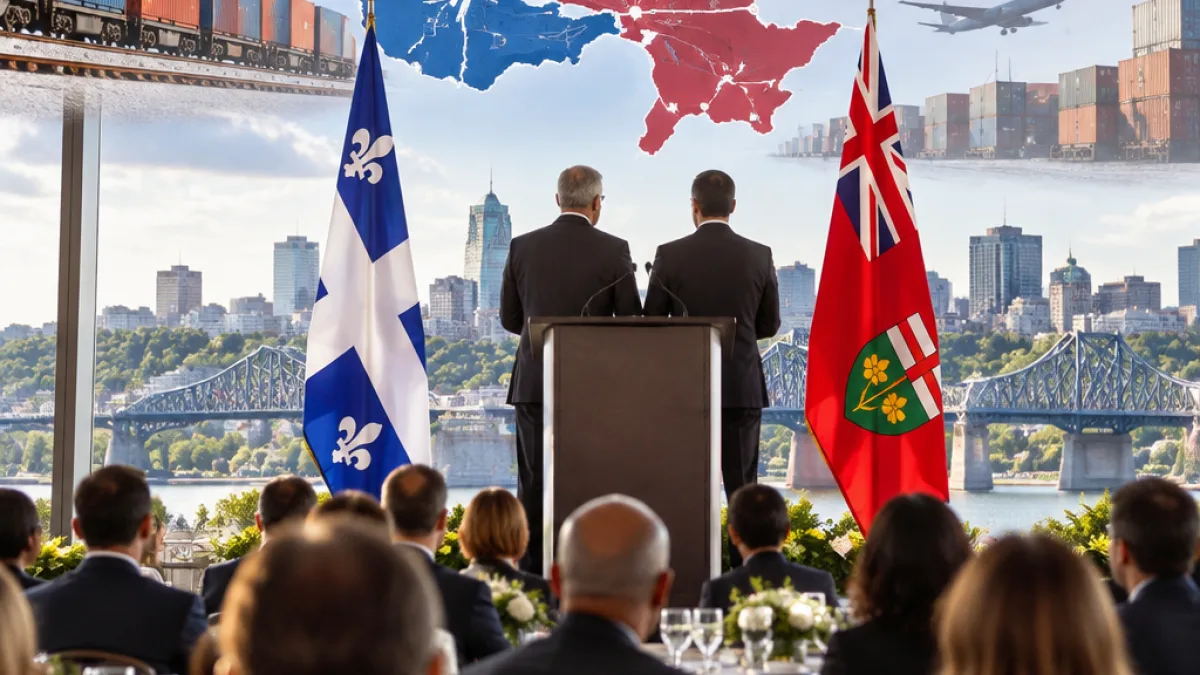
Ontario Premier Doug Ford used a Montreal business luncheon to make the case that Quebec and Ontario should deepen their economic partnership, presenting closer ties between the two provinces as a response to pressure from the United States and a changing political climate in Quebec.
Ford said Tuesday that the two provinces need to reduce barriers to trade within Canada and work more closely on major industrial and infrastructure projects. His remarks came at an event hosted by the Chamber of Commerce of Metropolitan Montreal, where he framed co-operation between Ontario and Quebec as a matter of economic strength rather than simply provincial goodwill.
“Quebec and Ontario make up 61 per cent of Canada's population and 58 per cent of our economy,” Ford said.
The Ontario premier argued that the combined weight of the two provinces would be substantial by international standards. He said their economies together would rank as the 17th largest in the world, a comparison intended to underline the potential reach of a more integrated Ontario-Quebec market.
Ford’s appeal comes as American tariffs remain central to the economic discussion on both sides of the Ottawa River. He described the trade pressure from U.S. President Donald Trump as a shock that had prompted Canadians to reconsider how closely the country’s provinces work together.
“He woke us up and he's united us as a country like we've never been united before,” Ford said of Trump.
His argument rests on the idea that Ontario and Quebec have complementary industrial strengths. Ford pointed to Ontario’s steel sector and Quebec’s aluminum production as resources that could be combined to help Canadian companies compete in markets beyond the United States. The emphasis was not only on defending existing trade, but also on developing a broader economic base between the two provinces.
Ford also identified possible areas for joint activity, including the construction of planes and trains and the development of infrastructure. He did not announce a specific project or agreement at the luncheon. Instead, he offered a political and economic proposition: that the two provinces should use their size and industrial capacity to pursue opportunities together.
| Measure cited by Ford | Figure |
|---|---|
| Share of Canada’s population represented by Ontario and Quebec | 61 per cent |
| Share of Canada’s economy represented by the two provinces | 58 per cent |
| Potential ranking of their combined economy | 17th worldwide |
The remarks also landed in a distinctly Quebec political context. The Parti Québécois recently formed a minority government, according to the source report, after campaigning on a promise to hold a referendum on sovereignty once Trump leaves the White House in 2029. That backdrop gives Ford’s message an added dimension: he is promoting closer links with Quebec at a time when the province’s constitutional future has returned to the centre of political debate.
The Ontario premier presented the two provinces as allies within Canada and said there were no stronger partners than other Canadian provinces. For Quebec, that language carries both an economic and political meaning. It places the province’s manufacturing and resource capacity within a Canada-wide strategy while also appealing to the practical benefits of co-operation, particularly when foreign trade conditions are unsettled.
Ford’s appearance was also notable because it brought an Ontario premier into a Montreal discussion involving Quebec’s business and political communities. Quebec Liberal Leader Charles Milliard attended the luncheon. The source report does not provide the substance of his comments, but his presence underscored the event’s connection to the province’s broader political conversation.
The call for fewer interprovincial trade barriers is likely to be judged by what follows beyond speeches and business gatherings. Ford’s comments identified broad areas for collaboration, but the report did not cite a new bilateral accord, financing commitment or timetable. For now, the proposal is a public appeal for Ontario and Quebec to treat their economic relationship as a strategic asset.
That message is directed at more than provincial governments. It also speaks to companies assessing where to build supply chains and pursue major contracts, as well as to communities whose economies depend on industrial production. Ford’s central point was that Quebec and Ontario have enough population, economic weight and complementary materials to strengthen one another rather than compete separately in every market.
In Montreal, the pitch was therefore both defensive and forward-looking. The immediate concern is the effect of American tariffs; the longer-term objective is a closer partnership capable of supporting industrial projects and infrastructure. Whether Quebec’s government embraces that approach will be shaped by the new political balance in the legislature and by the sovereignty commitment made by the Parti Québécois.