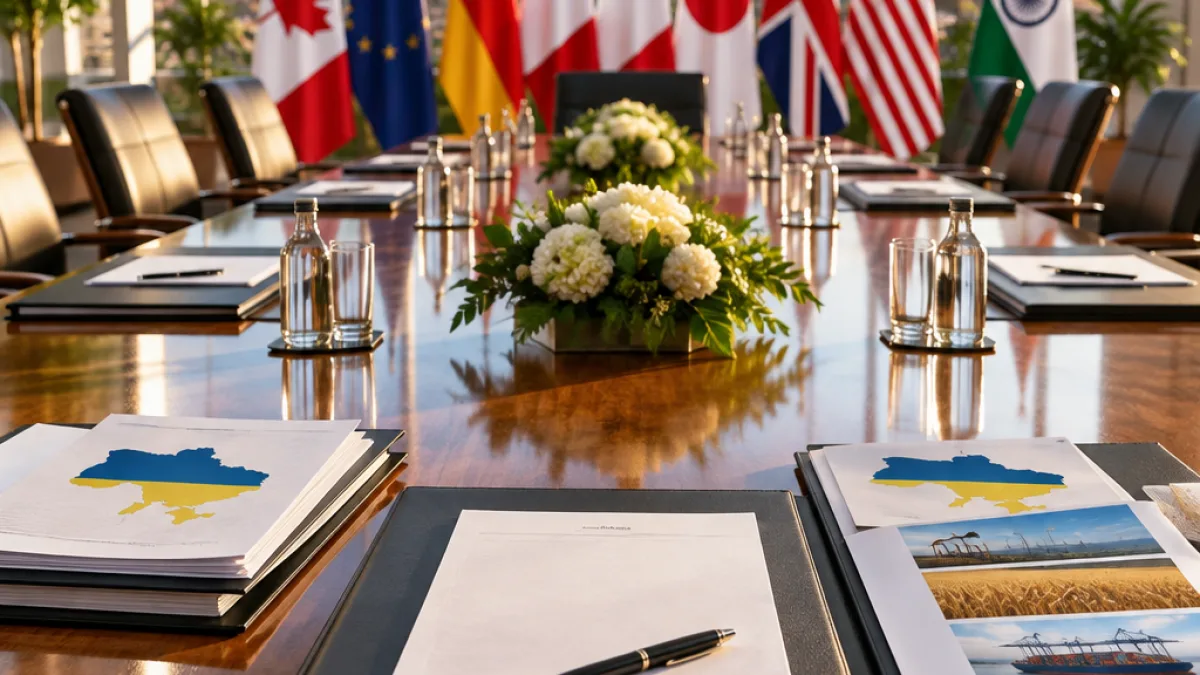
G20 foreign ministers ended two days of talks in Atlanta without a joint communique, as disagreements over Russia's war in Ukraine and other security questions prevented the world's largest economies from presenting a common position.
The meeting concluded Saturday with a chairman's statement released by U.S. Secretary of State Marco Rubio. Rather than setting out negotiated agreements, the statement identified areas the participating countries considered important, including energy security, food security, freedom of navigation, supply chains and critical minerals.
Rubio said the outcome reflected the limits of the discussions, while also arguing that some countries were prepared to continue working together on practical economic issues. His assessment suggested the group could co-operate in selected areas even as broader geopolitical disputes made a unified declaration impossible.
“I wouldn't pretend to you today that we are close to finding universally accepted solutions to these problems,” Rubio told reporters.
Division overshadowed the meeting
The divisions were visible from the opening of the Atlanta gathering and continued to shape its result. The war in Ukraine was identified as a central source of disagreement, leaving the G20 unable to agree on language that could have been issued in the name of the entire group.
That absence matters because a joint communique would have provided a collective account of the ministers' conclusions. Instead, the chairman's statement served as a summary of the proceedings without claiming that the countries had reached common commitments. The source material did not identify any agreement adopted by all members.
Rubio said the ministers had discussed a range of challenges that extend beyond any single conflict. Those subjects included the reliability of energy and food supplies, the protection of important maritime routes and the need to strengthen access to minerals considered critical to future economic activity.
- Ukraine: disagreement over Russia's war affected the meeting's final outcome.
- Trade and shipping: ministers discussed keeping major routes open and secure.
- Supply chains: critical minerals and resilient commerce were identified as areas for co-operation.
Focus turns to routes and resources
On Saturday, Rubio held separate talks with counterparts from Australia, India and Japan before leading the meeting's final session. That session examined freedom of navigation in the Strait of Hormuz and the Red, Black and South China seas.
Rubio said secure supply chains were necessary for economic growth and argued that key trade corridors had to remain open to commercial traffic. He specifically referred to the Strait of Hormuz and the Bab al-Mandeb Strait, while also emphasizing the importance of expanding critical-mineral supply networks.
Those comments placed economic security alongside traditional diplomatic and military concerns. Disruption in major shipping lanes can affect the movement of goods, while access to critical minerals has become a stated priority for countries seeking to protect their economic futures. The ministers' discussion therefore linked maritime security with supply-chain planning and long-term growth.
No common solution in sight
Rubio had described the first day as productive and struck an optimistic tone at a reception for G20 participants Friday night. He said the countries were charting an ambitious economic future. By the end of the meeting, however, his remarks were more cautious.
He maintained that some G20 members were already co-operating on supply chains and critical minerals, but acknowledged that the participants remained far from universally accepted answers to the problems before them. The contrast underscored the gap between identifying shared priorities and agreeing on collective action.
| Meeting outcome | Result |
|---|---|
| Joint communique | Not issued |
| Chairman's statement | Released by Marco Rubio |
| Areas highlighted | Energy, food, navigation, supply chains and critical minerals |
The Atlanta meeting consequently ended with a limited form of consensus: the G20 could list challenges and identify possible areas of co-operation, but it could not reconcile its divisions on major security questions. For the group, that leaves the next stage of diplomacy focused on whether practical work on trade routes, resources and supply chains can advance despite the unresolved disagreements that prevented a unified statement.