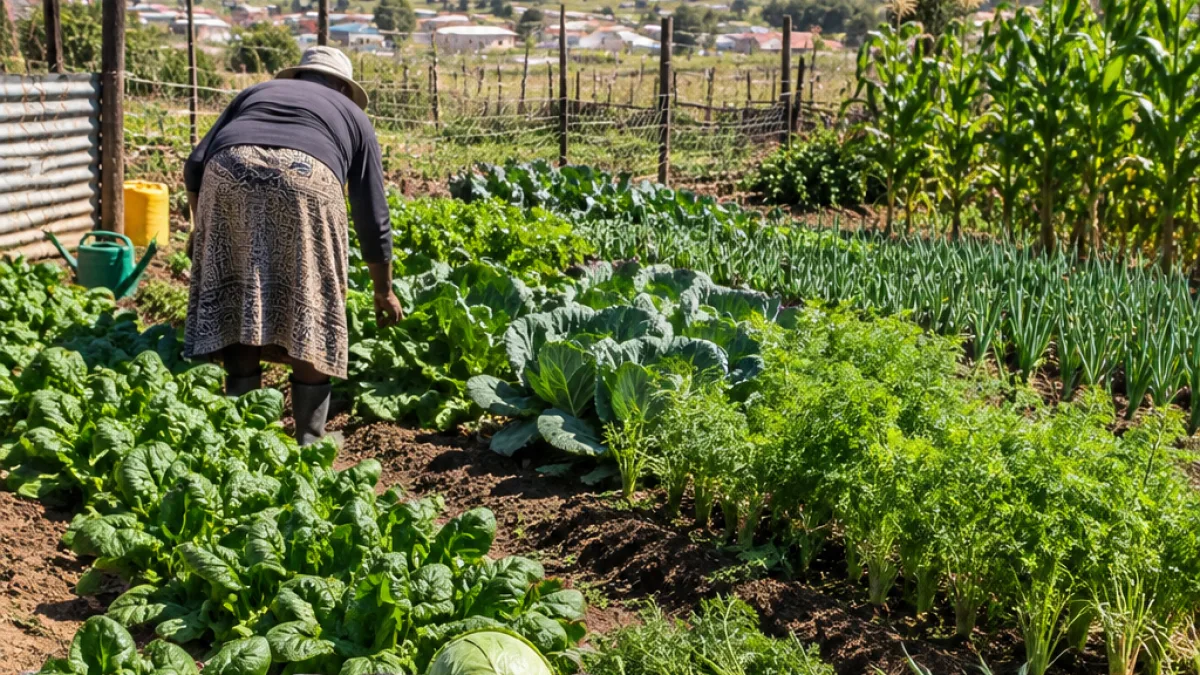
After spending more than a decade looking for formal employment, Khanyisa Ncamiso decided that waiting for a job was no longer enough. The 40-year-old mother from Mthatha is now using a vegetable garden to support her family, earn an income and provide produce to people in her community.
Ncamiso established KhashAgri-business in September 2024, planting potatoes, spinach, cabbage, maize, carrots and onions. The business remains small, but it has created a source of income after years in which her qualifications did not lead to permanent work.
Qualifications did not guarantee employment
Ncamiso holds a national diploma in Cost and Management, a technical diploma in Accounting and a BCompt in Accounting. Despite this training, she said she had spent more than 10 years seeking work and had only managed to secure an internship during 2024/2025.
Her decision to farm came as the number of graduates seeking employment continued to grow. Rather than remain dependent on an uncertain job search, she began producing food that could be sold locally while also helping to feed her household.
“I don’t have time to feel sorry for myself while waiting for job opportunities.”
Ncamiso sells part of her harvest to community members and vendors, keeping some of the vegetables for her family. Her approach combines income generation with household food security, a particularly important consideration for families managing rising food costs.
A garden serving local households
For customers, the garden offers an alternative to supermarket prices. Nolungisa Ngilane, 45, said buying from Ncamiso helped her household budget stretch further.
“Firstly, her prices are affordable.”
Ngilane’s comment reflects the immediate value of a local supplier: produce can reach households and vendors without customers relying only on larger shops. The available information does not provide the full range of prices charged by KhashAgri-business, but it records a comparison between supermarket cabbage costing R30 or more and the affordability customers associate with Ncamiso’s vegetables.
| Area | Details |
|---|---|
| Business | KhashAgri-business |
| Started | September 2024 |
| Produce | Potatoes, spinach, cabbage, maize, carrots and onions |
| Customers | Community members and vendors |
Fencing is the immediate need
The business’s most pressing challenge is not a lack of ambition, but the need for a fence around the garden. Ncamiso said fencing would protect the crops and provide a foundation for expanding the operation.
- Protect the garden: fencing is needed to secure the area used for planting.
- Grow the business: improved protection could help her increase production.
- Create opportunities: Ncamiso hopes eventually to employ workers.
- Reach more buyers: her long-term goal is to supply supermarkets and local shops.
She said she needed assistance with fencing and other forms of support. Without that protection, the garden’s ability to grow remains limited, even as demand exists among residents and vendors.
Ncamiso’s longer-term ambition is to expand beyond direct community sales and become a distributor for larger supermarkets and local shops. Reaching that point would require the business to increase its production and maintain a reliable supply of vegetables.
Building from what is available
For now, KhashAgri-business is both a livelihood and a statement of independence. Ncamiso, who once expected her accounting qualifications to lead to office-based employment, is instead building an enterprise from the land available to her and the needs of people around her.
Her experience also shows the gap between obtaining qualifications and finding work. While the garden does not replace the formal employment she originally sought, it gives her family an income and gives local customers another source of food. With the fencing and assistance she is seeking, she hopes the small operation can become a larger employer and supplier in Mthatha.