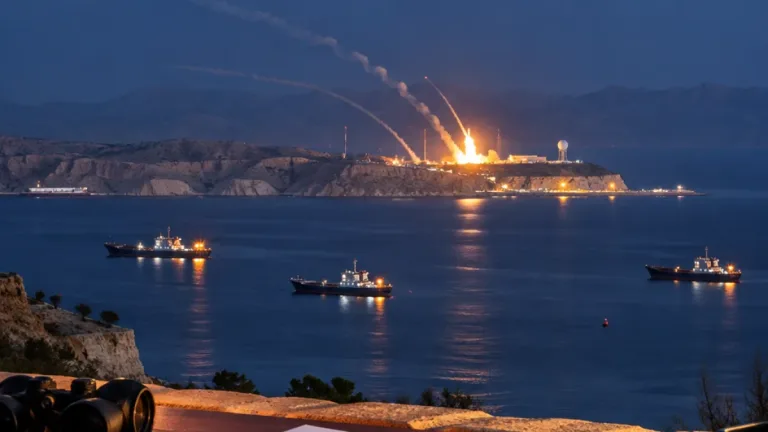
The continued disruption in and around the Strait of Hormuz following the joint US-Israeli attack on Iran in February has roiled global energy markets and drawn renewed comparisons with the 1973 Yom Kippur War, which triggered a major international oil crisis, international media reported.
Historical parallel
In 1973, a surprise offensive launched by Egypt and Syria — aimed at regaining territories lost in 1967 — precipitated a short but intense conflict that quickly involved outside powers. The United States provided decisive military support to Israel, and within days Arab oil producers announced an embargo on countries seen to back Israel. The resulting combination of export restrictions and production cuts tightened supplies and sent prices sharply higher, producing widespread economic dislocation in affected nations.
Analysts and commentators have pointed to this sequence as a reminder that conflicts involving Israel can prompt significant global energy consequences, and have noted similar market sensitivities as shipping through the Strait of Hormuz remains threatened.
Territorial backdrop
The 1967 Six-Day War reshaped the map of the region: Israel took control of the West Bank and East Jerusalem from Jordan, the Golan Heights from Syria and the Sinai Peninsula and Gaza Strip from Egypt. Five years later, Egypt and Syria launched their joint attack to recover some of those areas. Israel repelled the offensive within weeks, aided by US support, after which the Arab oil-producing states moved to punish nations perceived as supporting Israel.
| Year | Event |
|---|---|
| 1967 | Israel captures West Bank, East Jerusalem, Golan Heights, Sinai and Gaza during Six-Day War |
| 1973 | Egypt and Syria launch surprise attack on Yom Kippur; Arab oil embargo follows |
| 2026 | Closure of the Strait of Hormuz after February attack on Iran; oil markets react |
Impact of the 1973 embargo
On 17 October 1973, oil-producing Arab states announced an embargo targeting the United States and other nations that had supported Israel. The embargo and coordinated production cuts affected not only the US but also countries including Japan, Canada, South Africa, the Netherlands and a number of European states, according to contemporary accounts. The move restricted petroleum exports to the targeted states and triggered long queues at fuel stations in some countries, a vivid symbol of the wider economic strain.
- Supply shock: Export bans and production reductions tightened global crude availability.
- Price surge: International oil prices rose steeply, amplifying inflationary pressures.
- Economic fallout: Industrialised economies faced shortages and rationing measures.
Observers say the present situation is different in important respects — the geopolitical landscape, energy sourcing and market structures have evolved since the 1970s — but the basic dynamic linking regional conflict and energy security remains, and markets continue to respond sharply to disruptions around vital chokepoints such as the Strait of Hormuz.
For energy-importing countries, including India, volatility in Arabian Gulf shipping lanes can translate quickly into higher import bills, pressures on inflation and complex diplomatic calculations. The 1973 episode is frequently cited as a cautionary example of how regional wars can cascade into global economic crises.
As governments and companies monitor developments, the historical precedent underscores the strategic importance of diversifying supply, securing alternative routes and maintaining diplomatic channels to limit the broader fallout from regional instability.