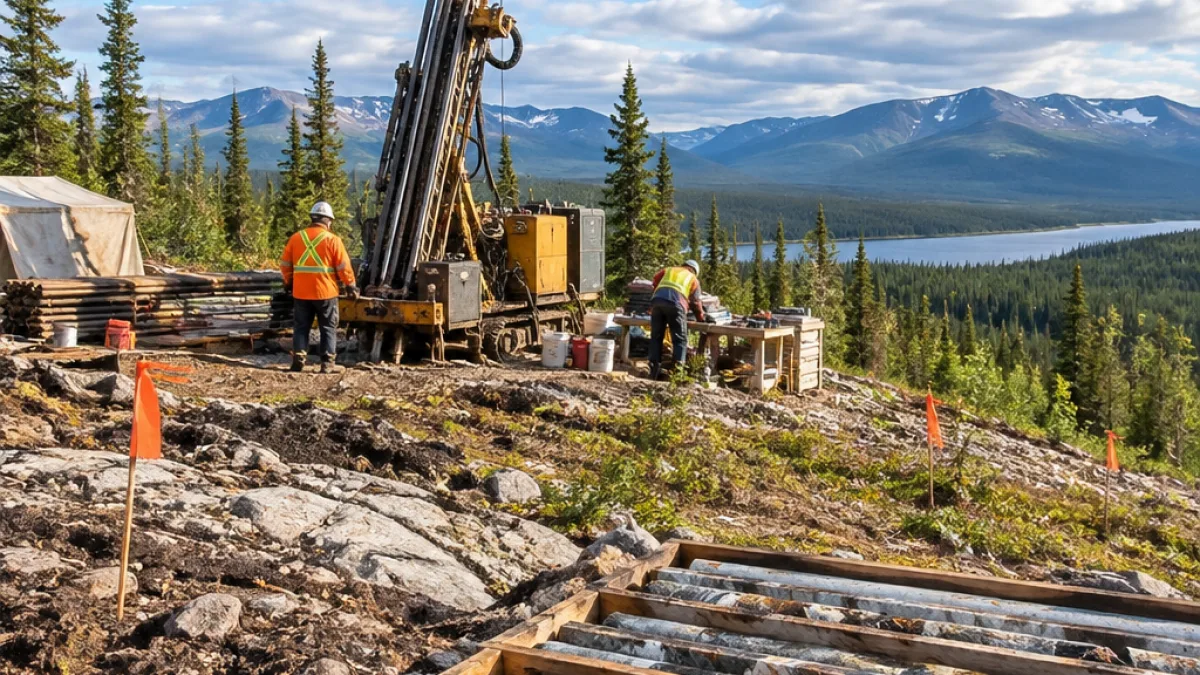
Prospector Metals Corp. says it has expanded its gold exploration program at the ML Project in Yukon, reporting further drilling along the TESS trend and outlining a separate target to the southwest.
The company’s Nov. 12 update combines new drill results with observations from mapping and surface prospecting. It describes the work as an exploration-stage development, with drilling aimed at testing the shape and continuity of mineralized zones rather than establishing a formal mineral resource.
Drilling pushes the TESS trend farther southwest
At TESS, Prospector reported results from additional holes, including a scissor hole that intersected gold across a lengthy interval. The company also identified a higher-grade section within that broader intersection, although the available disclosure does not provide the assay values in the material reviewed for this report.
The company said drilling has extended the TESS trend toward the southwest. Other holes also returned gold-bearing intervals, offering additional points for the company’s geological interpretation of the area.
Drill intersections are measurements from specific points underground. Their importance depends on how they line up with earlier results, whether mineralization continues between holes and how the structures fit into the project’s broader geological model. A positive intersection on its own does not establish the size, grade or economic viability of a deposit.
| Area | Work described in the update | What it may help assess |
|---|---|---|
| TESS trend | Additional drilling and reported gold-bearing intervals | Extension and geometry of the mineralized trend |
| Rubble trend | Initial drilling, mapping and surface sampling | Whether the new target warrants further testing |
A second target emerges at Rubble
Prospector also reported what it calls the Rubble trend, located southwest of TESS. The company’s first drillhole at the target returned several gold-bearing intervals, according to the update.
Before drilling began, surface mapping and prospecting had traced the feature for a meaningful distance. The trend then became obscured by thin overburden, limiting what could be seen directly at the surface and making subsurface testing more important.
Surface sampling is commonly used to help explorers decide where to place follow-up holes. Rock samples can reveal clues about mineralized structures and help identify areas for additional work, but they do not by themselves prove that a deposit continues underground or that it can be developed commercially.
- TESS: drilling has been extended to the southwest.
- Rubble: a separate target has been identified and tested with an initial hole.
- Surface work: mapping and sampling helped define the new target before drilling.
- Project status: the results remain an exploration update, not a mineral-resource declaration.
What the results mean — and what they do not
The release adds information about where gold-bearing structures may occur across the ML Project. The TESS results suggest that the company can continue testing the trend beyond its previously drilled area, while the Rubble work gives Prospector a second area to evaluate.
That does not yet answer the questions that matter for a potential mine: how continuous the mineralization is, how much material may be present, what its overall grade would be and whether extraction could be economically and environmentally practical. Those assessments require additional drilling, laboratory analysis and technical interpretation.
The distinction is particularly important for early-stage exploration. Individual samples and drill intervals can point to promising geology, but they are only pieces of a larger model. Further work would be needed to determine whether the reported zones connect and whether they have sufficient scale.
Northern access remains part of the exploration equation
Work in Yukon carries practical constraints that are central to any exploration program. Access, weather, available infrastructure and seasonal field conditions can all affect how companies plan and execute drilling, mapping and prospecting.
A program that uses several methods allows an explorer to prioritize targets before committing to more drilling. In this case, Prospector paired underground testing at TESS with surface observations at Rubble, a sequence that can help focus field activity where geological evidence is strongest.
Prospector Metals is listed on the TSX Venture Exchange under the symbol PPP. The company’s share information in the update showed a price of 53 cents, with the market data timestamped Nov. 12, 2026. Market performance, however, does not establish the geological or commercial value of the project.
For now, the Yukon update marks an expansion of the company’s exploration picture: a known trend has been followed farther southwest, and a separate target has moved from surface observation to initial drilling. The next significance of the results will depend on the company’s continuing assays, geological interpretation and any further work at both TESS and Rubble.