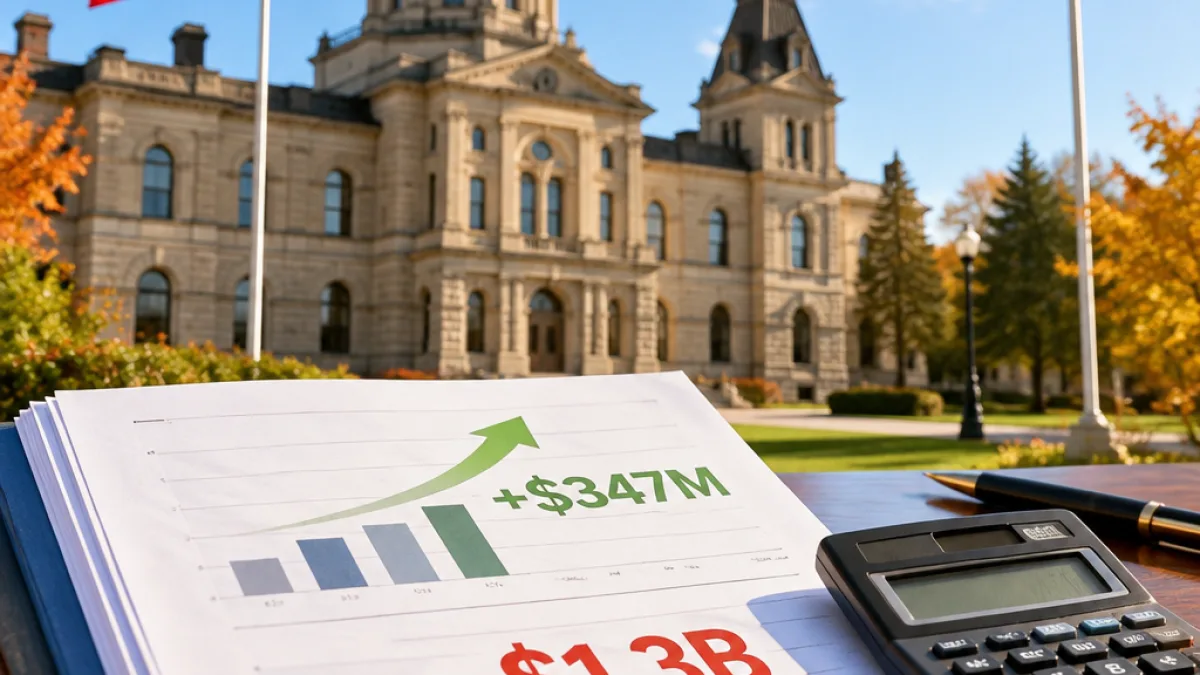
New Brunswick's fiscal position has improved by $347 million as stronger personal and corporate income-tax revenue changed the province's outlook, but the government is still projecting a deficit of roughly $1.3 billion.
The figures point to a fiscal picture that is better than previously anticipated, while leaving the province with a substantial gap between expected revenue and spending. The latest projection does not represent a balanced budget. Instead, it shows that higher tax receipts have reduced the size of the expected shortfall without removing it.
Tax revenue provides a partial lift
The improvement is linked to a jump in both personal and corporate income taxes. Those two revenue streams are affected by employment income, business earnings and broader economic activity, although the available report does not provide a breakdown showing how much of the $347 million came from either source.
That distinction matters because a rise in tax revenue can strengthen the government's accounts without necessarily representing a permanent change in the province's finances. The source report does not say whether the additional revenue is expected to continue at the same level in future years, nor does it identify the particular sectors or income groups behind the increase.
| Fiscal measure | Reported amount |
|---|---|
| Projected provincial deficit | $1.3 billion |
| Improvement in fiscal outlook | $347 million |
| Revenue sources identified | Personal and corporate income taxes |
A deficit remains the central issue
For New Brunswick, the key point is that the province continues to forecast a deficit measured in billions of dollars. A deficit means projected government expenditures exceed projected revenues over the reporting period. It is different from the province's accumulated debt, which reflects the effect of deficits and surpluses over time, along with other financial adjustments.
The report does not specify the province's total spending, the amount of debt, borrowing costs or the assumptions used to reach the latest projection. It also does not say whether the $1.3-billion figure includes any one-time items. Without those details, the tax increase can be measured as an improvement in the forecast, but not as evidence that the province's longer-term financial pressures have been resolved.
What the number could mean for public decisions
A large projected deficit can shape decisions about spending, taxation and borrowing. Any improvement gives the government more room than it would have had under the earlier outlook, but the remaining shortfall still presents a significant budget challenge. The available information does not identify any specific programs, departments or public services that are being considered for changes.
That absence is important for residents across the province. A fiscal projection alone cannot show how the government will respond. The practical questions for New Brunswickers will include whether the government plans to use the improved position to reduce borrowing, protect existing services, introduce new spending or make other changes to revenue policy. None of those decisions is identified in the report.
Revenue gains can change quickly
Income-tax revenue generally moves with the performance of households and businesses. When people earn more or companies report stronger results, government receipts can rise. When economic conditions weaken, the same revenue lines can slow or decline. The source does not provide a forecast for employment, wages, corporate profits or other economic indicators, so it is not possible to determine from the report whether the latest gain reflects a lasting trend.
That uncertainty is especially relevant when a province is still carrying a large projected deficit. A one-time improvement can reduce immediate pressure, while a sustained increase in the tax base would have a different effect on future budgets. The report establishes the size of the latest revision but does not provide enough information to determine which of those situations applies.
What to watch in the next fiscal update
The next detailed financial documents will be needed to put the revised projection into context. Residents, municipalities, businesses and public-sector organizations will be looking for information about the assumptions behind the forecast and the government's plans for the remaining gap.
- Whether the $1.3-billion deficit projection changes again.
- How much of the $347-million improvement is attributed to personal income tax and how much to corporate income tax.
- Whether the government identifies spending measures, revenue changes or borrowing plans.
- Whether the additional tax revenue is treated as a continuing trend or a temporary improvement.
The current numbers therefore offer mixed news. New Brunswick's outlook is stronger by hundreds of millions of dollars compared with the earlier projection, but the province remains far from a balanced position. Until more detail is released, the clearest conclusion is that higher income-tax revenue has narrowed the fiscal problem rather than settled it.