REITZ — Former SABC chief executive Hlaudi Motsoeneng told a large gathering in Reitz on Saturday that his party intends to capture control of Maluti‑a‑Phofung and Nketoana local municipalities and ultimately expand its influence across the Free State.
Campaigning in rural Free State
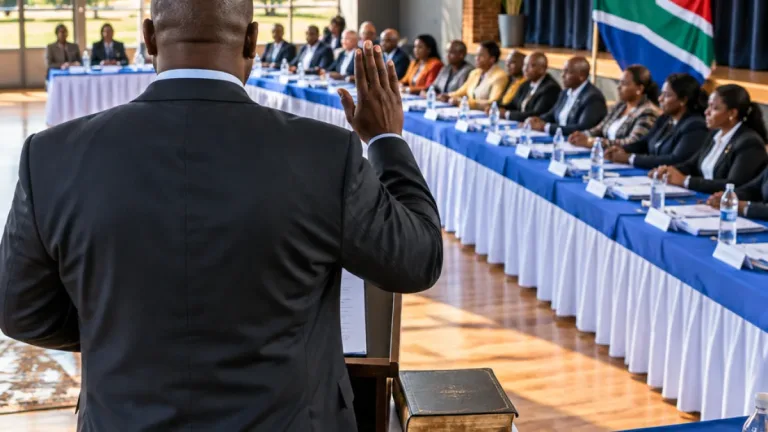
Motsoeneng addressed supporters at Phenduzame Primary School’s sports field in Petsana, Reitz, where organisers said thousands attended. According to the report, he framed his bid as a remedy for what he described as failing service delivery and a lack of local economic opportunities, promising job creation and improved municipal management.
He set out an ambitious roadmap that starts with the two municipalities and would later extend to the entire province. The claim places his party among a growing number of smaller political formations seeking to unsettle established local powerhouses ahead of the forthcoming municipal elections.
What he said
“I want to show South Africa what these municipalities can become under my leadership, with more employment opportunities, improved service delivery and meaningful economic development,”
The campaign speech also included a contentious comparison of economic conditions, with Motsoeneng asserting that towns in the province were economically better off during apartheid than under the post‑1994 ANC administrations. He portrayed himself as an unconventional candidate, pointing to his appointment at the SABC despite not holding a matric certificate and claiming the broadcaster was left in a "financially healthy state" when he departed.
Promises and political positioning
Motsoeneng’s pitch combined populist promises with personal assertions of competence. He said he was "far more intelligent than many people" and repeatedly emphasised his capacity to govern municipalities and create employment. The speech targets areas where residents have expressed frustration with joblessness and inconsistent municipal services.
Key elements of his message included:
- Targeted takeover of Maluti‑a‑Phofung and Nketoana municipalities.
- Commitments to increase local employment opportunities.
- Assurances of improved service delivery and economic development.
Local context and stakes
Maluti‑a‑Phofung and Nketoana have both faced governance and service delivery challenges in recent years, making them contested battlegrounds for parties seeking to demonstrate credible delivery records ahead of elections. Control of these municipalities would give any political formation a foothold in the Thabo Mofutsanyana district and a platform to influence rural development priorities.
Smaller parties and new political groupings often focus on local municipalities to build credibility, arguing that visible improvements in service delivery and employment at municipal level can translate into broader electoral support. Motsoeneng’s focus on the Free State illustrates that strategy.
Questions for voters and officials
Motsoeneng’s assertions raise practical questions that voters and municipal stakeholders will want answered before casting ballots:
- How will promised jobs be created and funded at municipal level?
- What specific measures will be taken to improve service delivery and municipal administration?
- Does the party have the technical capacity and personnel to manage complex municipal budgets and infrastructure projects?
| Municipality | Why it matters |
|---|---|
| Maluti‑a‑Phofung | Large rural municipality with service delivery history under scrutiny |
| Nketoana | Local governance and employment are key voter concerns |
What comes next
The report did not include policy documents or detailed implementation plans from Motsoeneng’s party. As the campaign season progresses, voters and local stakeholders will look for concrete proposals, budgetary outlines and evidence of administrative capacity. Opposition parties and municipal officials are likely to respond to the claims, setting up further local debate.
For residents of the Thabo Mofutsanyana district, the coming weeks will be important for scrutinising competing promises and assessing which parties can realistically improve service delivery and create sustainable local employment.
Note: All quotes and event details are reported from the campaign coverage. No additional figures or policy documents were provided in the source material.