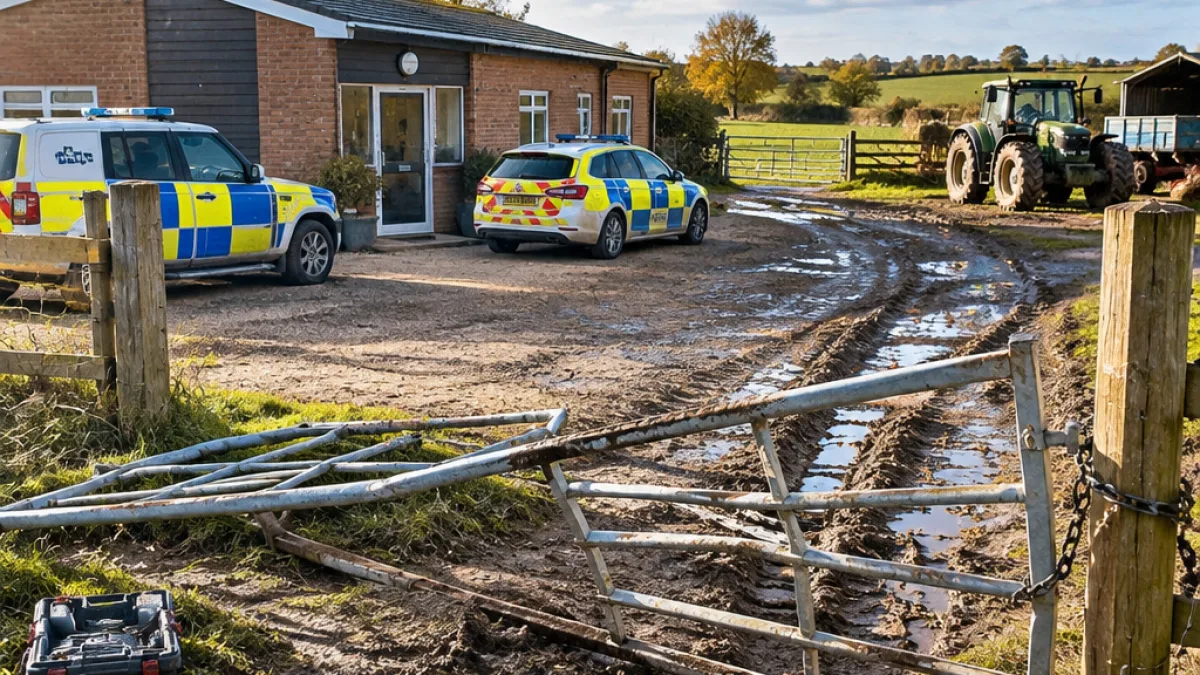
Thames Valley Police has opened a fifth base for its specialist rural crime officers, as farmers warn that repeated thefts and deliberate damage are continuing to disrupt agricultural work across the region.
The new office in Maidenhead is staffed by five people and forms part of the force’s Rural Crime Taskforce, established in March 2022. The operation now has 26 staff working from bases in Banbury, Buckingham, Abingdon, Newbury and Maidenhead.
Insp Chris Ball, who leads the taskforce, said rural offending had fallen by approximately 10% over the past year, following what he described as a substantial decline over a longer period. But the force is also urging victims to report every incident, including offences which may appear minor or where no property was ultimately taken.
“Nothing is insignificant. Just tell us. If you tell us and we do nothing, hold us to account. But if you don't tell us, we can't act.”
Farmers describe security measures
For some farmers, the practical effect of rural crime extends well beyond the value of stolen goods. Colin Rayner, who farms near Slough and whose family has worked in the area since the 16th Century, said tractors, machinery, tools and diesel had all been taken in recent years.
He said his site had been reinforced with earth barriers to prevent vehicles breaking through fences. The measures were intended to protect equipment, but he said incidents could leave farms unable to carry out essential work the following day. Damage caused when offenders failed to remove an item was also a concern.
“It’s not what they steal, it just means the next day we can’t plant our crops because we’re missing a tractor or a JCB. If they can’t steal it, they’ll smash it.”
The accounts highlight the distinctive consequences of offending in rural areas, where a stolen vehicle or piece of machinery can affect a farm’s ability to operate rather than simply represent a loss of property. Farmers may also be responsible for large, dispersed sites that require costly security measures.
Police call for more reports
Dan Willis, who runs a farm near Newbury, said rural residents tried to support one another, but questioned whether police resources and officer continuity were sufficient. He said officers could begin to understand local communities before being moved on, leaving new personnel to establish relationships again.
His comments point to an accountability problem central to the taskforce’s appeal: police data depends on victims reporting offences, while victims’ willingness to report may be influenced by whether they believe action will follow. Insp Ball said the force had invested significantly in the specialist response, but acknowledged that a lack of reporting remained a major frustration.
Recorded results and remaining concerns
| Measure | Details |
|---|---|
| Taskforce launched | March 2022 |
| Current staffing | 26 personnel |
| Operational bases | Five, including the new Maidenhead office |
| Reported annual change | Rural crime down by about 10% |
| Items returned last year | 88 caravans and 441 vehicles |
Thames Valley Police said that, during the previous year, it had returned hundreds of items to their owners, including 88 caravans and 441 vehicles. Those figures provide evidence of enforcement and recovery activity, but they do not remove the need for victims to make initial reports or resolve the concerns raised by farmers about recurring theft and damage.
- Five rural crime bases now operate across the Thames Valley area.
- Police say offending has reduced by around 10% in the past year.
- Farmers have reported thefts involving tractors, machinery, tools, fuel and vehicles.
- The force says unreported incidents limit its ability to identify patterns and act.
The new Maidenhead office is therefore both an expansion of the police response and a test of its ability to maintain a visible, consistent presence in rural communities. The force’s message is clear: without reliable reports from farmers and other victims, the scale and location of offending remain harder to establish, and the effectiveness of the taskforce is harder to measure.