
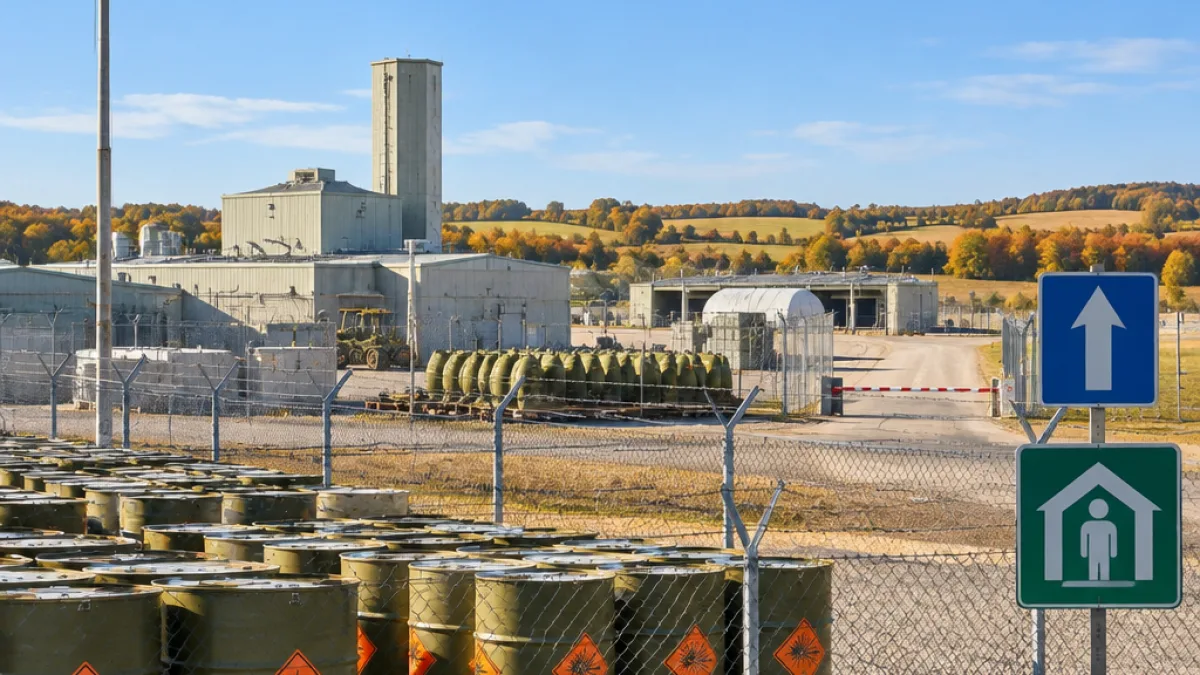
The U.S. Army says weather conditions are favourable for a controlled detonation Wednesday morning of its entire stockpile of degraded lead azide at the Iowa Army Ammunition Plant in Middletown, after officials postponed the operation to obtain safer winds and install additional protective measures.
The planned destruction of 68 barrels, containing about five tons of the bomb-making material, has prompted concern among nearby residents over possible health and environmental consequences. Army officials say the chemicals are deteriorating and could detonate unexpectedly as temperatures cool, creating the risk of a chain-reaction blast more dangerous than the controlled operation now planned.
“Inaction is no longer an option,” said Maj. Gen. Eric Shirley, the Army’s leader of the operation.
Wind direction is central to the plan
The Army shifted the detonation from last Friday to Wednesday partly because of the forecast. A government filing in court said winds were expected to move from the east toward the west, or from the southwest, keeping the anticipated plume away from densely populated areas and major bodies of water. The National Weather Service forecast called for winds of 5 to 10 m.p.h. at the start of the day, with cloudy conditions expected to give way to mostly sunny skies.
For an operation involving hazardous particulate matter, wind direction determines where airborne material could travel, while wind speed influences how quickly it disperses. The Army’s stated preference for Wednesday reflects the importance of having a predictable airflow away from areas officials have identified as more vulnerable. The forecast does not remove the possibility of impacts near the plant, however, which is why authorities have issued different instructions based on distance and direction.
| Item | Details |
|---|---|
| Planned time | 9 a.m. Wednesday |
| Material | Degraded lead azide |
| Stockpile | 68 barrels, about five tons |
| Forecast wind | East to west or southwest; 5 to 10 m.p.h. |
Barriers and containment measures added
The extra day has also allowed the Army to place more blast barriers around the bunkers where the material will be destroyed. Officials said they planned to use ballistic gels and foams intended to reduce the amount of particulate matter released by the detonation. Those additions are part of the Army’s effort to limit the plume and lessen the spread of airborne lead dust.
Army officials tried to reassure people living in the region Tuesday, saying barriers had been established around the blast zone and that the public should not panic. Acting Secretary of the Army Adam Telle said officials had taken steps to manage the operation, while acknowledging the public attention surrounding the decision and the frustration over the information provided so far.
Instructions vary by distance
An emergency notification sent to mobile phones in the area said the detonation was scheduled for 9 a.m. Wednesday. It warned that some people within five miles southwest of the plant could be evacuated. Residents as far as 20 miles away were told to remain indoors with windows closed to reduce exposure to airborne lead dust, as well as to limit the effects of noise and vibration.
- Some residents within five miles southwest of the facility may be evacuated.
- People up to 20 miles away were instructed to stay indoors.
- Windows should remain closed during the operation.
- The notification identified FEMA as the contact agency.
The Army has said the controlled blast is necessary because leaving the material in place could allow an uncontrolled explosion. The decision has nevertheless generated public concern because lead azide is both hazardous and capable of exploding, and because residents have sought more information about the potential effects of the detonation.
Wednesday’s forecast therefore serves as more than a routine operational detail. The expected airflow is being used to guide the timing of the blast, the location of protective measures and the instructions issued to people nearby. If the operation proceeds as planned, the Army will be relying on the predicted winds, added barriers and particulate-reduction materials to keep the effects of the detonation within the controlled area.