Hawaiʻi has the lowest reported special education enrolment rate in the United States, according to a new University of Hawaiʻi analysis that warns thousands of public school students may not be receiving formal support for disability-related needs.
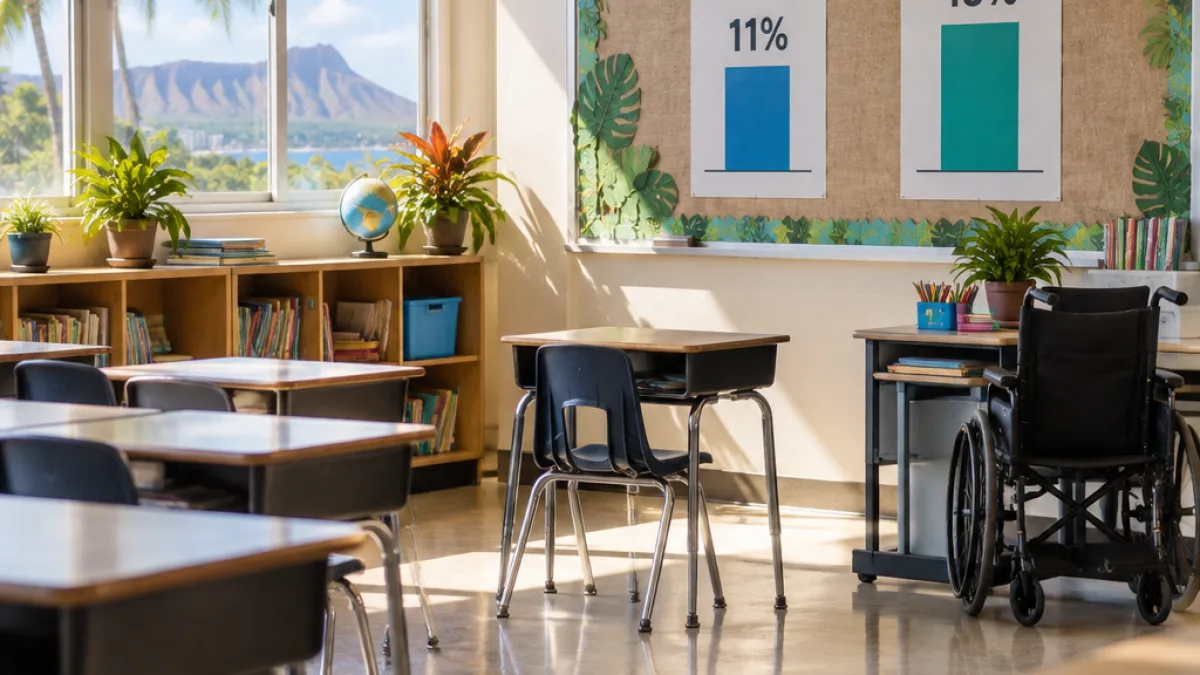
The study, published by the University of Hawaiʻi Economic Research Organization, found that about 11 per cent of students in the state Department of Education system received special education services during the 2024-25 school year. The national average was 15 per cent.
Researchers estimate the difference could represent nearly 7,000 K-12 students across the state who may be missing services they require. The estimate is based on a comparison with national enrolment levels, rather than individual assessments of students, and the department cautioned that it should not be treated as a confirmed count of students eligible for special education.
What the study found
Daniela Bond-Smith, a research economist at the university and lead author of the report, said the findings point to a continuing access problem. The report, titled Unpacking Hawai‘i’s Persistent Special Education Gaps: Access and Inclusion, also examines where students with individualized education programs spend their school day.
| Measure | Hawaiʻi | United States |
|---|---|---|
| Students receiving special education services, 2024-25 | About 11% | About 15% |
Bond-Smith said the report’s modelling suggests that for every 10 students with an individualized education program in general education classrooms, as many as six other classmates could have disability-related needs without having been identified. Those students, she said, would not have access to formal supports through an education plan.
“Until that changes, in the meantime, this really strengthens the arguments for designing all instructions, including and especially instruction in general education classrooms, in a way that's inclusive so that all students have access to learning.”
Department cautions against a simple comparison
Hawaiʻi Department of Education officials said the study’s figures are broad estimates and may not describe the needs of individual students. In an email to Hawaiʻi Public Radio, department spokesperson Nanea Ching said the estimate of approximately 6,930 potentially unidentified students was calculated by comparing Hawaiʻi’s rate with national enrolment rates.
Ching said the estimate should not be understood as a list of students who have been assessed and found eligible for special education. She also noted that identification rates differ among states because of variations in eligibility requirements, identification methods and student populations.
- The study places Hawaiʻi’s special education enrolment at roughly 11 per cent.
- The national comparison rate is about 15 per cent.
- The report estimates that close to 7,000 students could be affected, while stressing that the figure is not an individual eligibility count.
Implications for classrooms
The disagreement over how to interpret the estimate does not remove the practical question raised by the report: how schools identify students who need help, and how support is provided while that process takes place. A lower recorded enrolment rate may reflect differences in rules and practices, as the department said, but the study argues that it may also indicate that some students’ needs are going unrecognized.
Bond-Smith’s recommendation focuses in part on classroom design rather than relying only on formal identification. Making instruction more inclusive in general education settings could help students who have an individualized education program as well as those whose needs have not yet been formally documented, according to the report’s findings.
For families, teachers and school leaders, the findings place access and inclusion at the centre of the discussion. The report does not establish that every student represented by its estimate qualifies for special education services. It does, however, identify a sizeable gap between Hawaiʻi’s reported rate and the national benchmark, while calling for closer attention to how students are identified and supported in public schools.