
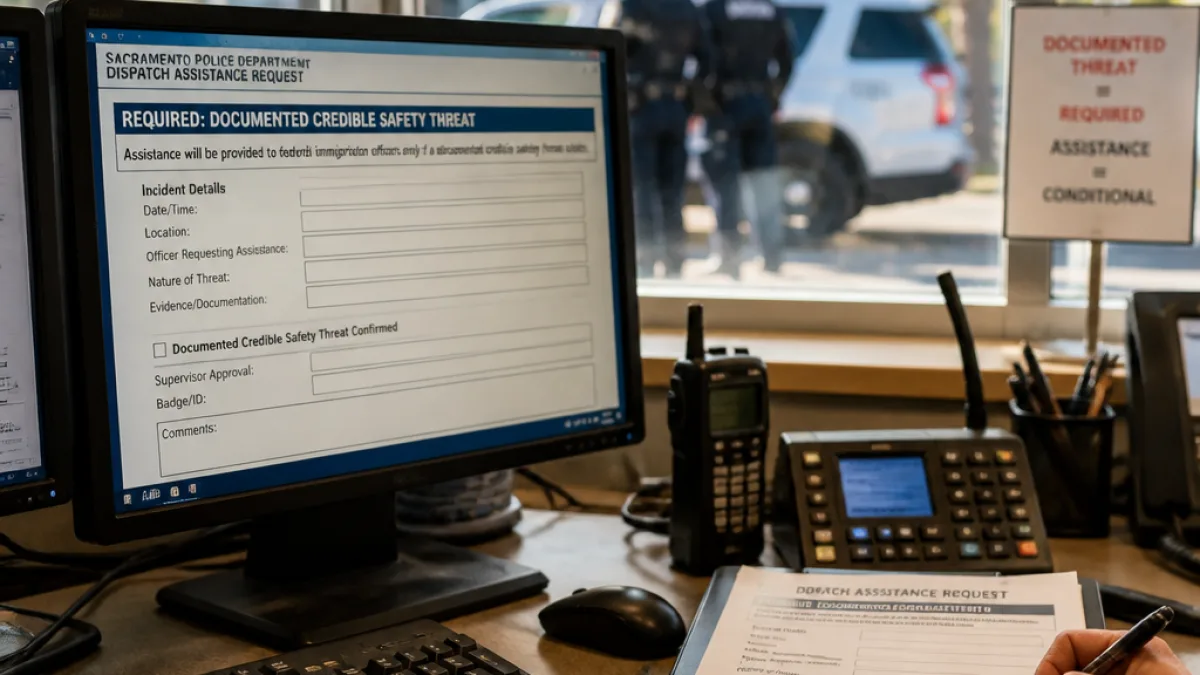
A narrower path to police assistance
Sacramento police are being instructed to establish a specific, credible safety concern before they are dispatched to assist U.S. Immigration and Customs Enforcement, according to a letter from the city manager. The directive places a documentation requirement at the center of interactions between the city department and federal immigration officers.
Under the guidance, a request from ICE is not by itself enough to trigger a Sacramento Police Department response. Dispatchers are being asked to collect and record details explaining why ICE officers may need help. Those facts must show a clear threat to the safety of ICE personnel, the public or another legitimate public-safety concern before city officers are sent.
The policy comes after NorCal Resist posted a video showing a Sacramento police officer telling an ICE observer to leave a neighborhood while an alleged ICE vehicle was nearby. The source material does not identify the neighborhood, describe the underlying immigration operation or say whether Sacramento officers ultimately provided assistance. The city manager's letter responds to that episode by spelling out the threshold officials say must be met.
“clear, credible safety threat”
That standard makes the distinction between ordinary cooperation and an emergency or other verified safety need central to the department's role. The letter does not say that Sacramento police can never assist ICE. Instead, it directs the department to establish the factual basis for assistance before dispatching officers, and it assigns dispatchers responsibility for preserving those details.
What the directive requires
- A request from ICE must be tied to a credible threat or another legitimate public-safety concern.
- Dispatchers must obtain and document information about the reason assistance is being requested.
- The concern may involve the safety of ICE agents, the public or another legitimate public-safety interest.
| Issue | Direction described in the letter |
|---|---|
| Trigger for deployment | Clear facts showing a credible safety threat or legitimate public-safety concern |
| Dispatch process | Details of the request must be obtained and documented |
| Potentially protected interests | ICE officers, the public or another legitimate public-safety need |
For Sacramento residents, the practical consequence is that calls involving ICE will now be evaluated through a stated safety test rather than handled without a documented explanation. The direction also creates a record of why assistance was sought and why a police response was, or was not, sent. The available information does not state how often ICE has requested help from Sacramento police, how many requests have been denied, or when the new instruction took effect.
The episode also illustrates how encounters involving federal immigration enforcement can quickly become local police matters. An ICE presence in a neighborhood, as described in the video posted by NorCal Resist, can raise questions about whether city officers are acting to protect public safety, supporting a federal operation or responding to a specific threat. The city manager's letter addresses that uncertainty by requiring the request to be supported by clear facts before Sacramento officers are dispatched.
Because the directive focuses on dispatch and documentation, its effect will depend on how requests are described, what information dispatchers receive and how officials determine that a concern is credible. The source does not provide additional procedures, enforcement consequences or public reporting requirements. For now, the stated policy is straightforward: ICE requests for Sacramento police assistance must be connected to a documented safety need, rather than proceeding without that showing.