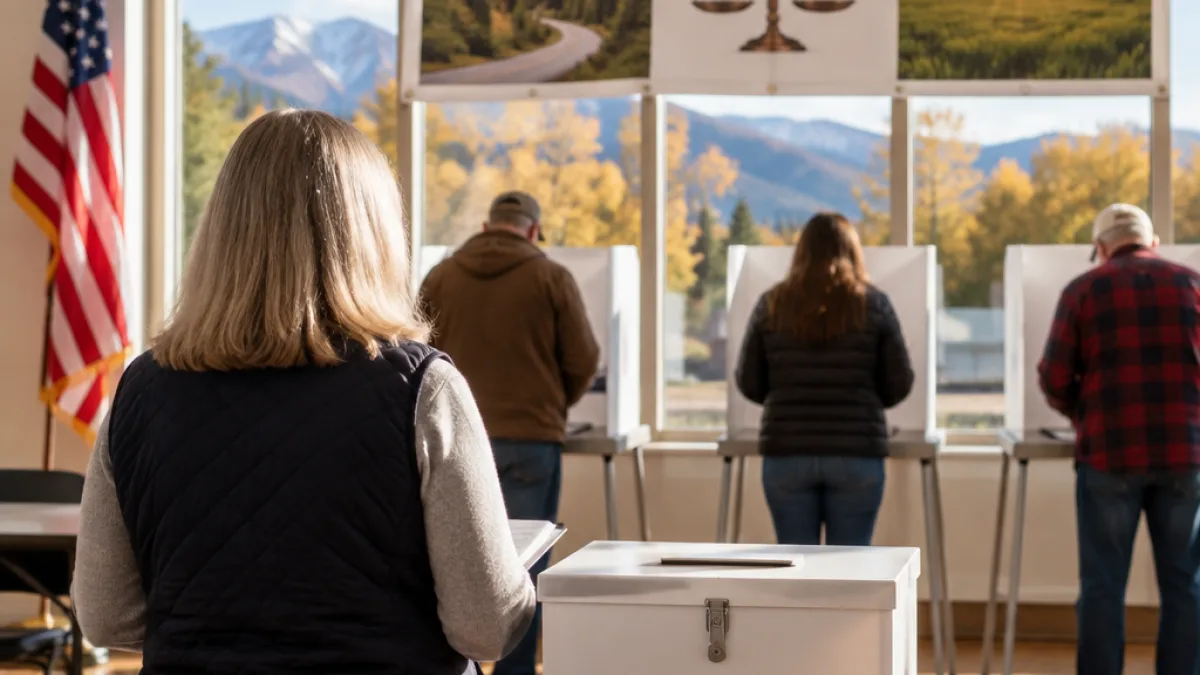
Idaho voters are deciding Tuesday whether to give Gov. Brad Little a third consecutive term, or choose a new direction in a state where Republicans have dominated statewide politics for decades. Little, a Republican who first won the office in 2018, is facing Democrat Terri Pickens and independent John Stegner.
The contest carries significance beyond the names on the ballot. A Little victory would extend the tenure of an incumbent who has already served two terms. A win by Pickens would end an unusually long Democratic drought in the governor’s office. Stegner, a former Republican and former Idaho Supreme Court justice, is presenting himself as an alternative to both major-party choices.
A bid for a third term
Little entered the general election after securing the Republican nomination by roughly 30 percentage points over Mark Fitzpatrick, a saloon owner and former police officer, along with several other candidates in the GOP primary. Little previously served as lieutenant governor and as a state senator before becoming governor.
Idaho is among 13 states without gubernatorial term limits, allowing Little to seek another four-year term. His candidacy therefore puts the question of extended incumbency directly before voters: whether the state should continue under a familiar Republican leader or use the election to change course.
| Candidate | Party | Background identified in the race |
|---|---|---|
| Brad Little | Republican | Incumbent governor; former lieutenant governor and state senator |
| Terri Pickens | Democrat | Attorney; 2022 lieutenant governor nominee |
| John Stegner | Independent | Former Idaho Supreme Court justice and former Republican |
Democrats face a steep historical challenge
Pickens won the Democratic primary with approximately 61% of the vote. She is attempting to accomplish what no Democratic gubernatorial candidate has done since Cecil Andrus, whose last successful campaign for governor came in 1990.
That history defines the scale of Pickens’ challenge, but it also gives the race a clear test of whether Idaho’s longstanding partisan pattern will hold. The source material identifies Andrus as a four-term governor, making him the last Democrat to win the office and the most recent marker of a different political era in the state.
Pickens is not new to statewide politics. She was the Democratic nominee for lieutenant governor in 2022 before seeking the top office this year. Her candidacy gives Democrats a statewide vehicle for trying to break a losing streak that has lasted 36 years.
An independent option
Stegner adds a third path to the contest. A former member of the Republican Party and former justice on the Idaho Supreme Court, he says current state leaders are failing Idaho residents. His campaign is built around the argument that voters should choose a change candidate outside the two-party structure.
The independent bid makes the ballot more than a simple contest between the incumbent and the Democratic nominee. It offers voters a choice that is neither a continuation of Little’s Republican administration nor a return to Democratic control of the governor’s office.
What voters are deciding
The race presents Idaho voters with three broad choices:
- Continuation: Re-elect Little to a third term after his two successful campaigns for governor.
- Partisan change: Choose Pickens and end the Democratic Party’s long absence from the governor’s office.
- Political independence: Select Stegner, who is running outside the Republican and Democratic parties and criticizing current state leadership.
Those choices also frame the trade-offs of the election. A vote for the incumbent would maintain the state’s current leadership. A Pickens victory would represent a major partisan shift by Idaho standards. A Stegner win would create a different kind of change, led by a candidate who has experience in Republican politics but is no longer running as a Republican.
Results expected after polls close
Polls are scheduled to close at 10 p.m. Eastern time. The available race information identifies the candidates and the state’s political backdrop but does not provide vote totals or a projected winner. As ballots are counted, the central questions will be whether Little can extend his time in office, whether Pickens can overcome the Democratic Party’s statewide losing streak, and whether Stegner can turn dissatisfaction with established leadership into an independent victory.
For Idaho, the outcome will determine who occupies the governor’s office for the next term. It will also show whether the state’s recent political alignment remains intact or whether voters are prepared to make a change at the top of state government.