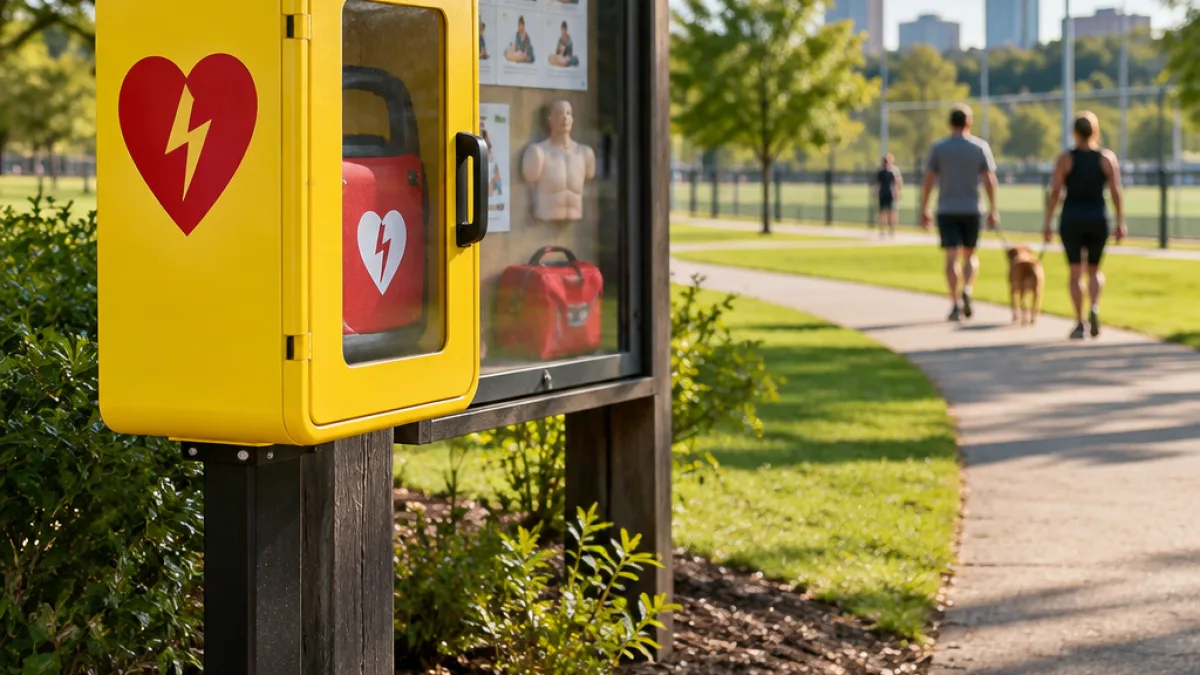
Knoxville residents and visitors now have access to automated external defibrillators at five city parks, marking the first time publicly accessible outdoor AEDs have been placed in Knoxville’s park system. The equipment was donated by the American Heart Association and is intended to give bystanders another tool during the critical minutes before emergency crews arrive.
Equipment now available at five locations
The AEDs are located at Victor Ashe Park, Ijams Nature Center, Tyson Park, Lakeshore Park and Claude Walker Ballfields. Those sites collectively receive well over one million visitors each year, according to officials. The locations include spaces where people gather for recreation, youth activities, exercise and time outdoors — settings in which a sudden cardiac emergency could unfold far from an immediately visible medical facility.
An AED is designed to assess a person’s heart rhythm and deliver an electrical shock when appropriate. Officials said the devices can be used by members of the public, and a witness who encounters a cardiac emergency is instructed to first call 911 and then retrieve the unit from its cabinet. The cabinet’s alarm will sound, while 911 operators can guide the witness through using the device and beginning CPR.
“Public safety is my top priority, and these AEDs will provide access to life-saving equipment to park users every day.”
That statement from Knoxville Mayor Indya Kincannon reflects the practical purpose of the donation: placing emergency equipment where people already spend time, rather than limiting access to hospitals, fire stations or other dedicated medical locations. The American Heart Association said the survival benefit depends on a rapid sequence of actions — contacting 911, starting CPR immediately and using an AED as soon as one is available.
Minutes can shape the outcome
Officials said nine out of 10 people who suffer an out-of-hospital cardiac arrest die. The American Heart Association also said the chance of survival falls by 10% for every minute that passes without CPR while a person waits for emergency assistance. When 911 is called, CPR begins and an AED is used, the association said, a person’s chance of survival can triple.
| Park | New resource |
|---|---|
| Victor Ashe Park | Publicly accessible outdoor AED |
| Ijams Nature Center | Publicly accessible outdoor AED |
| Tyson Park | Publicly accessible outdoor AED |
| Lakeshore Park | Publicly accessible outdoor AED |
| Claude Walker Ballfields | Publicly accessible outdoor AED |
The initiative goes beyond installing the cabinets. The American Heart Association also supplied CPR and AED training kits for each selected park and worked with the Knoxville Parks and Recreation Department on a cardiac emergency response plan. Officials said many parks staff members were trained in CPR and certified. The kits include inflatable mannequins for practice and AED trainers that staff can use while teaching others.
A wider public-safety network
For Knoxville park users, the training component could help make the equipment less intimidating in an emergency. An AED provides voice instructions, and 911 dispatchers can assist by phone, but a nearby person still must recognize the emergency, call for help and begin the response. The combination of trained staff, practice equipment and a formal response plan is intended to support that chain of action.
The AEDs were funded through American Heart Association donors, with support from Pilot Company. Kayla Smith, executive director of the Greater Knoxville American Heart Association, said parks create repeated opportunities for public access to a lifesaving device because families, athletes and other community members use them throughout the year.
Smith said she hopes Knoxville eventually places an AED in every city park and on the public bus transit system. For now, the five installations establish a new baseline for emergency readiness in Knoxville’s outdoor public spaces. Their value will depend on visibility, public awareness and the willingness of bystanders to act quickly — call 911, begin CPR and use the device when a cardiac arrest occurs.
- Call 911 as soon as a cardiac emergency is recognized.
- Start CPR immediately while emergency help is on the way.
- Retrieve and use the AED, following its instructions and guidance from 911 dispatchers.