
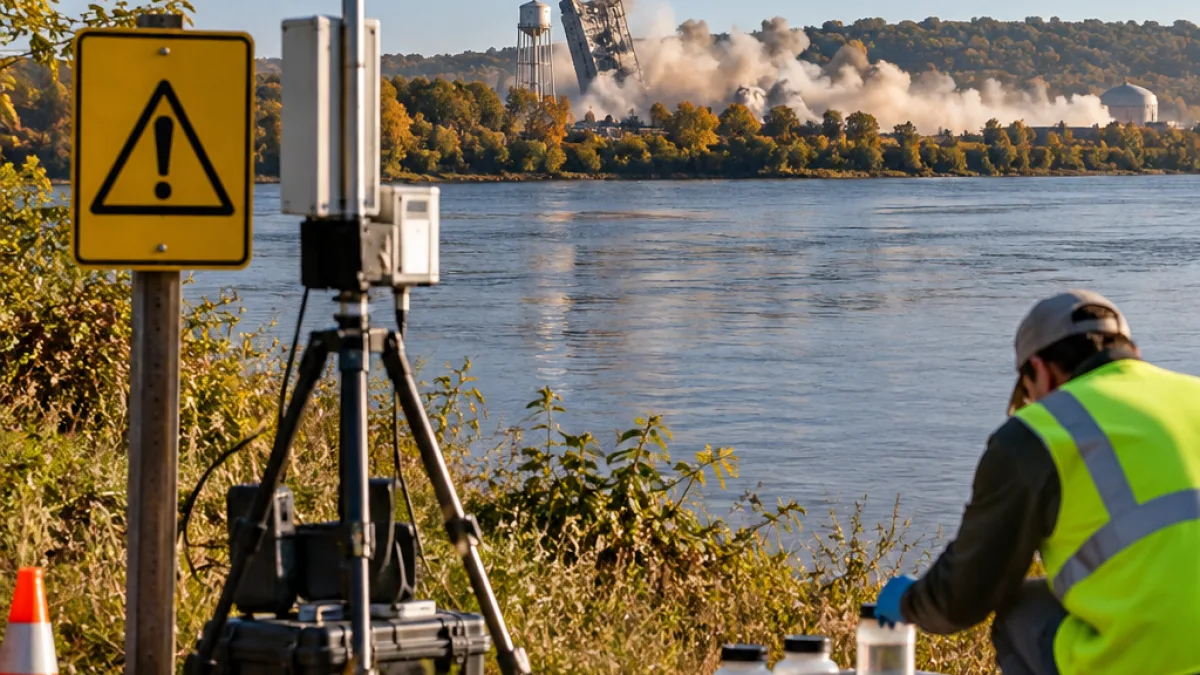
A planned military demolition in southeast Iowa is drawing concern from Illinois environmental officials, who warn that a cloud of lead-contaminated dust could cross the Mississippi River and affect communities on the opposite bank.
The Defense Department has announced plans to detonate approximately 5 tons of hazardous material at the Iowa Army Ammunition Plant in Middletown, southwest of the Quad Cities. The operation is scheduled for Friday between 11 a.m. and noon, according to a federal public notice issued Monday.
The waste is identified in the notice as lead azide, a chemical used in making bombs. The material is considered dangerous because it could explode if workers try to move it or leave it in storage, the Defense Department said. That risk is the stated reason for destroying it at the Iowa site rather than transporting it elsewhere.
Illinois seeks testing beyond the blast site
James Jennings, director of the Illinois Environmental Protection Agency, said the potential for airborne pollution to move across state borders makes monitoring and follow-up testing essential. Illinois officials are particularly focused on whether particles settle onto land, buildings or other surfaces after the blast.
“Air pollution does not respect state lines and accordingly we strongly urge the Department of Defense to conduct comprehensive post-detonation environmental sampling.”
Jennings asked Defense Department officials to make the results public. He said the sampling should cover several parts of the environment rather than relying on a single air reading.
- Air: monitoring for airborne contamination after the detonation.
- Soil: testing in areas that could receive deposited particles.
- Surface dust: examining material that settles on exposed surfaces in potentially affected Illinois communities.
The Illinois EPA will conduct its own air monitoring, the agency said. The source material does not specify the locations of that monitoring or how long the effort will continue. It also does not provide a projected path or concentration for any possible plume.
Lead exposure is the central health concern
Lead is toxic to people and animals. Health experts cited in the report say there is no safe level of lead exposure, while children face particular concern because their brains and nervous systems are still developing. The warning places added importance on determining whether particles leave the Iowa facility and where they ultimately settle.
The possible impact in Illinois remains uncertain. Officials have not said whether lead dust could travel as far northeast as Chicago. The concern is centered on the possibility that wind could carry material across the Mississippi River, but the available notice does not establish how far a plume might extend or which locations would be affected.
| Detail | Information released |
|---|---|
| Facility | Iowa Army Ammunition Plant |
| Community | Middletown, Iowa |
| Material | Lead azide hazardous waste |
| Amount | About 5 tons |
| Planned timing | Friday, from 11 a.m. to noon |
Why the Army says destruction is necessary
The Defense Department's notice describes the waste as posing an explosion hazard if it is moved or kept in place. That creates a difficult balance for officials: eliminating a dangerous stockpile requires an explosion, but the process may release toxic particles into the surrounding environment.
The information released so far does not describe the detonation method, expected weather conditions, the plant's distance from the Illinois border, or the protective measures planned for nearby communities. It also does not say whether the operation could be delayed because of wind or other conditions.
Those unanswered questions are part of why Illinois officials are pressing for environmental results that can be reviewed by the public. Air measurements can indicate whether contamination is present during or after the event, while soil and surface-dust sampling can help show where particles may have settled. Publishing those findings would give residents a clearer picture of any cross-river effect.
A concern shared across state lines
The episode highlights the practical limits of state boundaries in the Mississippi River region. The Iowa plant is located near the Quad Cities area, where communities on both sides of the river are closely connected. A release from an industrial or military site in one state can therefore become a concern for officials and residents in another.
For now, the confirmed information is limited to the federal announcement, the planned timing and the Illinois EPA's request for expanded testing. The potential reach of the lead dust has not been determined, and the source does not report any contamination or injuries. The next significant public information will likely come from monitoring conducted around the detonation and from any post-event sampling results released by federal or state authorities.