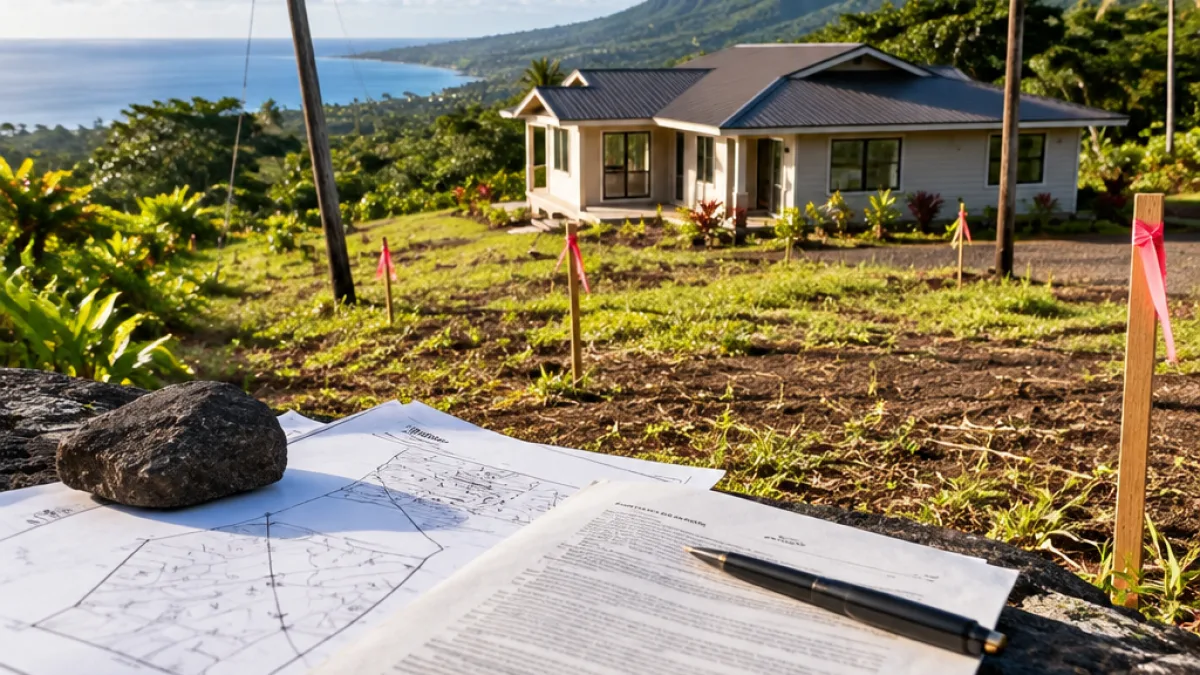
A California woman says she was stunned to learn that a newly built house had been constructed on land she purchased in Paradise Park for $22,500. Annaleine “Anne” Reynolds said she did not discover the construction until a real estate agent contacted her in 2023, after the home had already been sold.
Reynolds told Hawaii News Now that she bought the parcel in 2018 with plans to create a meditative retreat for women. Instead, she has become involved in a legal dispute tied to the property, the home and the parties involved in its development.
A call revealed the unexpected construction
According to Reynolds, the broker who handled the sale of the house called her after completing the transaction. The agent told her the residence had been built on land that belonged to her, she said.
“And then he informed me, ‘Oh well, I just sold the house, and it happens to be on your property,’” Reynolds told Hawaii News Now.
Reynolds said the news was difficult to absorb because she had not authorized the construction on her parcel and had not known that a house was being built there. The discovery came several years after she had purchased the property and while her original plans remained on hold.
Plans for a retreat were put on pause
Reynolds said the land held personal and spiritual meaning for her. She had selected it as the site for a meditative healing retreat for women and believed the parcel had the qualities she was looking for.
“There’s a sacredness to it, and the one that I chose to buy had all the right qualities,” Reynolds said.
Those plans were delayed by the pandemic, according to the account. While Reynolds waited to move forward, Keaau Development Partnership began work on homes in a new subdivision, the source reported.
Developers allegedly relied on landmarks
An attorney for the construction company said the developers chose not to hire surveyors before beginning construction. Instead, they relied on telephone poles to identify the boundaries of the lots, according to the report.
That decision is at the center of the dispute described by Reynolds and the construction company’s attorney. The result, according to the account, was a home valued at roughly $500,000 being built on the wrong parcel.
| Property detail | Information reported |
|---|---|
| Purchase year | 2018 |
| Purchase price | $22,500 |
| Location | Paradise Park, Hawaii |
| Reported home value | About $500,000 |
| Discovery of construction | 2023 |
A dispute involving several parties
Reynolds is now involved in litigation with the construction company, the family of the prior property owner, the architect and the county, according to the source. The developers sued all five parties, the report said, placing Reynolds alongside the other defendants in the legal fight.
The available account does not describe a final court ruling or say what will happen to the house. It also does not establish whether Reynolds will retain the parcel, receive compensation or be offered another arrangement. Those questions remain part of the unresolved dispute.
The proposed neighboring-lot exchange
Reynolds said the developers offered to give her a neighboring parcel in exchange for her land. The proposal would allow them to avoid demolishing the newly built home or selling her the property that properly corresponds to her ownership, according to the source.
The report does not say whether Reynolds accepted that offer. Her account makes clear that the proposed exchange came after the house had been built and sold, rather than before construction began.
Why the case matters to property owners
The episode illustrates the practical consequences of inaccurate lot identification in a developing subdivision. A boundary mistake can affect not only the owner of the land but also builders, buyers, brokers, architects and public agencies connected to the project.
For Reynolds, the issue is also tied to a long-delayed personal plan. She purchased the parcel intending to create a place centered on meditation and healing, but said the land was altered without her knowledge while she was waiting to resume that work.
The case remains unresolved, and the source content does not report a court decision, settlement or timetable for the next legal step. For now, Reynolds’ account centers on a basic property question: how a home could be constructed and sold before anyone involved discovered that it stood on someone else’s land.