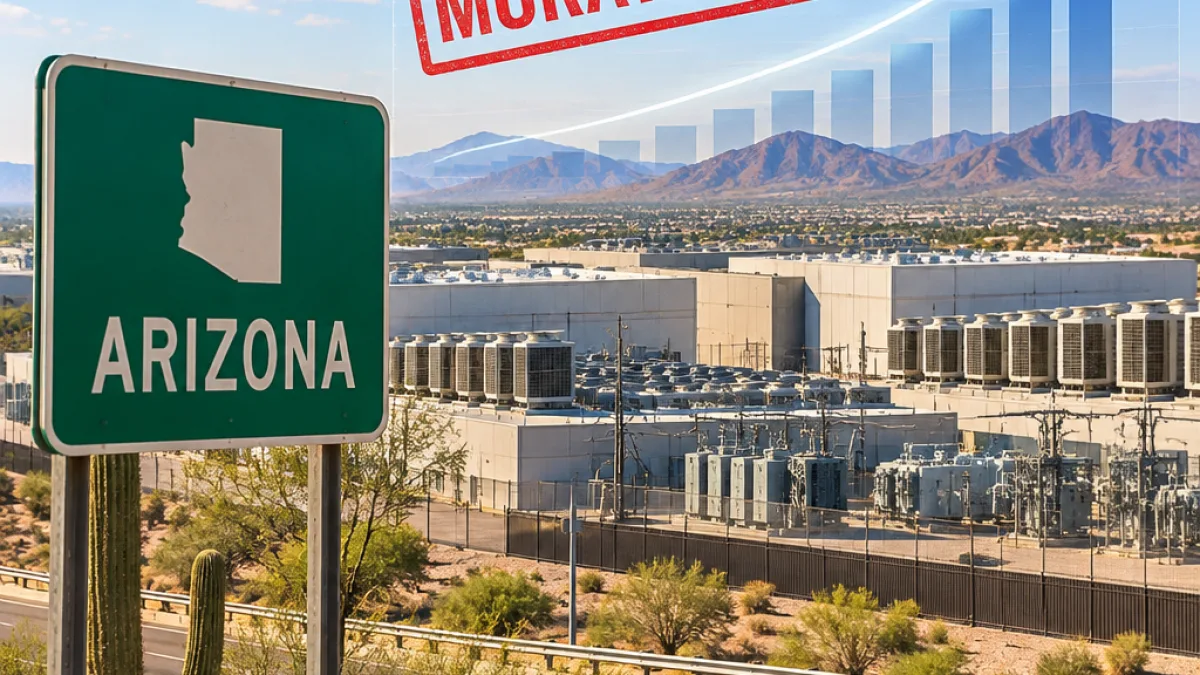
Arizona’s tax break for data centers reached a record $56 million in foregone state revenue during the most recent fiscal year, undercutting claims that a new moratorium would quickly reduce the cost of the program. The figure, released Nov. 16 by the Arizona Department of Revenue, represents a 40% increase from the previous year and nearly triple the cost reported in 2024.
The increase comes as Arizona officials try to put limits on an incentive that has become increasingly expensive. Democratic Gov. Katie Hobbs negotiated a three-year pause on new applications as part of a compromise with Republican lawmakers. The agreement was presented by leading Democrats as a way to curb a corporate subsidy and keep public money from being directed toward special interests.
A moratorium with a narrow reach
The pause may not produce the savings lawmakers expected. Arizona accepted more than 100 applications between June 15 and June 30, the period immediately before the moratorium took effect. That late surge roughly doubled the size of the program in two weeks, leaving developers who entered before the deadline eligible to continue pursuing the benefit.
The moratorium does not cancel exemptions that were already approved. That distinction is central to the state’s financial outlook. Data center projects can remain in the program for 10 to 20 years, depending on the length of their certification term. Even if no new applicants are accepted during the pause, previously approved projects can continue producing tax costs over a long period.
| Measure | Reported figure |
|---|---|
| Latest annual revenue forgone | $56 million |
| Change from previous year | 40% increase |
| Change from 2024 | Nearly 200% increase |
| New application pause | Three years |
| Certification terms | 10 to 20 years |
The deadline became the pressure point
The application rush has become the most politically sensitive feature of the program. More than 100 submissions arrived during the final two weeks before the freeze, according to the information released about the program. Because the new applicants may proceed under the existing rules, the state’s temporary pause could shield fewer dollars than the initial budget estimate assumed.
Anthony Elmo, an analyst with the policy watchdog group Good Jobs First, said Arizona is part of a broader national struggle to contain the cost of data center incentives. He characterized the deadline as an opening for developers to secure access before the rules changed.
“An arbitrary deadline was set up for people to line up at the public trough. And they did.”
That criticism goes beyond the political symbolism of the June agreement. It raises a practical question about how lawmakers measure the value of a tax incentive when projects can be approved just before a restriction begins and remain eligible for years afterward. The state’s accounting must therefore track not only applications submitted during the pause, but also the long-term obligations created before it.
Budget savings remain uncertain
Arizona’s nonpartisan Joint Legislative Budget Committee estimated that the moratorium would save $57 million over three years. That estimate was made before the late-June influx of applications. The Department of Revenue’s new $56 million annual figure now gives lawmakers a more expensive baseline, although the eventual cost of the recently approved projects remains difficult to calculate.
The uncertainty is built into the program. Projects are still being developed, and the state cannot yet know how extensively approved exemptions will be used over time. The reported cost reflects revenue the state did not collect, not a direct appropriation from the treasury. But the effect on public finances is similar in one important respect: money that otherwise could have supported state priorities is unavailable for those uses.
- The latest estimated cost is $56 million in forgone revenue.
- The annual cost rose 40% from the prior year.
- More than 100 applications arrived before the three-year pause.
- Existing certifications may last as long as 20 years.
Industry defense and public accountability
Industry advocates have continued to defend the exemption as new data centers receive permits across Arizona. Their position places the incentive within the state’s broader effort to attract large technology facilities and the investment associated with them. The source material does not provide a dollar figure for that investment or a measure of jobs created, so the economic return cannot be weighed here against the $56 million revenue loss.
That gap is consequential. A subsidy can be defended only if the public can compare its cost with measurable benefits. Arizona now has a reported annual cost, a rapidly expanded pool of participants and certification periods that can extend for decades. It still faces the harder task of determining what taxpayers receive in exchange.
For the next three years, the political debate will shift from whether new applications should be accepted to how much the approved projects will cost. The June compromise stopped one pipeline, but it did not shut down the existing program. As the Department of Revenue continues to report its figures, the record $56 million may prove to be a warning about the past—or an early indication of Arizona’s continuing obligation to data center developers.