A long-empty section of Mesa is set for new construction
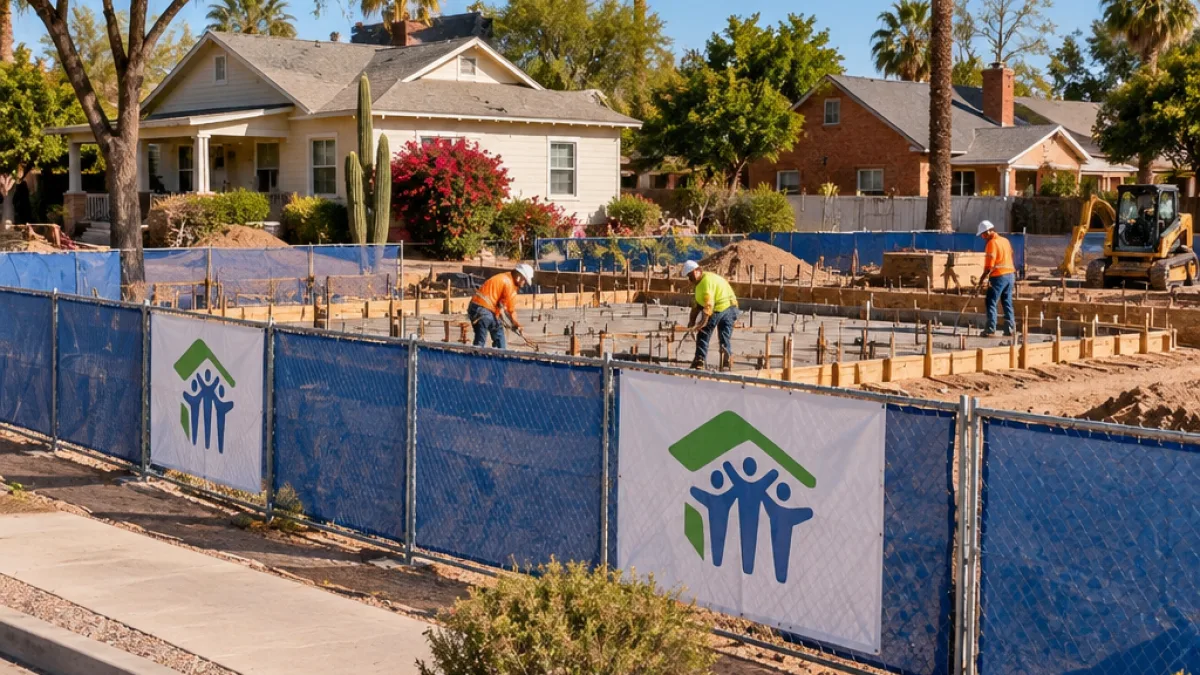
The Mesa City Council has approved an agreement that will transfer three vacant lots in the Washington-Escobedo Heritage neighborhood to Habitat for Humanity Central Arizona. The nonprofit plans to build one single-family home on each lot, putting properties that have sat unused for decades back into residential use.
Construction is expected to begin in early 2027, with completion targeted for December 2028. The timeline gives the city a defined path for addressing vacant land in a neighborhood where the empty parcels have become part of the landscape. Habitat for Humanity CEO Todd Rogers said the lots have remained open for multiple decades.
“It’s been multiple decades since these lots have been open,” Habitat for Humanity Central Arizona CEO Todd Rogers said.
The agreement carries restrictions intended to keep the project focused on housing rather than short-term investment. Buyers will have to satisfy Habitat’s affordable-housing requirements, and the homes will not be allowed to become short-term rentals or Airbnb properties. Rogers said the affordability protection will last for at least 99 years.
Affordability rules are central to the deal
The city’s decision is consequential because the homes are being created with a long-term affordability requirement, not simply as market-rate additions to the neighborhood. The buyers will be screened under affordable-housing qualifications, according to Rogers. That condition is designed to preserve the homes for eligible residents well beyond the initial sale.
| Project detail | Plan |
|---|---|
| Lots involved | 3 |
| Housing type | Single-family homes |
| Construction start | Early 2027 |
| Target completion | December 2028 |
| Affordability period | At least 99 years |
The nonprofit’s obligations extend beyond the new construction. Under the agreement, Habitat also will be able to make improvements to existing homes in the neighborhood that need work. Rogers said that could increase the value of surrounding properties, connecting the vacant-lot project to the condition of homes already occupied by residents.
“It really just raises the value of the homes around it,” Rogers said.
A historic neighborhood weighs change
Washington-Escobedo Heritage is not simply a collection of residential parcels. The area was home to some of Mesa’s first Black and Hispanic families during the period when the city was segregated. The Alston House, once the home and office of Dr. Lucius Alston, Mesa’s first Black doctor, is now a community space and is listed on the National Register of Historic Places.
That history gives the council’s housing decision a broader consequence. New construction will change vacant parcels, but the project is also entering a community whose identity is tied to families who have remained connected to the area across generations. The question for residents is not only whether homes are built, but whether growth strengthens the neighborhood without displacing its character.
Edith Stephens, who has lived in the neighborhood for 28 years, said her family’s connection reaches back to her great-grandparents, who came from Texas in a covered wagon. She recently paid for a new roof on her own home before the council vote, a detail that underscored the timing of the city’s investment for her.
“Well, I wish they would’ve gotten me six months ago before I paid for that roof right there,” Stephens said.
Stephens said the neighborhood’s evolution is bittersweet, but she continues to value the community and the relationships that define it. For Mesa, the project now sets a test: whether vacant land can become permanently affordable housing while preserving the history and stability of the residents who built the neighborhood.
- Three vacant lots are slated for single-family homes.
- Construction is planned to start in early 2027 and finish by December 2028.
- The homes must remain affordable for at least 99 years and cannot become short-term rentals.