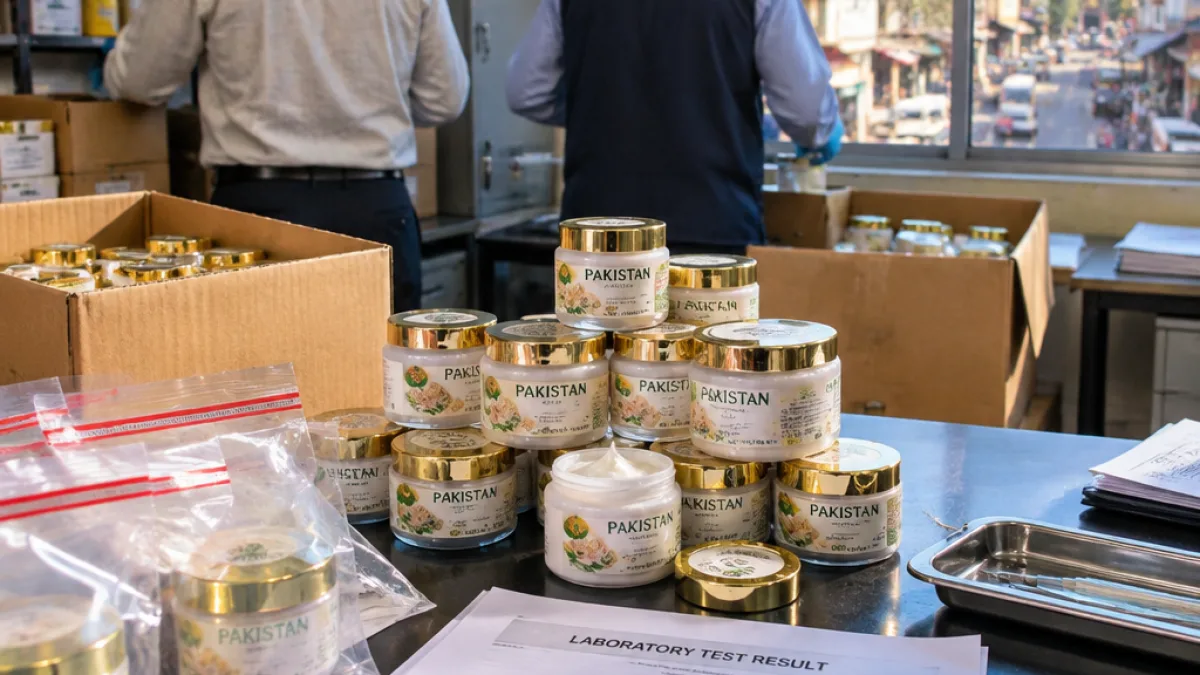
Nanded: Beauty creams labelled as being made in Pakistan and seized during a raid in Maharashtra’s Nanded have been found to contain mercury concentrations as high as 48,453.44 parts per million (PPM)—more than 48,000 times the permitted limit for cosmetics. The government laboratory report also detected hazardous levels of other heavy metals, including arsenic, raising concerns over the health risks posed by their unauthorised sale and use.
The products, estimated to be worth ₹39.69 lakh, were confiscated on July 9 from Afrah Collection, also identified as Afrah Tours and Travels, in the Makkah Galli area of Nanded. Personnel from the Itwara police station carried out the operation with officials of the Food and Drug Administration (FDA). Samples collected during the action were subsequently sent for laboratory analysis.
Laboratory findings
The examination found that two of the creams contained exceptionally high quantities of mercury. The product marketed as Parley 24K Gold Gleam Beauty Cream recorded 48,453.44 PPM of the metal, while Goree Beauty Cream with Lycopene contained 6,924.94 PPM. Under the applicable cosmetic regulations, the permissible mercury level is 1 PPM.
| Product | Mercury detected | Permitted level |
|---|---|---|
| Parley 24K Gold Gleam Beauty Cream | 48,453.44 PPM | 1 PPM |
| Goree Beauty Cream with Lycopene | 6,924.94 PPM | 1 PPM |
The scale of the excess is significant because mercury is not a harmless cosmetic ingredient at such concentrations. Officials said prolonged exposure to excessive mercury and arsenic through beauty products can result in serious skin disorders, damage to the kidneys and neurological complications. The risks may be particularly difficult for consumers to identify because creams are applied directly to the skin and may be used repeatedly over a period of time.
Products carried Urdu and English labels
According to the police, the shop operator, Mohammad Ziauddin Mohammad Wajid, was found in possession of products carrying labels in both Urdu and English and claiming Pakistani origin. The laboratory report has now added a scientific basis to the concerns that led to the seizure, while the case brings the storage and sale of the products under scrutiny.
The action also highlights the difficulty consumers can face when trying to distinguish between legitimate imported cosmetics and products brought into the market without the required approvals. A foreign-origin label by itself does not establish that a product is safe, properly regulated or authorised for sale. In this case, the products were taken for testing only after officials conducted the raid and collected samples.
Case registered under three laws
Police have registered a case under relevant provisions of the Bharatiya Nyaya Sanhita, the Drugs and Cosmetics Act and the Foreign Trade (Development and Regulation) Act. The provisions invoked cover the criminal, regulatory and trade-related aspects of the alleged violations. The laboratory findings are expected to form an important part of the continuing investigation into the consignment and its distribution.
The seized stock was valued at a level that suggests the matter extends beyond an isolated personal-use purchase. However, the available findings do not establish how many customers may have bought or used the creams, nor do they specify the extent of their circulation before the raid. The authorities’ warning is therefore directed at preventing further use and encouraging information about similar products in the market.
What consumers should watch for
Police have appealed to citizens to report counterfeit, unlicensed or suspicious imported cosmetic products. Consumers who encounter creams with unclear labelling, unusual packaging or no reliable regulatory information can assist enforcement agencies by sharing details rather than continuing to use or distribute them.
- Check whether the product carries clear labelling and regulatory information before purchase.
- Do not use a cosmetic that appears counterfeit, unlicensed or suspiciously imported.
- Report the sale of questionable products to the police or the Food and Drug Administration.
- Seek medical advice if prolonged use is followed by skin, neurological or other health problems.
The Nanded findings have renewed attention on the safety of fairness and beauty creams sold through informal channels. The investigation will determine the wider chain behind the seized products, while the test results provide a clear warning about the consequences of applying unverified cosmetics. Until the authorities complete their inquiry, consumers are being urged to treat products of uncertain origin with caution and to alert enforcement agencies about their sale.