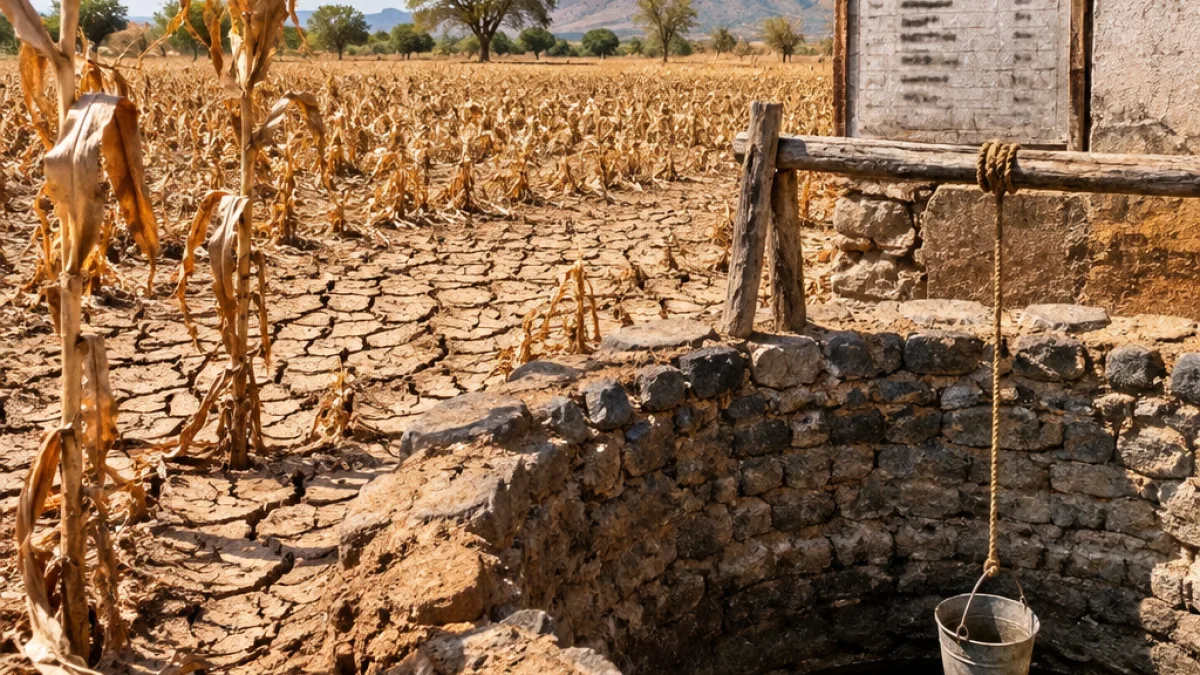
Maharashtra has expanded its drought-affected area to 308 of the state’s 358 talukas, adding Chiplun, Wada, Vikramgad and Dindori to the relief list after concerns over water scarcity and crop losses were raised before the state’s drought-relief committee.
The decision was announced on November 17 by Revenue Minister Chandrashekhar Bawankule, who heads the Cabinet sub-committee on drought relief. The latest additions cover three talukas in the Konkan region and one in Nashik district. The move comes even as the Konkan region is recognised for receiving the highest rainfall in the state annually, underlining the local variation in the current water and crop situation.
Four talukas added to the relief framework
Chiplun, Wada and Vikramgad have been included from Konkan, while Dindori has been added from Nashik district. The government’s decision followed the presentation of 13 proposals at the committee meeting. Of these, four were accepted and incorporated into the drought list.
“The four talukas were added after members at the meeting brought to notice the water scarcity and crop losses faced by farmers in these regions. 13 such proposals were made, four talukas were added to list,” Bawankule said.
Nine other talukas are still being assessed for drought conditions. These include Hatkanangale, Karveer and Gadhinglaj in Kolhapur district, as well as Pen and Mahad in Raigad. Their eventual status will depend on the assessment of the situation presented before the state authorities.
Relief coverage has widened steadily
The latest announcement follows two earlier expansions of the drought list. The government initially identified 265 talukas as drought-affected. In October, another 40 talukas were added, raising the figure to 305. With the four announced this week, the number has reached 308.
| Indicator | Figure |
|---|---|
| Total talukas in Maharashtra | 358 |
| Talukas initially listed | 265 |
| Total after October additions | 305 |
| Current drought-affected total | 308 |
| Additional talukas under assessment | 9 |
For the talukas already notified, the application of Trigger 1 and Trigger 2 makes them eligible for assistance under the Centre’s National Disaster Response Fund guidelines. The designation therefore serves as the basis for accessing specified relief measures, rather than being only an administrative classification.
Students to receive fee relief
One of the stated measures is a complete waiver of examination fees for students in drought-affected talukas. The waiver does not carry an eligibility condition, according to the government’s relief provisions. This applies to students in the talukas covered by the drought declaration and adds an education-related component to the wider agricultural and water-relief response.
Financial assistance for farmers was also discussed at the drought committee meeting. The Agriculture Department has reported that ₹4,701.6 crore has so far been distributed to 94.3 lakh farmers across Maharashtra. The assistance covers farmers in the areas included under the state’s drought-relief process.
Chhatrapati Sambhajinagar division gets largest share
Among the administrative divisions, Chhatrapati Sambhajinagar received ₹1,704.5 crore, the highest amount cited by the Agriculture Department. Nashik followed with assistance of ₹1,001.2 crore. The source did not provide a division-wise break-up for the remaining amount.
- Newly included: Chiplun, Wada, Vikramgad and Dindori.
- Under assessment: Nine talukas, including five named areas in Kolhapur and Raigad.
- Farmer assistance distributed: ₹4,701.6 crore to 94.3 lakh farmers.
- Student support: Full examination-fee waiver in notified drought-hit talukas.
The expansion places nearly 86 per cent of Maharashtra’s talukas within the drought-affected category, based on the current total of 308 out of 358. The latest inclusions also broaden the geographical spread of the notified areas, bringing in talukas from Konkan alongside the already affected parts of Nashik and other divisions.
Officials have not yet announced the outcome of the assessment of the nine additional talukas. For now, the government’s notified relief framework applies to the 308 talukas on the list, while further decisions on the remaining areas will depend on the continuing evaluation of water availability and crop losses.