A small beekeeping experiment begun by an IAS officer in Gangtok has grown into a household practice centred on pollinator protection, sustainable harvesting and self-reliance. Mingma Tempa (M.T.) Sherpa, a 2011-batch IAS officer of the Sikkim cadre, keeps bee boxes in a corner of his home and harvests honey in limited quantities during the year.
The initiative began around 2020, when Sherpa was serving in the Horticulture Department. His official association with horticultural development gave him an opportunity to understand beekeeping and its place within efforts to support agriculture. The experience later prompted him to apply the knowledge at home instead of treating the practice only as an institutional or departmental activity.
From departmental exposure to a home apiary
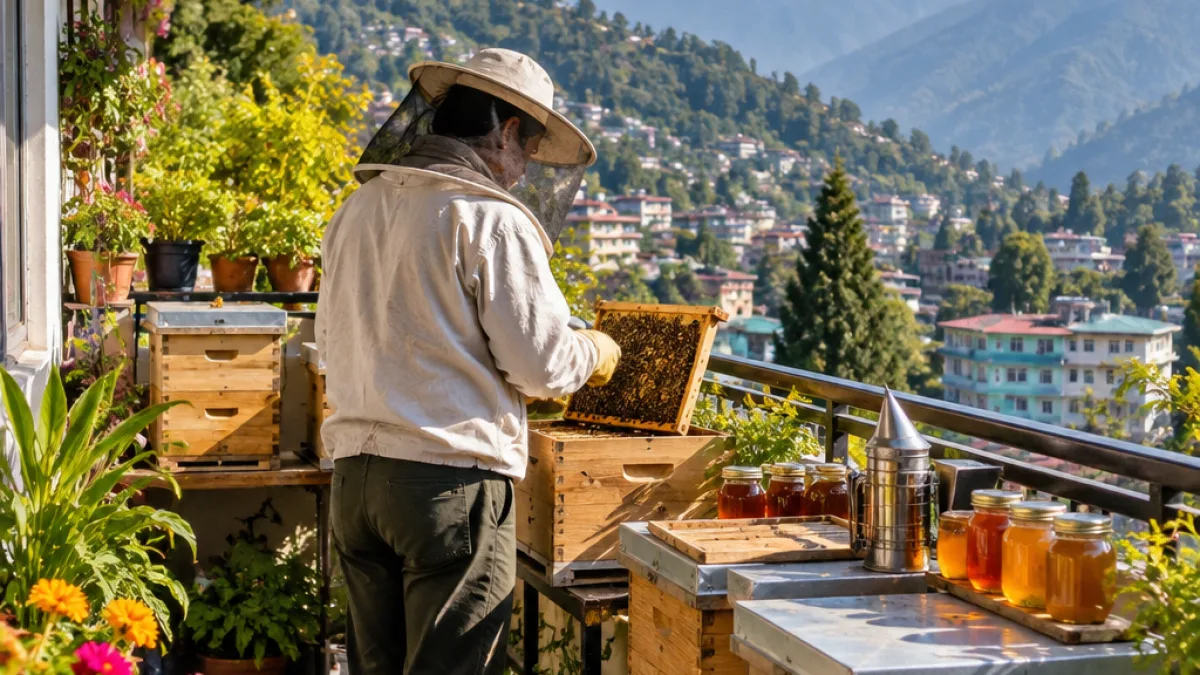
The Gangtok setup uses specially designed boxes placed on the balcony. The arrangement has allowed Sherpa to practise beekeeping in an urban household setting, demonstrating that the activity does not necessarily require a large rural holding or a commercial farm. What started as an experiment has since developed into a continuing personal interest in scientific honey production.
According to the report, the household apiary yields approximately 8 to 10 litres of honey annually. The honey is collected over three harvesting cycles, allowing production to remain modest and managed rather than being pursued on an industrial scale.
| Aspect | Details |
|---|---|
| Location | A home balcony in Gangtok |
| Beginning | Around 2020 |
| Annual output | Approximately 8–10 litres |
| Harvesting pattern | Three cycles each year |
| Primary use | Household consumption |
Conservation is central to the practice
For Sherpa, the value of the activity extends beyond obtaining honey for domestic use. His approach places emphasis on keeping bees safe, limiting harm during extraction and recognising their contribution to pollination and agricultural productivity. That focus gives the small initiative an environmental dimension, particularly in a state where horticulture is an important part of the relationship between communities, land and seasonal cultivation.
The report said Sherpa has adopted scientific methods of beekeeping and is conscious of the need to protect the insects during honey collection. The practice therefore combines production with care: the objective is not simply to remove honey, but to maintain the bee colonies and acknowledge their wider ecological role.
Limited surplus reaches interested buyers
Most of the honey remains within the household. On some occasions, however, surplus has been sold to people interested in purchasing it. The limited sale of excess production does not appear to be the primary purpose of the activity. Instead, it provides an outlet for the quantity that is not required for domestic consumption while keeping the operation small.
- The bee boxes are installed on a residential balcony in Gangtok.
- Production is estimated at 8–10 litres of honey a year.
- Harvesting takes place in three rounds.
- The main emphasis is on careful extraction and bee protection.
- Most of the honey is used at home, with occasional surplus sales.
A practical example of urban sustainability
The initiative offers a local example of how environmental awareness can be incorporated into everyday life. Rather than presenting conservation as an activity separate from household routines, the balcony apiary links it with food production and personal consumption. The scale is small, but the method demonstrates how a technical practice encountered through public service can be adapted for individual use.
It also reflects the connection between horticulture and pollinators. Bees support the reproductive cycle of flowering plants, and their work contributes to agricultural output. By maintaining colonies and reducing damage during harvesting, Sherpa’s approach seeks to preserve that function while producing honey for the family.
Knowledge applied beyond official programmes
The experience began after Sherpa worked with initiatives related to the Horticulture Department. The report described his view that people involved in promoting a practice through government programmes should also be able to understand it through personal experience. His home-based effort has consequently become an example of applying departmental knowledge in a private, manageable setting.
The Gangtok experiment does not claim to replace organised beekeeping or larger horticultural programmes. Its importance lies in showing how a resident can engage with a practice in a controlled way while remaining attentive to ecological safeguards. The output is limited, but the emphasis on method, continuity and protection makes the activity relevant beyond the quantity of honey produced.
Small efforts and wider awareness
Sherpa’s beekeeping practice underlines the role that individual action can play in building awareness about nature conservation. The report said he believes even modest efforts can make a difference. In this case, a corner of a Gangtok home has become a working space where food, horticultural knowledge and environmental responsibility intersect.
The initiative also gives the public a practical view of pollinator conservation: protect the colonies, harvest without unnecessary damage and use the output responsibly. Its contribution is therefore measured not only in litres of honey, but also in the example it sets for sustainable engagement with the natural systems that support agriculture.