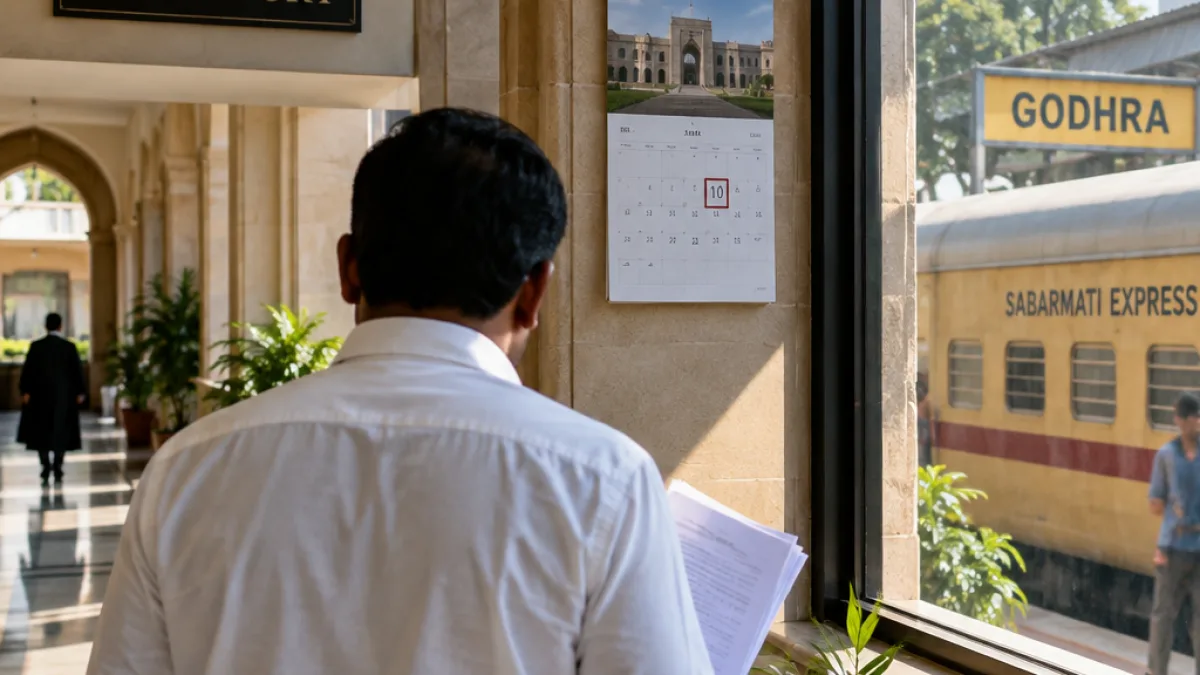
The Gujarat High Court has extended by three weeks the parole granted to seven convicts in the case related to the burning of a coach of the Sabarmati Express at Godhra in 2002. The order keeps the parole arrangement in place until the matter is taken up again on December 10.
The decision concerns seven petitioners who had approached the High Court seeking continuation of the relief granted to them. The proceedings are taking place against the backdrop of pending criminal appeals before the Supreme Court and separate challenges filed by the Gujarat government against the commutation of their death sentences.
Order linked to December hearing
Justice DN Ray, while listing the matter for December 10, directed that the parole leave granted earlier should continue for the additional period. The court also ordered that a report submitted by the Additional Public Prosecutor be placed on record.
The parole leave granted earlier is extended till the said date. The report submitted by the learned APP is ordered to be taken on record.
The extension is a procedural order concerning the period for which the seven petitioners may remain outside prison under parole. It does not conclude the criminal appeals or settle the separate issue of remission, both of which remain part of the wider legal proceedings.
Seven petitioners covered
The petitioners named in the proceedings are Mehbbob Yakub Mitha alias Popa Shaikh, Mehbub Ahmed Yusuf Hasan alias Latiko, Jabir Binyamin Bahera, Ramjani Binyamin Bahera, Sokat Yusuf Ismail Mohan alias Bibino Ghanchi, Siraj Mohammad Abdul Raheman Meda alias Lal and Andwar Mahamad Meda alias Lala Shaikh.
| Aspect | Position recorded in the proceedings |
|---|---|
| Number of petitioners | Seven |
| Latest relief | Parole extended by three weeks |
| Next listing | December 10 |
| Related proceedings | Convicts’ appeals before the Supreme Court and State appeals on sentence commutation |
The case arises from the burning of the Sabarmati Express in Godhra in 2002. In March 2011, a trial court convicted 31 persons. Of these, 11 were awarded the death penalty and 20 received life imprisonment. The same proceedings resulted in the acquittal of 63 other accused.
Death sentences were commuted in 2017
In 2017, the Gujarat High Court altered the sentences imposed on the 11 persons who had been awarded capital punishment, commuting them to life imprisonment. It upheld the life sentences imposed on the other 20 convicted persons. The Supreme Court is now dealing with criminal appeals filed by the convicts against their convictions.
The State government has also filed separate appeals challenging the High Court’s 2017 decision to commute the death sentences. The two sets of proceedings raise distinct questions: the convicts’ appeals challenge their convictions, while the government’s appeals relate to the sentence imposed after the High Court’s intervention.
Remission review also underway
The parole proceedings are also connected with the status of applications seeking remission. During an earlier hearing in July, the State submitted that the competent authority had begun reconsidering the remission pleas after the expiry of one year from the previous order rejecting them.
The High Court had then directed the concerned authority to take an appropriate decision as quickly as possible, preferably within four months. While considering the parole requests, the court also took into account the period of imprisonment already undergone by the petitioners.
The latest extension therefore provides a defined period of continuity while the court awaits the next stage of the proceedings. The December 10 hearing is expected to bring the parole issue back before the bench, with the report already ordered to be taken on record. Any further decision will have to be read alongside the pending Supreme Court appeals, the State’s challenge over sentencing and the remission process being reconsidered by the authorities.
The development keeps the matter within judicial supervision at a time when several legal questions remain open. The convictions have not been set aside by the latest parole order, and the extension itself is limited to the period specified by the High Court.