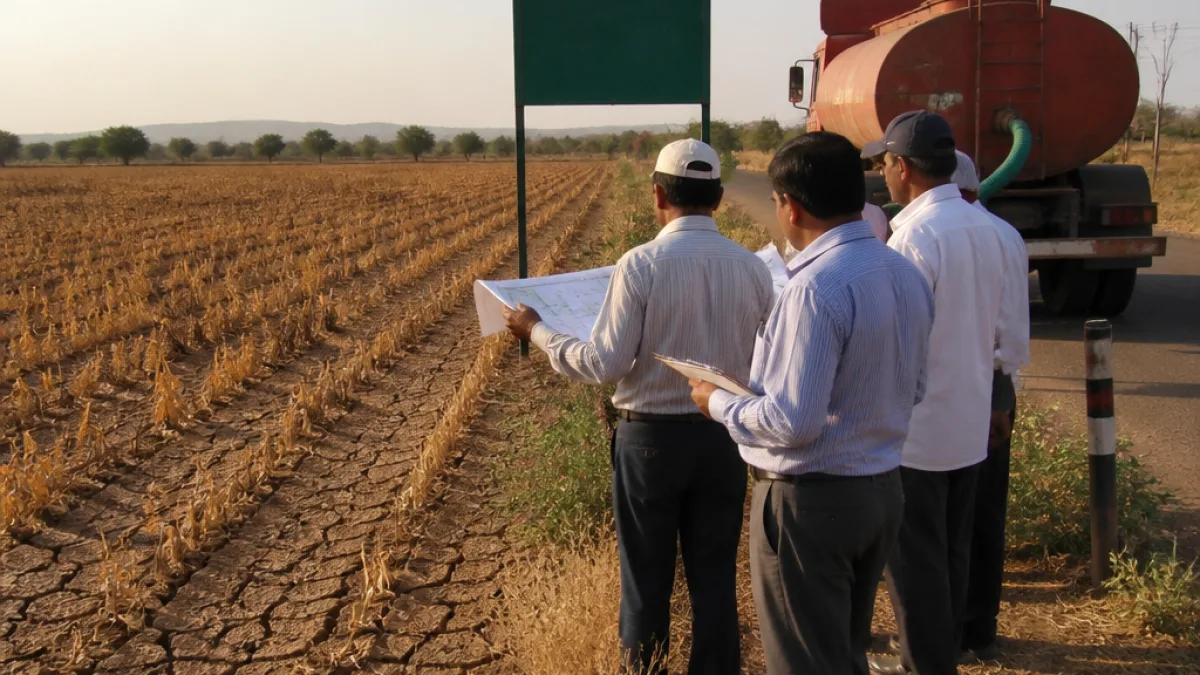
Gandhinagar: The Gujarat government on Monday officially declared Devbhumi Dwarka, Kutch, Porbandar and Jamnagar as drought-hit after these districts recorded substantially deficient rainfall during the monsoon season, Chief Minister Bhupendra Patel said.
Extent of rainfall deficit
As per state data cited by the Chief Minister, Gujarat received 89% of normal seasonal rainfall overall. However, the four districts named for drought relief registered sharply lower figures: Devbhumi Dwarka at 16.5%, Porbandar at 30.9%, Jamnagar at 43.3% and Kutch at 57.6% of their seasonal averages.
| District | Seasonal rainfall received (%) |
|---|---|
| Devbhumi Dwarka | 16.5% |
| Porbandar | 30.9% |
| Jamnagar | 43.3% |
| Kutch | 57.6% |
Relief and rehabilitation measures
The state has invoked the Centre’s 2016 guidelines on drought and the declaration will remain in effect for six months, the Chief Minister said. He announced an immediate relief package aimed at supporting farmers and livestock owners in the affected districts.
- Financial assistance of ₹8,500 per hectare under the State Disaster Response Fund (SDRF) for farmers whose crops have failed, limited to a maximum of two hectares per farmer.
- Subsidised fodder supply at ₹2 per kilogramme, with officials stating there is currently no shortage of fodder stock in the state.
- Provision of 150 days of rural employment under the VB-G RAM G (Viksit Bharat - Guarantee for Rozgar & Ajeevika Mission (Gramin)), to be implemented from 1 November in the affected districts.
- Support of ₹80 per cattle per head for cattle shelters to assist with upkeep.
“The state government will stand with farmers and provide all assistance possible to them in these difficult times,”
State officials noted that several talukas within the districts experienced especially severe deficits. In Devbhumi Dwarka, Kalyanpur taluka received only 8% of expected seasonal rains, while Khambhaliya recorded 15%. In Porbandar talukas the shortfall ranged around 19–20%. In Kutch, Abdasa received 38%, Lakhpat 48% and Nakhatrana 47% of normal rainfall, meaning these talukas had received less than half the seasonal average.
Local impact and implementation challenges
The declaration activates administrative and financial measures aimed at immediate relief, agricultural rehabilitation and livelihood support. For farmers, the SDRF aid and employment guarantee are intended to provide short-term cash relief and mitigate distress migration. Subsidised fodder and support to cattle shelters are designed to protect livestock — a critical asset for many rural households in Saurashtra and Kutch.
Implementation will depend on district administrations and line departments quickly identifying eligible farmers, assessing crop loss and ensuring timely disbursal of benefits. The VB-G RAM G employment programme requires mobilisation of local works and adequate staffing at Gram Panchayat and block levels to process and record job cards and payments from 1 November.
Context and historical perspective
This is the first time since 2018 that multiple districts in Gujarat have been formally declared drought-hit. In 2018, the state had announced drought status for 51 talukas, mostly in north Gujarat and Saurashtra. The current declaration is narrower in geographic scope but concentrated in coastal and western districts that grow significant rainfed crops and depend on livestock.
Officials emphasised the action follows standard central guidelines and will be in force for six months. Local administration teams in the affected districts have been instructed to expedite relief work, distribute subsidised fodder and prepare employment projects under the rural guarantee scheme.
Farmers and stakeholders in the four districts are likely to seek rapid clarity on eligibility criteria and timelines for SDRF claims, while non-government actors such as co-operatives and private suppliers may play a role in feed distribution and labour mobilisation. Monitoring by state departments will be crucial to ensure relief reaches intended beneficiaries without undue delay.
Bhavesh Dholakia | Correspondent, Gujarat