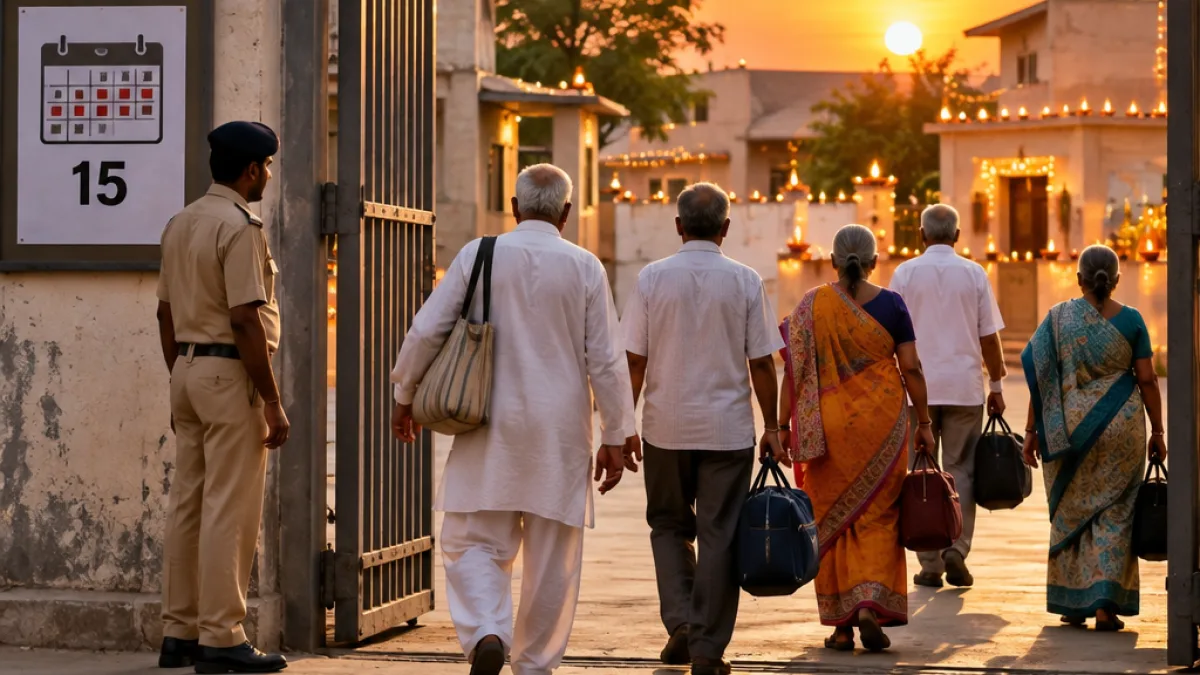
Gandhinagar: The Gujarat government has approved 15 days of parole for 143 eligible prisoners across the state ahead of Diwali, allowing them to return home temporarily and spend the festival with their families. The parole period will begin on Dhanteras, November 6, 2026, according to the Gujarat Prisons and Correctional Department.
The beneficiaries comprise 103 male prisoners aged 60 years or above and 40 women prisoners. The annual release is part of the state’s prisoner-welfare and prison-reform measures, with eligibility determined under government rules. The arrangement has been followed at Diwali since 2003, making it a continuing seasonal parole practice rather than a one-time concession.
The decision provides temporary family access to an identified group of inmates while retaining exclusions for categories considered ineligible under the rules. The programme is particularly significant for older prisoners and women in custody, for whom a short period with family members coincides with one of Gujarat’s most important festival periods.
Who is covered by the decision
| Category | Number | Eligibility basis |
|---|---|---|
| Male prisoners | 103 | Aged 60 years or above |
| Women prisoners | 40 | Eligible under state rules |
| Total | 143 | Parole from November 6 for 15 days |
Deputy Chief Minister Harsh Sanghavi has guided the initiative, while Dr K L N Rao, Director General of Police for the Gujarat Prisons and Correctional Department, outlined the restrictions governing the release. The parole applies only to prisoners who meet the prescribed conditions and does not extend to all inmates serving sentences in the state’s jails.
Prisoners involved in serious offences are outside the scope of the Diwali parole. The exclusions include inmates whose appeals are pending before the High Court, non-resident Indian prisoners and prisoners belonging to other states. The rules also bar several groups convicted or accused under specified security and narcotics-related laws.
Categories excluded under the rules
- Prisoners serving sentences under the Narcotic Drugs and Psychotropic Substances Act.
- Those covered by the Terrorist and Disruptive Activities (Prevention) Act or the Prevention of Terrorism Act.
- Prisoners involved in terrorist activity or conduct considered harmful to the state’s economy.
- Inmates convicted of more than one offence.
- Those convicted in serious and anti-social cases, including rape, kidnapping, robbery, dacoity, theft or extortion.
- Prisoners against whom preventive detention orders remain in force.
The exclusions establish a clear dividing line between the welfare measure and cases involving serious criminal, security or public-order concerns. They also mean that the final number of releases depends not simply on the total prison population but on age, gender, conviction details, legal status and the nature of the offence.
For families, the parole period offers an opportunity for reunion during the festival season without ending the prisoner’s sentence. The temporary nature of the release is central to the arrangement: eligible prisoners are permitted to spend the specified period outside jail and are expected to remain subject to the conditions attached to parole.
The state has not provided a district-wise distribution of the 143 prisoners in the information available. It has also not disclosed the individual names of those being released or the administrative schedule for their return. The announcement, however, places the start of the exercise six days after November 1 and fixes the duration at 15 days.
Gujarat has maintained prohibition on alcohol, but the Diwali parole decision concerns prison administration and family contact rather than any relaxation of criminal or regulatory laws. The department’s stated approach combines a limited release benefit for eligible prisoners with continued restrictions on inmates linked to serious offences and specified legal provisions.
As the releases begin on November 6, jail authorities will have to implement the approved list within the eligibility framework laid down by the state. For the 143 prisoners covered, the order means a temporary return to their families during Diwali; for those excluded, their sentences and custody arrangements will continue under the applicable rules.