A rail connection between Quebec City and Toronto could be significantly improved by modernizing the existing corridor rather than building the high-speed line now being developed by the state-owned company Alto, according to a study obtained by The Canadian Press.
The analysis, prepared by Vision Transport experts with the Union of Agricultural Producers, examines whether existing railway infrastructure could deliver a faster and more affordable service. Its authors say the approach would have virtually no impact on the territory and would cost only a fraction of the amount contemplated for Alto’s project, although the journey would remain longer than the proposed high-speed connection.
The study was prepared by Vincent Duguay, a master’s student in research at the National School of Public Administration, and Pierre DuSablon, a longtime railway-industry specialist. It considers two possible service patterns: one retaining the 22 stations currently served by Via Rail, and another stopping only in the largest cities to create a faster express route.
Time savings without a new corridor
At present, a train trip from Quebec City to Toronto takes about eight hours and 40 minutes. That is slightly longer than the estimated eight-hour-and-20-minute drive by car. Under the study’s proposal, a modernized service that continued to call at intermediate points such as Saint-Hyacinthe or Drummondville could cut the journey to six hours and 40 minutes.
An express version, with stops limited to major cities, could reduce the trip to five hours and 50 minutes. That would still be slower than Alto’s proposed high-speed service, which promises a four-hour-and-30-minute connection between the Old Capital and Toronto, but the study’s authors argue that the train becomes more attractive when it is clearly faster than driving.
| Service option | Estimated Quebec City-Toronto time |
|---|---|
| Existing rail service | 8 hours 40 minutes |
| Modernized route with intermediate stops | 6 hours 40 minutes |
| Modernized express route | 5 hours 50 minutes |
| Alto high-speed proposal | 4 hours 30 minutes |
Work focused on the existing railway
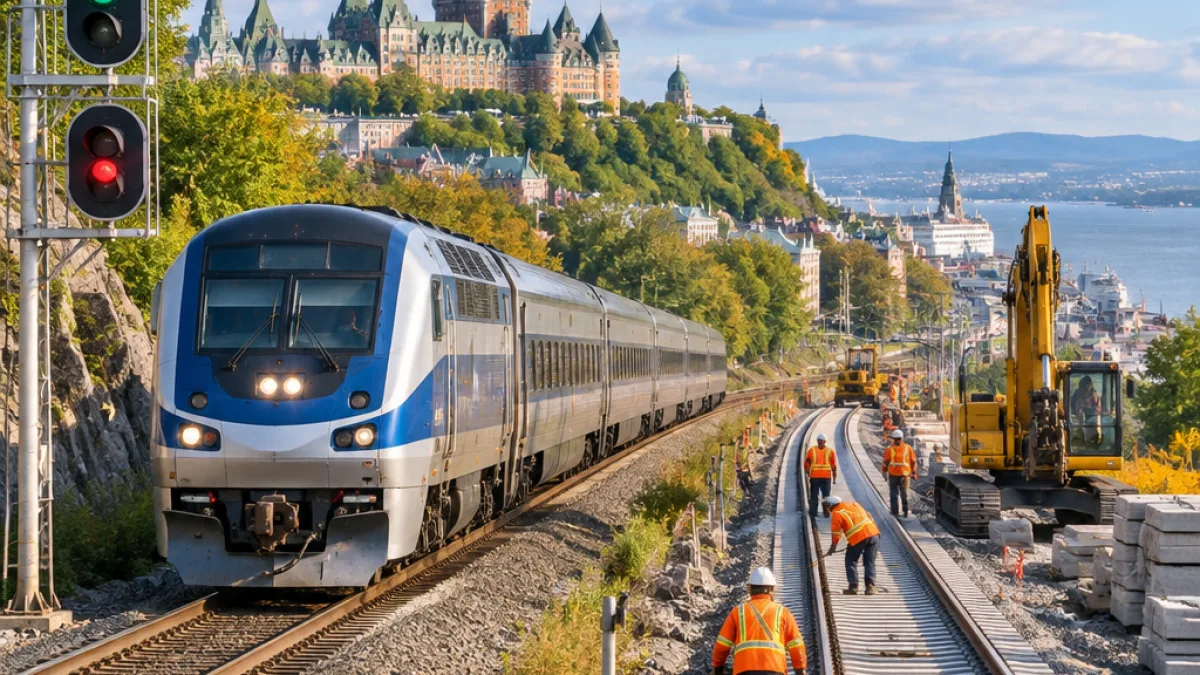
The proposed modernization plan is organized around five areas of intervention. The most expensive and labour-intensive measure identified in the available study material would be to add a second track along the entire route. At present, 37 per cent of the corridor is single-track, meaning passenger trains can be required to wait on sidings while freight trains pass.
That operating constraint is familiar to regular rail users and is central to the study’s argument: improvements to the current corridor could produce meaningful time savings while avoiding the construction of a separate route. The proposal therefore places the debate partly on a choice between speed and scale—whether to pursue Alto’s faster service or a less ambitious connection that could rely on infrastructure already crossing the region.
- Existing service: roughly 8 hours 40 minutes between Quebec City and Toronto.
- Modernized service: six hours 40 minutes with intermediate stations, or five hours 50 minutes on an express route.
- Main infrastructure measure identified: doubling the tracks along the corridor, 37 per cent of which is currently single-track.
For Quebec City, the question is not simply whether a faster train would shorten a trip. The competing approaches also raise questions about public investment, the use of agricultural and other land, and the balance between a transformational new railway and upgrades to an established route. The study’s conclusions are expected to add another perspective to the ongoing discussion over how the city should be connected with major centres in Quebec and Ontario.
The analysis does not present the modernized corridor as faster than Alto’s plan. Instead, it argues that a somewhat slower service could still achieve the central objective of making rail competitive with the car, while requiring less territorial intervention and a smaller financial commitment. Its release places those tradeoffs before residents and decision-makers as work continues on the proposed high-speed connection.