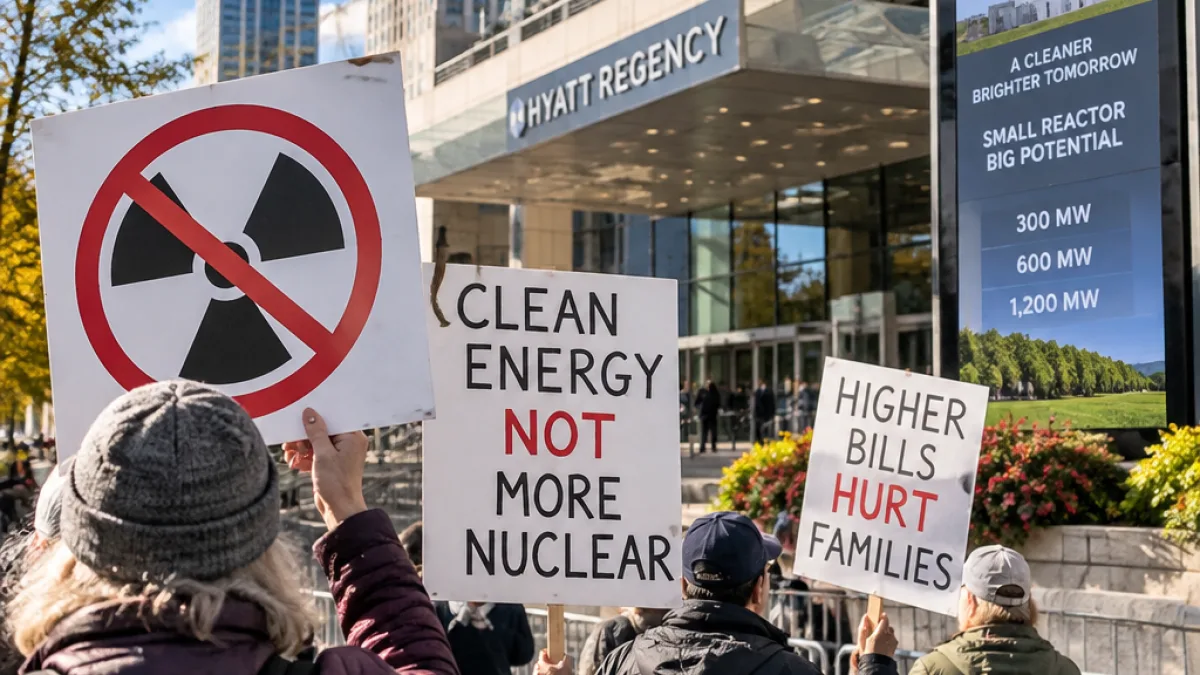
ROCHESTER, N.Y. — New York state officials used a Rochester summit Wednesday to lay out an ambitious nuclear-energy strategy, while protesters outside the meeting challenged the premise that new reactors will deliver more affordable power. The competing messages placed the region at the center of a statewide argument over how New York will meet rising electricity needs and what communities may be asked to accept in return.
The gathering at the Hyatt Regency on East Main Street brought together state agency leaders, federal officials, nuclear specialists, labor representatives and environmental advocates. During the second day of the summit, state leaders released a master plan describing how agencies intend to assist with the safe and timely development of advanced nuclear plants in upstate New York. The document calls for 5 gigawatts of additional nuclear capacity.
Eastman Business Park remains in the conversation
Rochester’s most direct connection to the proposal is Eastman Business Park, one of eight locations identified by the state as a possible site for new reactors. RED Rochester, which operates the park’s power plant, has indicated that it is willing to be considered and appears on the New York Power Authority’s list of potential locations. The prospect has significance beyond the energy sector because the park is home to businesses whose operations require dependable electricity.
Gov. Kathy Hochul previously instructed the state power authority to seek communities and sites willing to consider nuclear development. At the summit, she framed additional generation as a condition for retaining industrial opportunities in New York rather than allowing them to move elsewhere.
“They don’t run on dreams — they need to be powered. They need a lot of electricity. So if we don’t increase New York’s electricity supply in a major way, we’re going to risk losing our opportunities. They can go elsewhere, but we want them here,” Hochul said.
| Energy facility or target | Capacity or status |
|---|---|
| State nuclear goal | 5 gigawatts of new capacity |
| State target referenced at summit | 1 gigawatt from nuclear power |
| Possible Eastman reactor contribution | Up to 300 megawatts |
| Ginna Nuclear Power Plant | About 580 megawatts |
A small reactor at Eastman Business Park could provide as much as 300 megawatts toward the state’s one-gigawatt nuclear objective, according to information presented in connection with the plan. That figure would not satisfy the entire target on its own. The Rochester area already has nuclear-generation experience: the Ginna Nuclear Power Plant in Wayne County has operated since 1970 and produces roughly 580 megawatts, enough to serve about 400,000 homes.
Protesters challenge the cost argument
Outside the summit, grassroots organizations organized a demonstration and introduced a campaign titled “We Won’t Pay for Hochul’s Nuclear Bills.” Organizers told News10NBC that they do not believe nuclear power is the answer to reducing household energy bills. Their presence underscored that the state’s plan faces resistance even as officials, business interests and labor representatives describe expanded generation as essential to New York’s economic future.
- Supporters’ case: More electricity could help preserve industrial opportunities and provide power for businesses that need reliable supply.
- Opponents’ concern: New nuclear construction could impose costs on residents without guaranteeing lower energy bills.
- Rochester’s position: Eastman Business Park is among the sites under consideration, while Ginna continues operating in neighboring Wayne County.
The debate now moves beyond the summit’s meeting rooms. The state plan establishes an intended direction, but the source material does not identify a final reactor site or announce construction at Eastman Business Park. For Rochester, that distinction matters: being listed as a possible location places the region in the path of a major policy discussion, not at the conclusion of one. The questions raised in and around the Hyatt Regency — how new nuclear facilities would be financed, how safety would be managed and whether customers would see relief on their bills — remain central to the public argument over New York’s energy future.