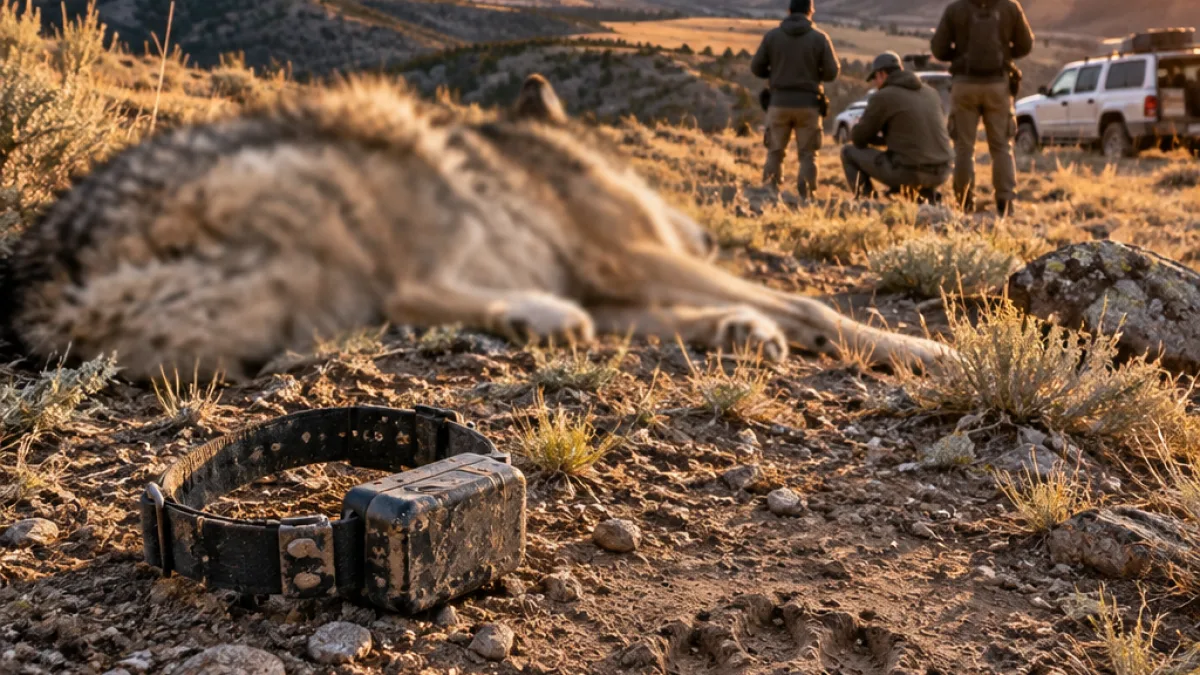
A long-ranging wolf is dead
A female gray wolf relocated to Colorado from Canada has died in Utah, prompting an investigation by federal and state wildlife agencies. Colorado Parks and Wildlife said the animal, identified as wolf 2516, was one of the wolves transported from British Columbia to Colorado in January 2025.
The agency said it received a mortality alert on Nov. 7. The alert notified officials that the wolf had died, but the circumstances surrounding the death were not immediately known. Colorado Parks and Wildlife confirmed that the death occurred in Utah and said no additional details were available.
The U.S. Fish and Wildlife Service will lead the investigation into what happened, working with Colorado Parks and Wildlife and Utah agencies responsible for wildlife resources and law enforcement. The involvement of authorities in both states reflects the animal’s movements and the fact that the death occurred outside Colorado.
A journey across several states
According to Colorado Parks and Wildlife, wolf 2516 covered about 9,000 miles on her own during an 18-month period. Her travels took her across Colorado and into neighboring states before she reached Utah, illustrating how difficult it can be to track a wide-ranging animal after it leaves the area where it was initially released.
That movement also gives the case significance beyond a single animal. A wolf that crosses state lines can become subject to different jurisdictions, investigative responsibilities and wildlife-management systems. In this case, officials from Colorado, Utah and the federal government are coordinating because the animal’s final location was in Utah while her history is tied to Colorado’s relocation effort.
What officials have confirmed
| Detail | Information released |
|---|---|
| Animal | Female gray wolf, identified as 2516 |
| Origin | British Columbia, Canada |
| Arrival in Colorado | January 2025 |
| Distance traveled | About 9,000 miles |
| Death location | Utah |
| Cause | Unknown |
The agencies have not announced how wolf 2516 died. That distinction is important: the available information confirms the mortality and the location, but it does not identify whether the death resulted from natural causes, an accident, human activity or another circumstance. Until investigators release additional findings, any conclusion about the cause would be speculative.
Why the investigation matters
Wildlife mortality investigations can establish facts that are important for management decisions, particularly when an animal is part of a state-coordinated effort. Here, officials will need to determine what evidence is available in Utah and what information can be assembled from the wolf’s movements through Colorado and other states.
The case also connects environmental policy with the practical geography of the West. Wolves do not remain within political boundaries, and their movements can span large distances over time. That means a conservation action taken in Colorado can produce consequences for communities, land managers and agencies elsewhere. It also means responsibility for understanding an animal’s death may be shared among multiple jurisdictions.
Information remains limited
Colorado Parks and Wildlife said there were no further details to provide at this time. The agency’s statement leaves several questions unanswered, including the precise location in Utah, the condition of the animal when it was found and whether investigators have identified evidence pointing to a particular cause.
Those questions are now part of the federal and state review. Until that work is complete, the confirmed account is narrow but consequential: a female gray wolf brought to Colorado from British Columbia traveled roughly 9,000 miles across the region and died in Utah after approximately 18 months of movement. The U.S. Fish and Wildlife Service, Colorado Parks and Wildlife and Utah authorities are expected to determine what happened and whether additional information can be made public.