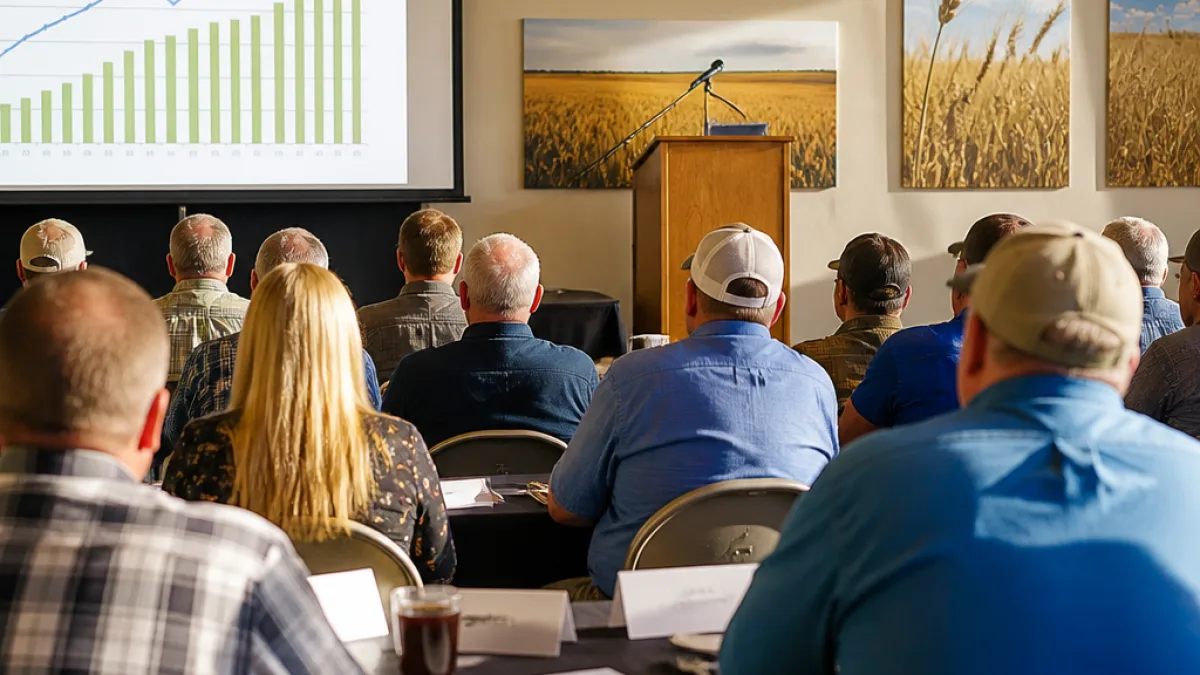
JAMESTOWN — Farm producers with high debt levels are the most exposed to financial strain in North Dakota's current agricultural economy, the head of the North Dakota Farmers Union told a gathering of local agribusiness leaders Tuesday.
Differences from the 1980s, but shared vulnerabilities
Speaking at the Jamestown Area Chamber of Commerce 2026 AgEnergy Luncheon at Farmers Union headquarters, Matt Perdue said the present environment bears some resemblance to the agricultural downturn of the early 1980s — but with important distinctions that change which operators are most at risk.
Perdue noted that while interest rates have risen in recent years, they remain well below the extreme levels that characterized the 1980s. He pointed to Farm Credit Administration and U.S. Department of Agriculture analyses that link the earlier crisis to inflation-driven rate spikes, with many operating loans topping 20% in that era. That episode also featured a sharp decline in land values as collateral values collapsed.
“The challenges are different,” Perdue said. “We have lower interest rates now and higher asset values.”
That combination — elevated land prices and substantially lower peak borrowing costs than in the 1980s — affords more breathing room for many established producers. However, Perdue warned, operators who entered farming recently or who expanded aggressively and financed that growth are vulnerable if margins tighten or interest rates rise further.
Who is most at risk
Perdue highlighted two groups in particular: new farmers building a business and producers who pursued rapid expansion financed by debt. Those operations tend to carry a high debt-to-asset ratio, meaning a smaller change in revenue or asset values can push cash flow into negative territory.
- New farmers acquiring land, equipment and inputs while carrying start-up debt.
- Aggressive operators who continuously expanded acreage and machinery using borrowed funds.
- Producers heavily reliant on variable incomes or single commodities when global demand softens.
“For a farmer with a high debt load, it might feel like the 1980s already,” Perdue said. He added that while many operators are reacting with belt-tightening measures, others are still assessing how to operate if conditions deteriorate into 2027.
Why land values matter
Land values remain a central buffer in today’s farm finance structure. During the 1980s, falling land prices eroded the primary collateral most farms used to secure loans, forcing lenders into write-downs and prompting forced sales. Perdue cautioned that if land prices begin to decline materially, the current situation could begin to resemble past crises more closely.
| Early 1980s | 2026 (current) | |
|---|---|---|
| Typical peak operating loan rates | ~20%+ | Well below 20% |
| Land values | Collapsed during crisis | Remain elevated |
The table above summarizes the broad contrast Perdue emphasized: borrowing costs are lower now than during the worst of the earlier crisis, and land values have stayed higher — factors that cushion many balance sheets but also create a potential vulnerability if those values reverse.
Practical implications for local producers and lenders
Perdue’s remarks carry immediate implications for producers, rural communities and lenders across North Dakota. Farmers with thin margins or heavy short-term debt may need to rework budgets, delay nonessential capital purchases and consider hedging strategies to manage price risk. Lenders and local banks, which hold much of the regional ag debt, will be watching cash-flow metrics and collateral values closely.
Perdue said some operators are already trimming costs and preparing for a tougher 2027. He did not offer specific policy prescriptions at the luncheon, but his emphasis on financial resilience suggests that cooperative extension services, local lenders and farm organizations will need to prioritize counseling and risk-management tools for vulnerable operations.
As North Dakota’s farm economy navigates higher input costs and global market uncertainty, the state’s fiscal health will increasingly hinge on how many producers can withstand tighter margins without forced asset sales. For now, higher land values and lower peak interest rates distinguish today’s environment from the 1980s — but the margin for error is narrower for heavily leveraged farms.