Lucknow: With crowds expected at riverbanks, ponds and other water bodies across Uttar Pradesh, Chief Minister Yogi Adityanath has ordered district administrations to leave no gap in arrangements for Chhath Mahaparva, placing devotee safety, sanitation and crowd control at the centre of preparations.
Chairing a review meeting through video conferencing on Friday, the Chief Minister asked officials to finish arrangements in advance, particularly in districts where large gatherings are expected. The instructions come just ahead of the festival’s key rituals, when devotees will assemble at ghats for offerings to the setting and rising Sun.
Districts specifically identified for heightened attention include Varanasi, Gorakhpur, Ballia, Azamgarh, Ghazipur, Lucknow, Ghaziabad, Basti and Kanpur Nagar. The directions cover not only major riverfront locations but also ponds and other local water bodies that draw devotees during the four-day observance.
Safety checks ordered at every major venue
The Chief Minister directed officials to personally inspect prominent ghats and assess conditions before devotees arrive. Water levels and depth at vulnerable points are to be examined, followed by the installation of sturdy barricades and warning boards wherever necessary.
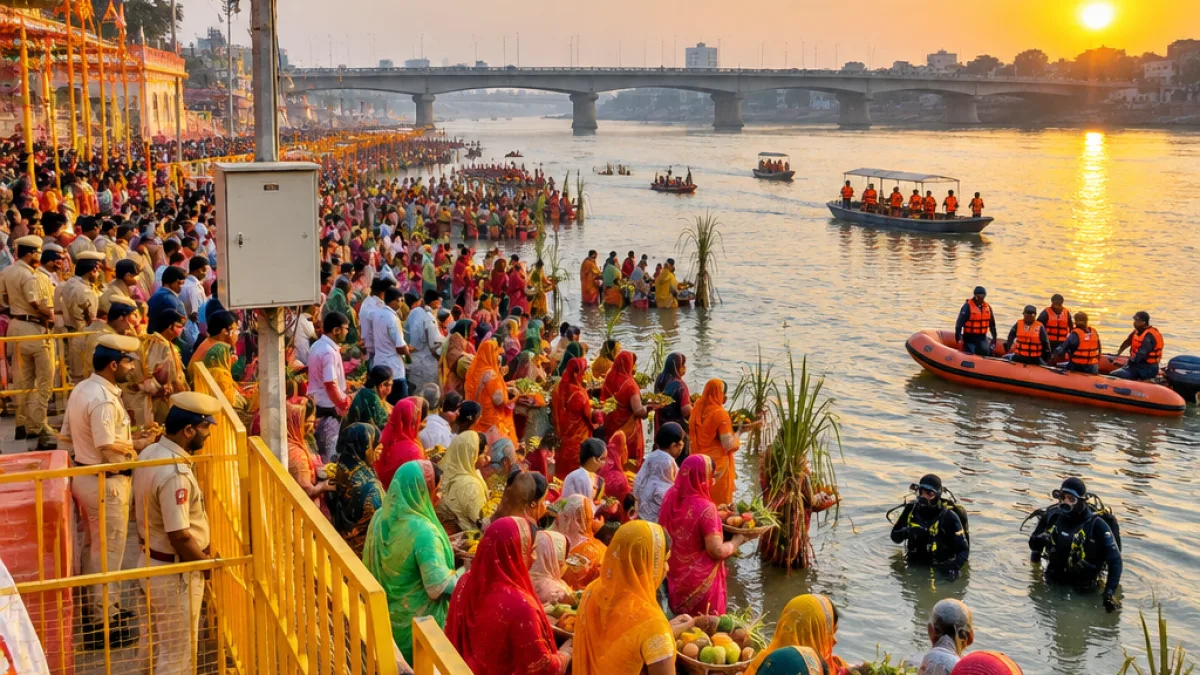
The safety plan also includes the deployment of trained divers, boats and water police personnel. These teams are intended to respond to emergencies and keep watch over areas where devotees may enter or stand close to the water. The administration has also been asked to use CCTV cameras and public-address systems to maintain surveillance and manage movement at crowded sites.
“Adequate numbers of trained divers, boats and water police personnel must be deployed to prevent accidents. CCTV cameras and public address systems should also be installed for continuous surveillance and crowd management,” the Chief Minister said.
The emphasis on water safety is significant because the principal Chhath rituals take place at the edge of rivers, ponds and other water bodies. Barricading, clear warnings and visible supervision are therefore expected to form the first line of protection as devotees gather for evening and morning offerings.
Basic facilities for devotees
Adityanath also instructed officials to ensure that the approach to ghats is clean and usable. The list of essential facilities includes adequate lighting, accessible roads, drinking water, toilets and changing rooms for women. These arrangements are to be checked at the venue level rather than left to last-minute execution.
Cleanliness has been given a separate focus in the preparations. The Chief Minister described Chhath as a festival associated with faith, discipline, purity and gratitude towards nature, and asked officials to ensure that the locations where rituals are performed remain orderly and clean throughout the observance.
- Inspect ghats, ponds, rivers and other water bodies before the gatherings.
- Install barricades and danger warnings at vulnerable stretches.
- Position divers, boats, water police and adequate police personnel.
- Provide lighting, drinking water, toilets, roads and women’s changing facilities.
- Use CCTV systems, public-address equipment and district control rooms for coordination.
Focus on women, children and elderly devotees
The review placed particular emphasis on groups that may need additional assistance in dense crowds, including women, children and senior citizens. The Chief Minister directed that sufficient police personnel, including women officers, be posted at important ghats.
He also asked police leadership to ensure that personnel approach their responsibilities with restraint and sensitivity. The instruction seeks to combine firm crowd management with a cooperative public-facing approach, especially at points where devotees may require guidance or assistance.
“Police personnel should be counselled and encouraged to discharge their duties with restraint, sensitivity and a cooperative approach,” Adityanath directed.
Two key ritual days
| Date | Festival activity | Administrative priority |
|---|---|---|
| November 15 | Offerings to the setting Sun | Evening crowd control, lighting and water-safety measures |
| November 16 | Offerings to the rising Sun; conclusion of the festival | Early-morning surveillance, access and emergency readiness |
According to the review details, devotees will offer arghya to the setting Sun on November 15, while the festival will conclude on November 16 with offerings to the rising Sun. The two occasions will require arrangements to remain functional across evening and early-morning hours, when large numbers may arrive within a short period.
Adityanath further called for district-level control rooms and effective coordination between the departments involved in the arrangements. The aim is to ensure that information about crowd movement, water-related risks and urgent requirements can be handled through a coordinated administrative response.
For district administrations, the immediate task is to translate the instructions into checks at each identified venue before the first major gathering. The Chief Minister’s message was clear: the scale of the festival cannot dilute attention to basic amenities or safety, and no compromise should be made where devotees assemble to observe Chhath.