GORAKHPUR: Uttar Pradesh Chief Minister Yogi Adityanath on Thursday turned a political challenge over Ayodhya into an offer of a direct contest, saying he would also file his nomination from the constituency if Samajwadi Party chief Akhilesh Yadav did so.
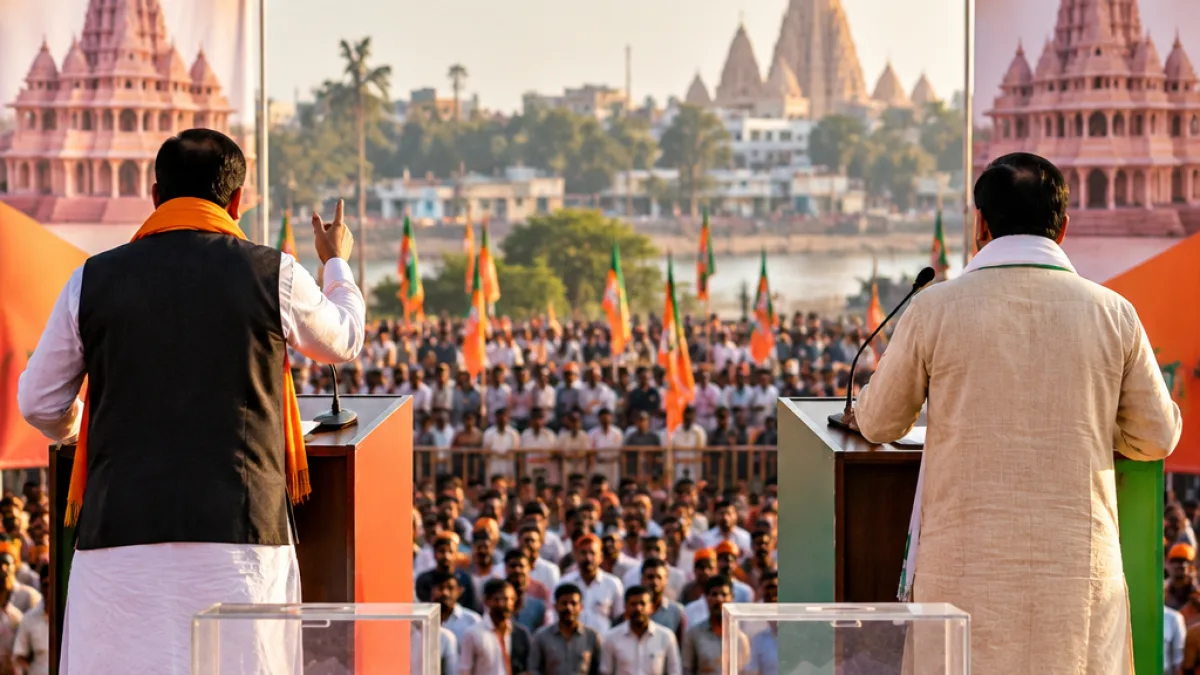
Speaking at a public rally in Gorakhpur, Adityanath responded to Yadav’s reported challenge with an invitation for a face-to-face electoral battle. The exchange places Ayodhya at the centre of a fresh political confrontation involving the state’s ruling Bharatiya Janata Party and its principal opposition force.
“If you file your nomination from there, I will also file my nomination. Let there be a direct, face-to-face contest,” Adityanath said.
The Chief Minister also questioned Yadav’s willingness to fight an election directly, alleging that the Samajwadi Party leader did not have the courage to contest head-on. He used the language of an aggressive campaign speech, contrasting what he described as direct political confrontation with attacks carried out from behind.
A sharper contest over Ayodhya
Although the statement was conditional on Yadav filing his nomination from Ayodhya, it immediately raised the political temperature around the constituency. Adityanath’s remarks were not framed as a routine criticism of the opposition; they amounted to a public offer to enter the same contest if the Samajwadi Party chief chose to do so.
The proposed contest would bring two of Uttar Pradesh’s most prominent political figures into a single electoral arena. Adityanath is the Chief Minister, while Yadav heads the Samajwadi Party. The Chief Minister’s formulation, however, remained tied to Yadav’s decision and did not announce an independent candidature from Ayodhya.
| Political issue | Position stated in the rally |
|---|---|
| Ayodhya contest | Adityanath said he would file his nomination if Yadav contested there |
| Nature of challenge | A direct, face-to-face electoral contest |
| Opposition criticism | Allegations concerning mafia influence, employment and public safety |
Attack on Samajwadi Party record
Adityanath used the rally to broaden his attack beyond the proposed contest. He accused the Samajwadi Party of depending on mafia elements, obstructing employment opportunities for young people and putting the safety of women and traders at risk in Uttar Pradesh.
He further alleged that the party’s politics had been associated with hooliganism, anarchy, riots and curfews. These accusations formed the wider political frame for his challenge to Yadav, with the Chief Minister presenting law and order as a central dividing line between his government and the Samajwadi Party.
“These are the people who trampled Uttar Pradesh on the strength of the mafia, sabotaged youth employment, and endangered the safety of our daughters and traders,” he said.
The remarks also targeted the concerns of several groups identified in the speech: young people seeking employment, women, traders and residents affected by criminal activity. Adityanath said the Samajwadi Party had betrayed the public and relied on what he described as mafia support.
Warning to criminals
The Chief Minister coupled the political attack with a warning to those involved in criminal activity. He said anyone attempting to indulge in “mafiagiri” would face firm action under the law and claimed that his government had already curbed the influence of goons and mafias.
Adityanath said the government was preparing to take further action against such elements. His message was aimed at reinforcing the law-and-order narrative that he used against the Samajwadi Party, while also signalling that criminal conduct would invite action regardless of political affiliation.
“If anyone tries to indulge in mafiagiri, it will not take long to reduce that mafia to dust,” Adityanath said.
The Chief Minister also used a proverb to argue that those he described as goons and mafias could not be reformed without the force of law. He said his government had already acted against their influence and was preparing to “tighten the noose” again.
What the statement means politically
The Ayodhya challenge gives the opposition’s criticism and the ruling side’s response a clear electoral shape. Instead of remaining an exchange of claims, the issue has been presented as a possible contest between the two leaders themselves. Any such contest would carry significance beyond the campaign in one constituency because of the stature of both politicians and the broader political weight of Ayodhya.
- Adityanath linked his possible candidature to Yadav contesting from Ayodhya.
- He described the proposed contest as direct and face-to-face.
- His rally speech combined the electoral challenge with attacks on the Samajwadi Party over crime, employment and public safety.
For now, the Chief Minister’s statement remains a conditional offer rather than a formal announcement of candidature. The next political move rests with Yadav, whose reported challenge prompted the response. Until that decision is made, the exchange stands as a high-profile confrontation in Uttar Pradesh politics, with Ayodhya emerging as its proposed stage.