Hazard assessment along proposed corridor
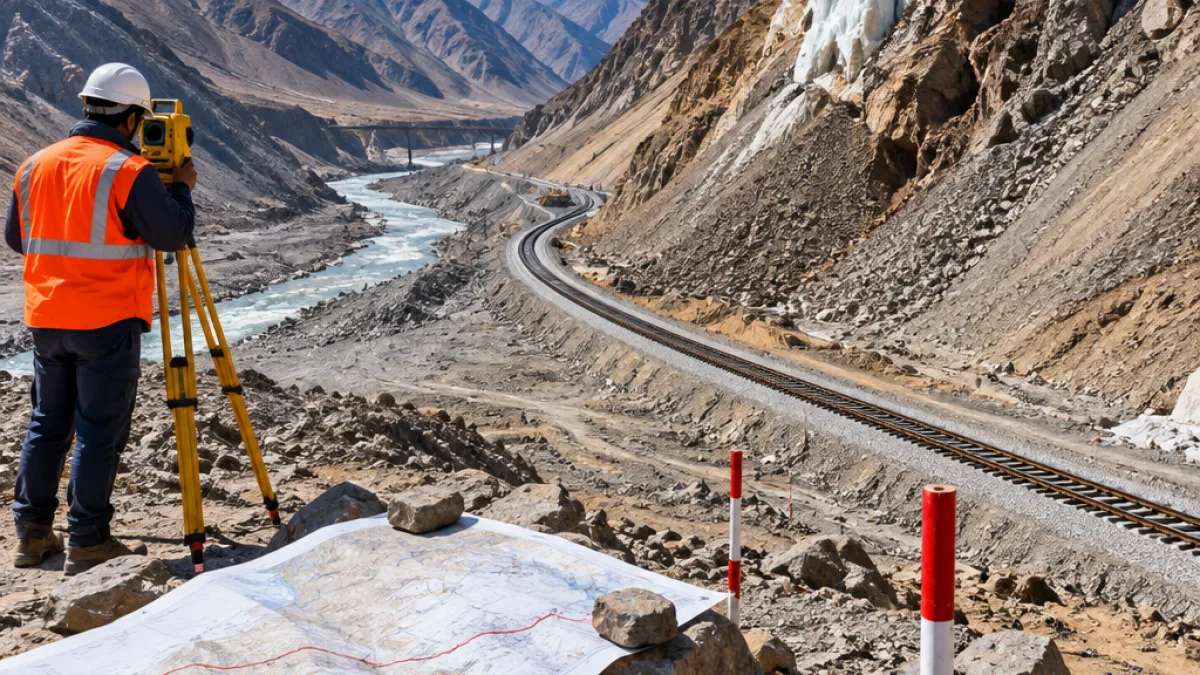
Nearly 60 per cent of the proposed 275-km Manali-Leh strategic railway falls within areas assessed as having moderate to very high susceptibility to natural hazards, according to a new study. The findings underline the need for extensive ground investigations before construction of a rail link through one of the most difficult and environmentally sensitive mountain regions connected to Leh.
The assessment places 7.96 per cent of the study area in the very high susceptibility category, while 20.28 per cent is classified as high susceptibility and 29.32 per cent as moderate susceptibility. The remaining 42.44 per cent falls within low and very low susceptibility zones. Researchers said the distribution indicated that a substantial part of the alignment would pass through terrain where construction and long-term operation could face geological and climate-related risks.
“The results suggest that a significant portion of the railway line will pass through moderate to high hazard-prone regions, which emphasizes the need for detailed geotechnical and cryospheric investigation before construction,” the researchers said.
Stations identified in high-risk areas
The study specifically identified several proposed railway stations as being located in high-susceptibility zones. These include Chhuchot, Phe Yard, Debring, She Road and Darcha. The assessment does not state that construction at these locations is impossible, but points to the need for detailed examination of the ground conditions and the hazards that could affect the alignment and associated infrastructure.
| Susceptibility category | Share of study area |
|---|---|
| Very high | 7.96% |
| High | 20.28% |
| Moderate | 29.32% |
| Low and very low | 42.44% |
The proposed railway crosses a landscape marked by steep elevation changes and extreme seasonal conditions. The study area ranges from about 6,870 feet near Manali to 21,000 feet in Ladakh. Temperatures were recorded in the assessment as reaching around 35 degrees Celsius in summer and falling below minus 28 degrees Celsius in winter. Such conditions place additional demands on the design, construction and maintenance of transport infrastructure in the high-altitude region.
Permafrost and cryospheric threats
According to the researchers, the corridor is exposed to a range of cryospheric hazards, including permafrost-related landslides, avalanches and glacial lake outburst floods. The railway is also expected to pass through permafrost areas, where changes in frozen ground conditions can cause instability and damage to infrastructure. The study’s emphasis on cryospheric investigation reflects the role of frozen ground, glaciers, glacial lakes and seasonal snow conditions in assessing the safety of the alignment.
For Ladakh, where the proposed route would reach some of its highest elevations, the findings add an environmental and engineering dimension to discussions around improved connectivity with the rest of the country. A rail corridor would have to function across terrain where access, weather and ground conditions vary sharply along the route. The study therefore places detailed site-level assessment before construction as a key step in understanding how the line could be built and protected against hazards.
Method used by researchers
The study was carried out by three researchers from the School of Civil and Environmental Engineering at IIT Mandi and published on October 30 in the peer-reviewed journal Geodesy and Geodynamics. For the analysis, the researchers examined a 20-km-wide zone along the proposed railway and assessed nine factors linked to natural-hazard susceptibility:
- Elevation and slope;
- Permafrost zonation and distance from glaciers;
- Distance from glacial lakes and rivers;
- Geological lineaments, lithology and geomorphology.
The researchers’ assessment provides a broad hazard profile for the proposed corridor. Further geotechnical and cryospheric investigations, they said, would be necessary to examine local conditions in greater detail before construction decisions are taken.