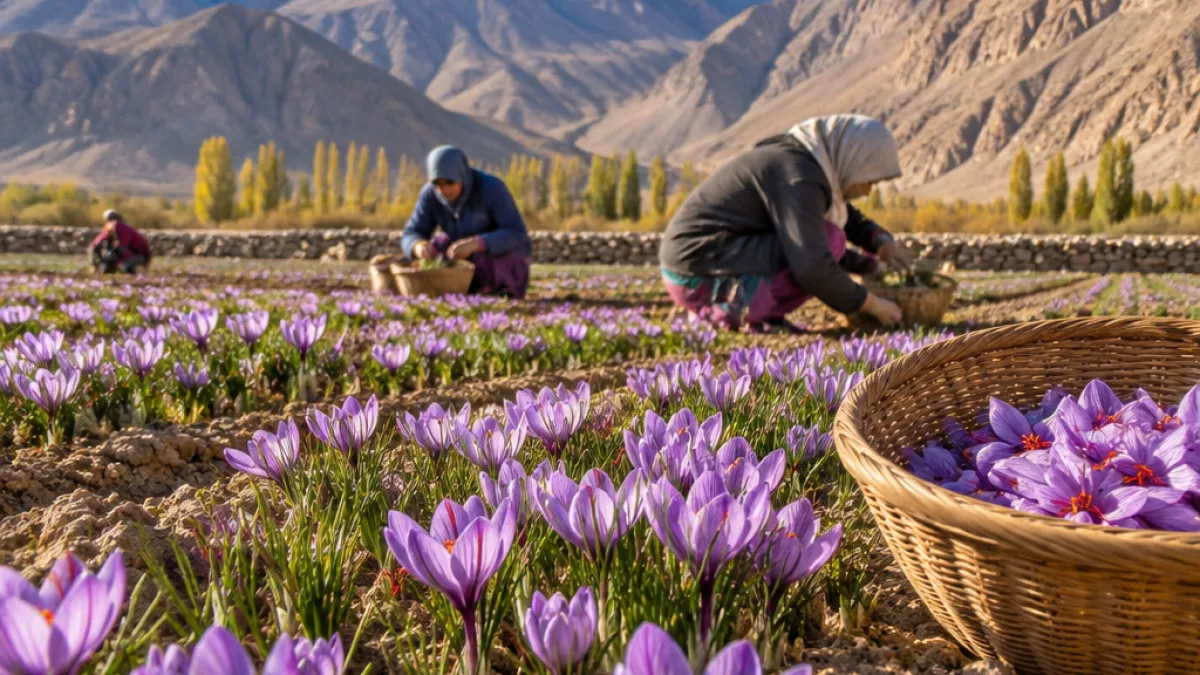
LEH: A pilot project to grow saffron in Ladakh has produced its first flowers within 30 days of planting, offering an early indication that the high-altitude Union Territory’s cold desert landscape may support cultivation of the valuable spice under carefully selected conditions.
The plantation, established on land that had earlier been barren and was subsequently restored under Project Him Sarovar, has begun yielding purple flowers at a pace officials described as faster than the usual flowering period of around two months. The experiment is being conducted near Leh over approximately 4,000 square metres.
Lieutenant Governor VK Saxena inspected the site on Monday and witnessed the flowering. Officials accompanying the inspection said the field was producing an average of 20 to 25 flowers a day, while the highest daily count recorded so far was 72 blooms on Monday morning.
“The initiative is guided by Prime Minister Narendra Modi’s vision of diversifying traditional agricultural practices.”
The early harvest has also provided an initial measure of the trial’s output. Nearly 22 grams of pure saffron were collected over four days, according to officials. The quantity comes from a plantation containing about 90,000 corms, indicating the project is still at an experimental stage rather than being a large commercial operation.
Details of the pilot plantation
| Parameter | Reported details |
|---|---|
| Planting date | October 1, 2026 |
| Planting material | Nearly 800 kg of Iranian saffron corms |
| Number of corms | About 90,000 |
| Area under cultivation | Approximately 4,000 square metres |
| First flowering | Within 30 days |
| Harvest reported | Nearly 22 grams in four days |
Saffron cultivation is particularly demanding because the spice is harvested from the delicate red stigmas of the flower. The trial’s first result is therefore relevant not only because of the blooms themselves, but also because the plantation has already allowed a small quantity of saffron to be collected and processed. Officials said the field continued to show daily flowering during the inspection.
The site’s earlier condition is central to the significance of the experiment. The corms were planted on a patch described as barren before it was restored and rejuvenated through Project Him Sarovar. In that setting, the flowering has been presented as an example of how degraded land may be tested for productive use while remaining linked to broader restoration work.
Possible agricultural diversification
The administration has described the initiative as part of an effort to diversify conventional farming practices and create avenues for financial sustainability. In the official account of the project, the intended beneficiaries include farmers and young people in Ladakh, where the severe climate and limited cultivable land place constraints on agricultural choices.
- The trial is testing saffron cultivation on land recently brought back into use.
- The first flowers appeared earlier than the period generally associated with the crop.
- The initial harvest provides a basis for assessing the crop’s performance in Ladakh’s conditions.
However, the figures currently available describe only the opening phase of the experiment. The first harvest and the accelerated flowering are encouraging indicators, but they do not by themselves establish the long-term productivity, cost-effectiveness or wider suitability of saffron cultivation across Ladakh. Further observations would be needed before the method could be considered for expansion.
The quantity of planting material used also shows the scale of the administration’s test. Nearly 800 kg of premium Iranian corms were placed in the field, with the corms distributed across the restored plot. Their performance will be watched through the flowering and harvesting stages, particularly in a region where temperature, water availability and the short agricultural season shape what can be grown.
Environmental and livelihood dimensions
For Ladakh, the project joins two concerns that are often treated separately: the need to restore damaged or unproductive land and the search for livelihood opportunities suited to its high-altitude environment. The field’s transformation from a barren patch into a flowering plantation has given the initiative a visible environmental dimension, while the value associated with saffron has created an economic rationale for the trial.
The administration has not released further production estimates or details of any wider rollout in the information available. For now, the plantation remains a pilot project whose immediate milestones are the early emergence of flowers, the recorded daily bloom count and the collection of the first saffron. Those results will form the starting point for assessing whether the experiment can be sustained beyond its first flowering season.