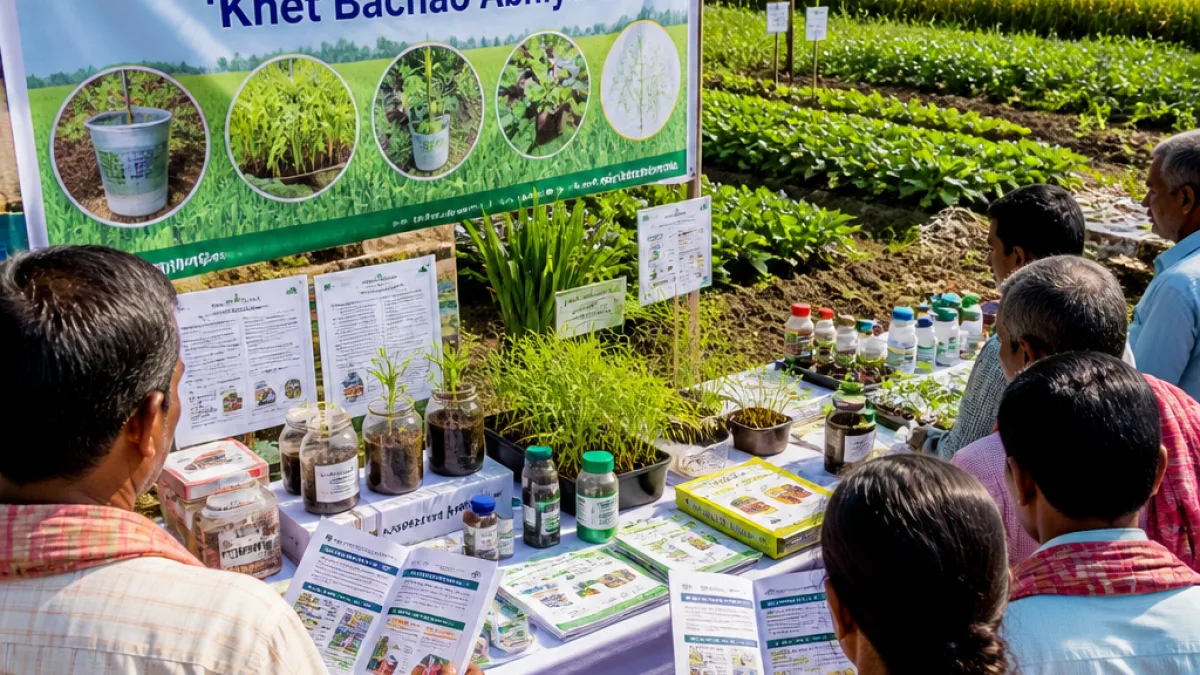
Howrah, 1 June 2026: A locally focused roll‑out of the national Khet Bachao Abhiyan was held at the Krishi Vigyan Kendra (BCKV), Howrah, operating under ICAR‑ATARI, Kolkata, bringing together farmers, agricultural scientists, and district extension officials to prioritise soil health as the foundation of rural livelihoods and food security.
Local mobilisation around soil and sustainability
The programme, organised on the KVK campus, convened elected and administrative representatives including Anupam Ghosh, MLA of Jagatballavpur, and senior ICAR officials. Presentations and deliberations underlined the campaign’s aim to halt further deterioration of cultivated land in Howrah and to promote sustainable practices suited to the district’s agro‑ecology.
Speakers at the event urged combining scientific soil testing with farmer outreach so that fertiliser application is balanced and resource use becomes more efficient. Emphasis was laid on building resilience through low‑cost, locally adoptable measures such as green manuring, vermicompost and use of biofertilisers.
"Khet Bachao Abhiyan links soil health with food security, farmer prosperity and environmental sustainability," said Dr Pradip Dey, Director, ICAR‑ATARI, Kolkata.
Officials and extension: roles and priorities
The meeting included Dr Santosh Kumar Jana, Deputy Director of Agriculture (Howrah), the Assistant Director of Agriculture for Jagatballavpur Block, and the Assistant Director (Farm) from Uluberia, alongside KVK scientists. They reiterated the need for stronger convergence between departments and more intensive extension outreach at the village level to accelerate uptake of climate‑resilient practices.
MLA Anupam Ghosh highlighted the connection between preserved topsoil and sustained farm incomes, saying that farmer awareness and scientific guidance at the grassroots are essential to preserve productivity for future generations.
Practical measures promoted at the KVK
- Routine soil testing to determine nutrient status and guide balanced fertiliser use.
- Promotion of green manuring, vermicompost and biofertilisers to rebuild soil organic matter.
- Encouraging crop diversification under the Pulses Mission and Oilseeds Mission to improve profitability and ecological stability.
- Enhanced convergence among agriculture, horticulture and allied departments for coordinated extension services.
The KVK framed these interventions as part of a larger national objective to sustain productivity while reducing dependence on indiscriminate chemical inputs. Officials noted that soil health improvements would also support climate resilience by improving moisture retention and nutrient cycling in Howrah’s farms.
| Recommended Practice | Expected Benefit |
|---|---|
| Soil testing & balanced fertilisers | Reduced input costs; targeted nutrient management |
| Green manuring & vermicompost | Higher organic matter; better soil structure |
| Biofertilisers | Enhanced microbial activity; lower chemical load |
| Crop diversification (Pulses/Oilseeds) | Improved farm income and rotational benefits |
Participants at the KVK called for scaling up farmer‑centric demonstrations, field days and soil testing camps. They argued that without an organised outreach effort, promising technologies and practices risk remaining confined to research stations rather than reaching smallholders across Howrah’s blocks.
Local agricultural functionaries said the Khet Bachao Abhiyan dovetails with national targets to bolster food security and rural prosperity while advancing the government’s long‑term vision for sustainable development. They underlined that practical, low‑cost measures implemented now would pay dividends for the district’s agricultural landscape in coming years.
As the monsoon season approaches, KVK Howrah plans to intensify field demonstrations and coordinate with block‑level officers to ensure farmers can access soil testing facilities and extension inputs in time for sowing operations.
Implications for Howrah: The initiative seeks to shift local farming from short‑term input reliance to informed, resource‑efficient systems. For Howrah’s predominantly smallholder population, that transition could mean lower costs, steadier yields and improved resilience against erratic weather.