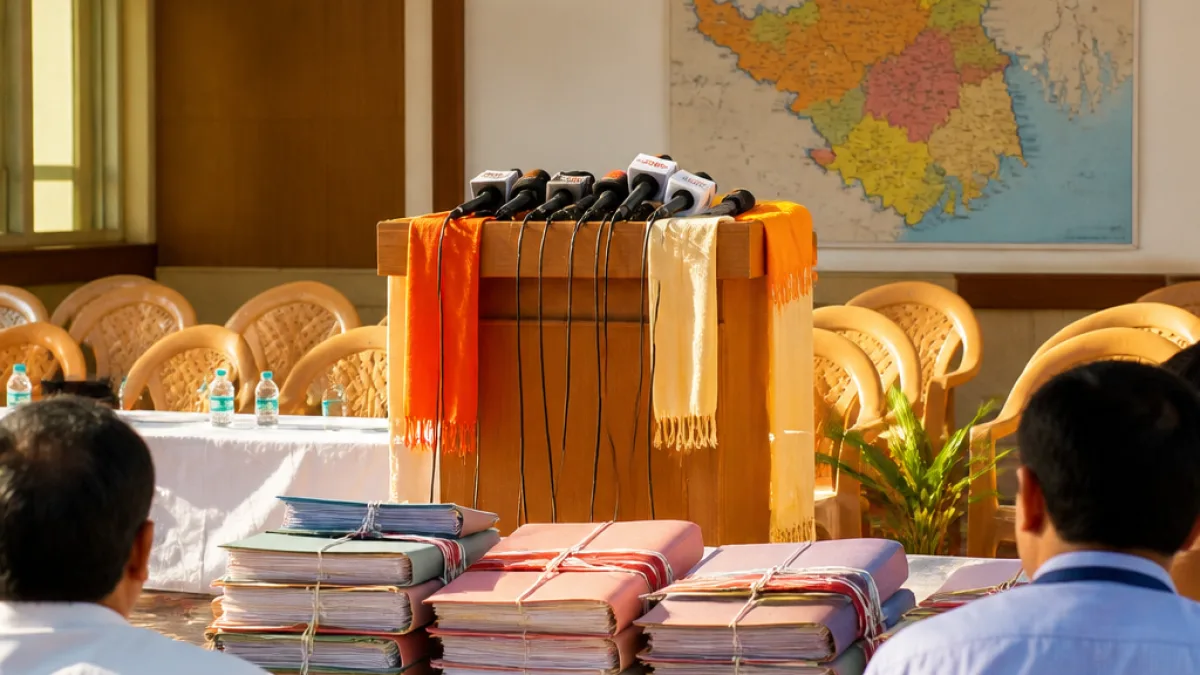
KOLKATA — West Bengal Chief Minister Suvendu Adhikari on Monday strongly criticised remarks made by Congress president Mallikarjun Kharge aimed at Prime Minister Narendra Modi, saying the choice of words did not represent Indian cultural norms but rather reflected the culture of the Gandhi family.
Addressing reporters, Adhikari characterised Kharge’s language as out of step with customary Indian public discourse and attributed it to the influence of Sonia Gandhi and Rahul Gandhi. He contrasted that with what he said were acceptable cultural standards in India for public speech.
“This is not the language of Mallikarjun Kharge; this is the language of Sonia Gandhi and Rahul Gandhi. It is not the language of Indian culture. In Indian culture, one does not use language that drags in one’s parents. It is the language of Sonia Gandhi’s culture.”
Political fallout from Patna event
The remarks by Adhikari followed an incident at the 139th birth anniversary celebration of Shri Krishna Singh in Patna, Bihar, where an attendee reportedly made an assertion about the Prime Minister’s political future. In his response, Kharge is reported to have said, “Modi ka baap bhi jayega.” He also questioned the Prime Minister’s earlier promise to retrieve black money within the first 100 days of his government, asking where that money was.
The exchange has thrust intraparty and interparty rhetoric back into the spotlight at a time when political polarisation is high across the country. Adhikari framed his criticism as a defence of cultural norms rather than a direct partisan attack.
Flood control meeting and river concern in Malda
Separately, Adhikari outlined his travel plans to New Delhi to participate in a meeting of the Ganga Flood Control Mission scheduled for Tuesday, which will be chaired by Union Jal Shakti Minister C.R. Paatil. He said representatives from Jharkhand, Bihar and West Bengal had been invited to the session.
Underlining the meeting’s urgency, Adhikari said a high‑level delegation led by the state Chief Secretary carried out a site inspection on Sunday. The team reportedly observed that the Phulwar and the Ganga rivers had come perilously close to each other in parts of Malda, raising concerns about potential flooding and bank erosion.
Adhikari also pointed to a 2018 agreement that involved the West Bengal government, the Inland Waterways Authority of India (IWAI), NTPC and the Farakka Barrage authority, saying its terms had not been honoured. He called for renewed attention to commitments made under that accord as part of coordinated flood‑mitigation efforts.
What is at stake and next steps
The meeting in Delhi is expected to review inter‑state coordination on flood management along the Ganga and its tributaries and to consider technical and infrastructural responses where rivers threaten inhabited areas. Adhikari indicated that West Bengal would press for urgent measures following the site inspection.
- Immediate concern: proximity of the Phulwar and Ganga in Malda as seen during a recent site visit.
- Policy focus: follow‑up on the 2018 agreement involving IWAI, NTPC and Farakka Barrage authorities, described by the Chief Minister as not fully implemented.
- Interstate forum: Ganga Flood Control Mission meeting in Delhi chaired by Union Jal Shakti Minister C.R. Paatil.
| Item | Details |
|---|---|
| Meeting | Ganga Flood Control Mission, chaired by Union Minister C.R. Paatil |
| Invitees | West Bengal, Bihar, Jharkhand (as reported) |
| Local risk highlighted | Phulwar and Ganga rivers approaching dangerously close in Malda |
| 2018 agreement | Involves West Bengal, IWAI, NTPC and Farakka Barrage; said to be unfulfilled |
Adhikari’s comments linking Kharge’s words to the Gandhi family’s culture shift the focus back onto normative questions of public language even as the state prepares to press central authorities on practical flood measures. The two strands — political rhetoric and administrative urgency on river management — will both be in view as the delegation from West Bengal goes to Delhi.
Political reactions from other parties and any formal outcomes from the Delhi meeting were not immediately available at the time of reporting.
Arup Mitra reports from West Bengal.