
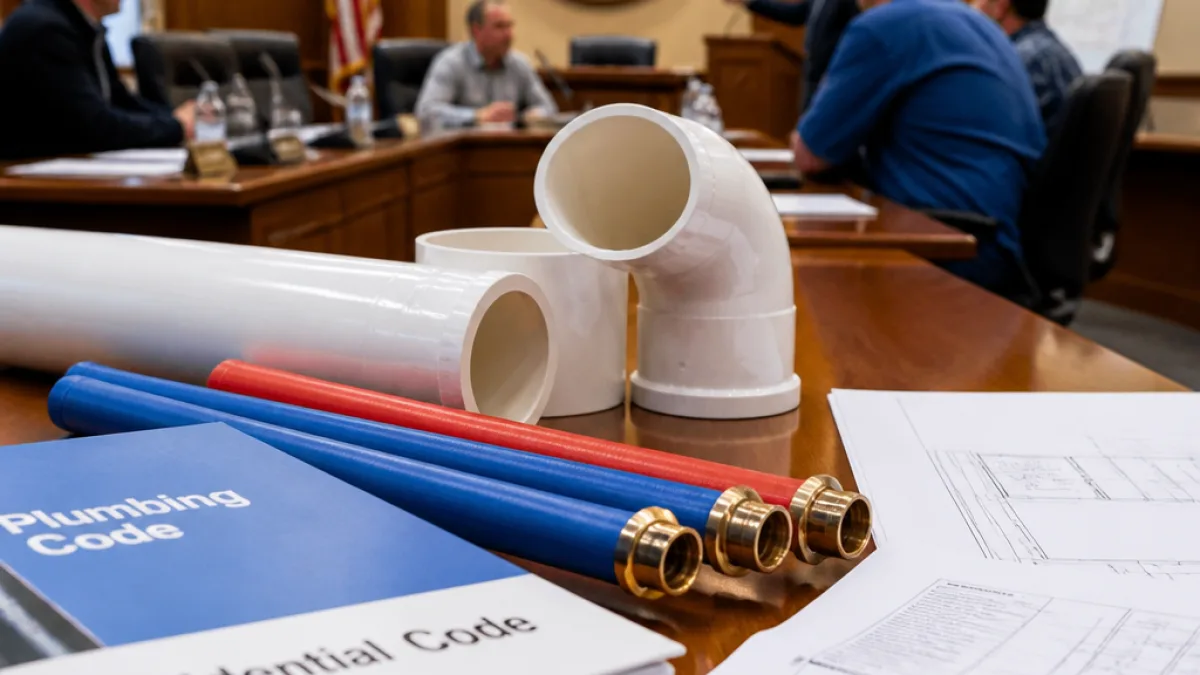
Code changes move into public debate
Omaha officials are looking to the city’s plumbing rules as one possible way to make new housing less expensive. The City Council is considering several revisions that supporters say could reduce construction costs, expand the pool of available plumbing workers and help Omaha compete with nearby communities where builders face fewer restrictions.
Le Nguyen, the city’s superintendent of permits and inspection, presented the proposals at a council meeting Tuesday. The changes would ease limits on PVC pipe, permit PEX as an alternative to copper for water service lines and adjust the ratio governing plumbers and apprentices. The proposals come as Omaha weighs how local regulations affect the pace and price of housing development.
Omaha currently places tighter limits on PVC than neighboring communities, according to the information presented to the council. The material is generally permitted in single-family homes, restaurants and multifamily buildings shorter than four stories. The proposed revision would broaden its use, including in projects where the city now more heavily favors cast iron.
“This is a significant cost saving without compromising safety,” Le Nguyen said.
Nguyen compared Omaha with Gretna using a school project with the same footprint. He said the project cost less to build in Gretna, where the plumbing requirements are less restrictive. The comparison illustrates the policy question facing Omaha: whether existing construction standards provide benefits that justify added expense, or whether some requirements are placing the city at a disadvantage when developers choose where to build.
| Issue | Current approach | Proposed direction |
|---|---|---|
| Pipe materials | PVC is more limited | Broader PVC use |
| Water service lines | Copper is required | PEX allowed as an alternative |
| Plumbing apprentices | One apprentice per plumber | Two apprentices per plumber |
Workforce and safety concerns
The apprenticeship provision is intended to address a labor shortage affecting plumbers across the metro area. Under the current code, one plumber may supervise one apprentice. City officials are considering a change to a one-to-two ratio. Nguyen contrasted that standard with the electrical trade, where the ratio is one electrician to six apprentices.
More than two dozen plumbers and contractors addressed the council. The testimony was divided, with roughly half supporting the initiatives and half opposing them. Those who raised concerns questioned the long-term durability of PVC compared with cast iron, the effect of the revisions on safety requirements and whether any savings would reach people buying or renting future homes.
Those questions leave the council with issues beyond the price of individual materials. A lower construction bill does not automatically become a lower sale price or rent, particularly when projects also face land, financing, labor and other development expenses. The debate therefore includes both the direct effect of the code and the broader question of how Omaha can encourage builders to produce housing without weakening protections that residents expect.
Barney Barrett, co-owner of Barrett Plumbing, said his company performs much of its work in Sarpy County, where he described the plumbing rules as less restrictive than Omaha’s. Barrett said his business has operated for more than 50 years and that the city is overdue for changes.
“We're overdue for changes,” Barney Barrett said.
Regional competition shapes the decision
Planning Director Dave Fanslau told council members the revisions are needed not only to support affordability but also to keep Omaha competitive with other cities. That regional dimension is especially significant for builders working across the Omaha metropolitan area. If similar projects cost more inside Omaha than in neighboring communities, development may shift beyond the city, even as Omaha seeks more housing within its boundaries.
- Supporters say updated materials and staffing rules could lower costs and increase construction capacity.
- Opponents have raised questions about durability, safety and whether consumers would receive the projected savings.
- The council must weigh affordability goals against construction standards and oversight.
The council was still considering the proposals after Tuesday’s presentation. No outcome was provided in the information available. For Omaha residents, the decision could become a test of how local government balances code enforcement with the need for more attainable housing. The proposed changes would not by themselves guarantee lower prices, but they would alter several rules that builders and plumbing contractors say influence how much—and how quickly—housing can be built in the city.