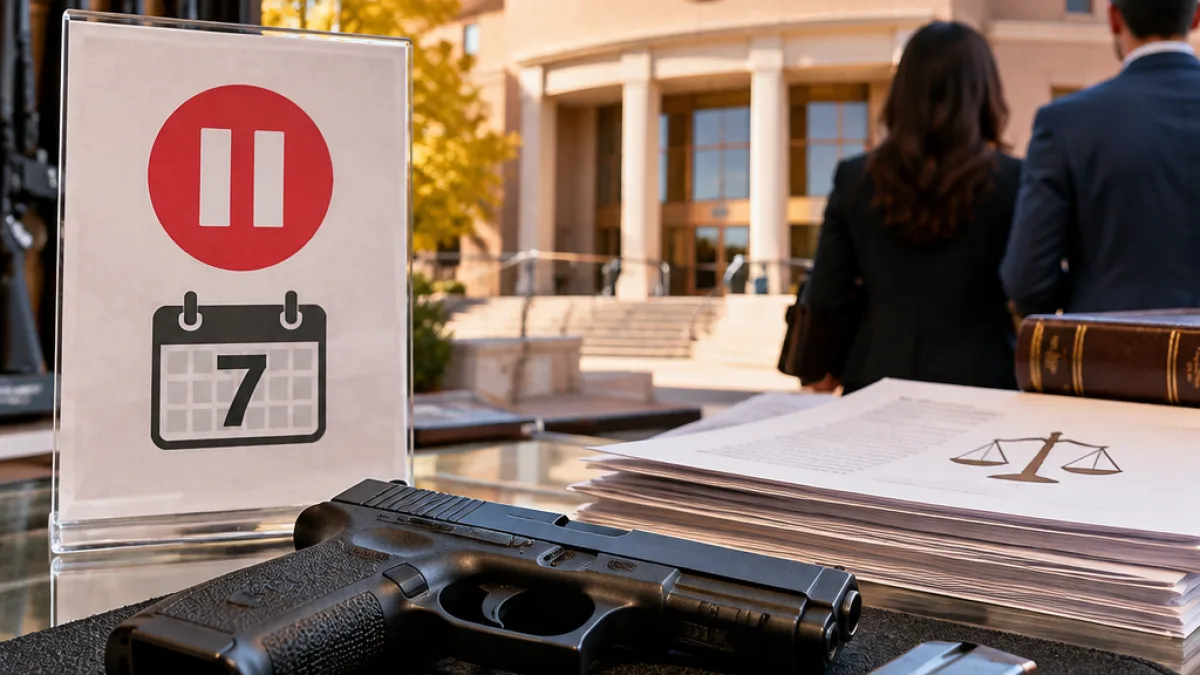
New Mexico’s seven-day waiting period for firearm purchases will not be enforced for now, as Attorney General Raul Torrez and gun-rights groups continue a legal fight over whether the law violates the Second Amendment.
The temporary pause follows an agreement by Torrez to stop enforcing the requirement while the case moves through the courts. The dispute began soon after the law took effect and now includes an appeal involving the state’s top legal office and Gov. Michelle Lujan Grisham.
Under the law, a person who purchases a firearm must wait seven days before taking possession of it from the seller. Lujan Grisham signed the waiting-period measure in March 2024. Supporters described the delay as a chance for someone considering suicide or a crime to reconsider before gaining access to a gun.
The pause does not end the statute or settle the constitutional question. Instead, the New Mexico Department of Justice said the agreement is intended to maintain current conditions while the appellate court reviews the issues raised by an order from the district court.
“The stipulation does nothing more than preserve the status quo until the court of appeals has an opportunity to consider the issues presented in the district court’s order.”
That distinction matters for buyers and sellers. The law remains at the center of the case, but the attorney general’s agreement means the immediate enforcement question has been set aside while the judicial process continues. The source material does not specify when the appellate court will issue its next ruling.
A law designed to create time
The waiting period was written around a simple intervention: creating distance between the decision to buy a firearm and the moment the weapon is collected. State officials’ stated purpose was to provide additional time in situations involving possible self-harm or criminal activity.
For firearms retailers, however, the requirement introduced a new step into transactions that previously could be completed without that statutory delay. Calibers, a local gun store, said it followed the law even as customers questioned why they could not retrieve purchases immediately.
“The problem with getting a seven-day wait is if you have a delay of three days, they're gonna add seven days on to the three, so they're a 10 day wait.”
That comment came from Craig Stumpf, the store’s director of training. He said some customers were caught off guard by the requirement and that others left town rather than wait. The account illustrates how a statewide policy can become most tangible at the counter, where retailers must explain the timing and customers must adjust expectations about when a purchase can be picked up.
Gun-rights challenge remains active
Several gun-rights groups challenged the waiting-period law after it took effect, arguing that it infringes on protections guaranteed by the Second Amendment. Their lawsuit has kept the measure in legal limbo rather than allowing the dispute to be resolved solely through the legislative process.
The 10th U.S. Circuit Court of Appeals said in 2025 that the law was likely unconstitutional, according to the source material. Lujan Grisham and Torrez have appealed, leaving the state’s defense of the measure before the courts even as the attorney general now agrees to suspend enforcement temporarily.
| Issue | What the source says |
|---|---|
| Waiting period | Seven days after a firearm purchase before pickup |
| Law signed | March 2024 by Gov. Michelle Lujan Grisham |
| Current status | Enforcement temporarily paused during the court battle |
| Appeal | The state is continuing its challenge in federal court |
What changes for the public
For now, the immediate change is practical rather than legislative: the state will stop enforcing the seven-day requirement while the case proceeds. The agreement does not repeal the law, and it does not represent a final ruling on whether the waiting period can stand.
- The statute was signed in March 2024.
- The required delay was intended to create time for reconsideration in potential suicide or criminal situations.
- Gun-rights groups argue that the requirement burdens Second Amendment rights.
- The attorney general’s enforcement pause is temporary and tied to the ongoing appeal.
The competing arguments reflect a broader tension in firearm policy: whether a mandated delay is a narrow public-safety measure or an unconstitutional barrier to exercising a protected right. In New Mexico, that question is now being tested through a case that has moved from the shop floor to the federal appellate system.
Until the courts resolve the dispute, residents and firearm dealers are left with a policy whose enforcement has been suspended but whose legal status remains unsettled. The next significant step will come from the court reviewing the district court’s order. The state’s appeal, meanwhile, keeps the waiting-period debate alive at the intersection of public safety, individual rights and the limits of government regulation.