Joint legal challenge targets an imminent groundbreaking
The District of Columbia and Virginia went to federal court Saturday seeking to stop President Donald Trump’s proposed 250-foot memorial arch before construction can begin near Arlington National Cemetery. The filing comes as the administration indicates that work on the project could start as early as next week, intensifying a legal fight over who has authority to reshape one of the capital region’s most prominent public spaces.
Attorney General Brian Schwalb of the District and Virginia Attorney General Jay Jones argue that the project would cause immediate and lasting damage once ground is broken. Their lawsuit asks for a temporary restraining order, the same type of emergency relief sought by the plaintiffs in an earlier case. The attorneys general say the administration is moving too quickly for the courts to fully review the project.
“As soon as Defendants break ground on this project, they will inflict irreparable harm on both the District and Virginia.”
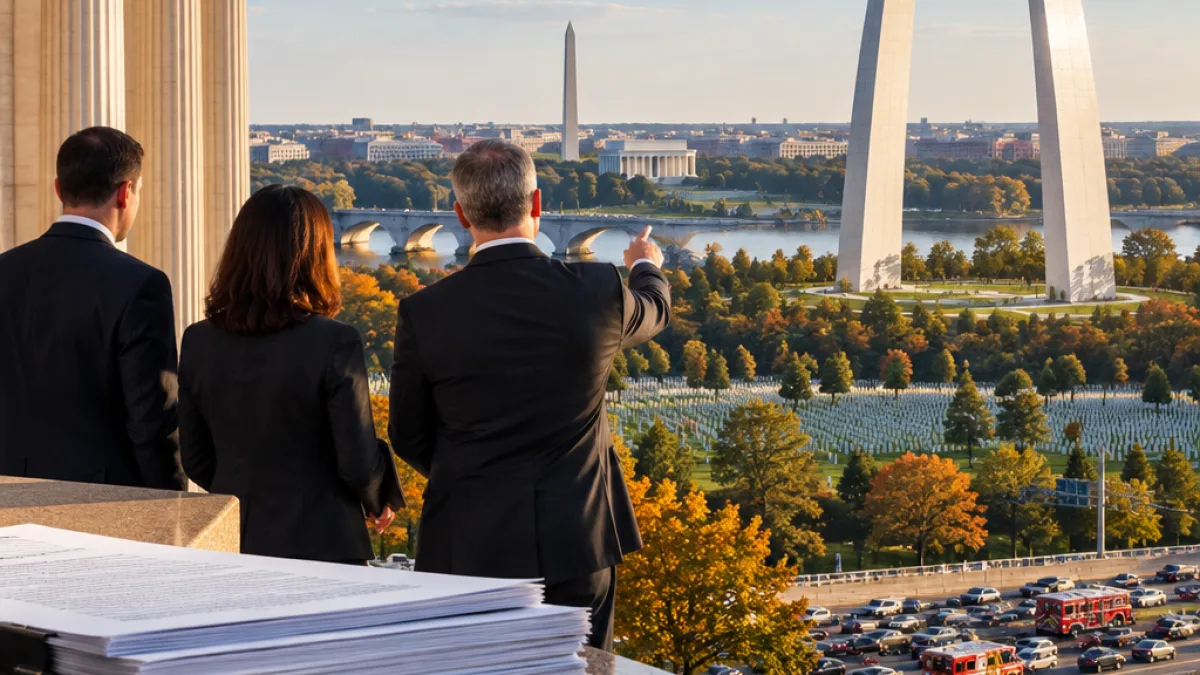
The lawsuit places the proposed structure at a strategically sensitive point: a grassy area near the bridge crossing the Potomac River between Washington and Arlington. The site lies along a major route connecting the District with Arlington National Cemetery and sits within the capital’s monumental core, where transportation, historic preservation and federal land-use decisions overlap.
Traffic and environmental effects are central to the case
D.C. and Virginia warn that the construction plan would not be confined to an isolated building site. The governments say a projected three-year construction period would affect traffic between the jurisdictions, create pollution and send stormwater runoff toward the Potomac River. They also cite potential disruptions to emergency services and other operational problems in an area already used heavily by commuters, visitors and people traveling to the cemetery.
Those arguments give the case a distinctly local dimension. The dispute is not only about the appearance or symbolism of a new monument. It also concerns how a large construction operation would function at a crossing that carries people between the District and Northern Virginia, and whether the administration has completed the approvals required before work begins.
| Project detail | Information in the lawsuit and filings |
|---|---|
| Proposed height | 250 feet |
| Location | Near the Potomac crossing between Washington and Arlington National Cemetery |
| Construction period cited | About three years |
| Current legal status | Three lawsuits seek to halt or delay construction |
A federal judge is already considering a pause
The new lawsuit adds to an earlier case brought by three Vietnam War veterans and an architectural historian. U.S. District Judge Tanya Chutkan held a hearing Friday on whether to issue an order stopping the project while that original lawsuit proceeds. She did not immediately rule but said she would act expeditiously.
That timing matters because the administration’s construction schedule could force the court to decide the emergency request before the broader questions are resolved. The District and Virginia contend that starting work would create conditions the government could later use to argue that stopping the project had become impractical. In their view, a groundbreaking would not be a neutral first step; it would alter the site and increase the pressure on the court to allow the project to continue.
A monument designed to dominate the skyline
The proposed arch would be 100 feet taller than the Statue of Liberty measured from its base to the top of the torch, according to the case materials. Its scale is a central reason the legal and political fight has drawn attention. The structure would not simply add another memorial to Washington’s landscape; it would become a highly visible feature beside a major bridge and the entrance to Arlington National Cemetery.
The administration has presented the arch as a commemoration of the country’s 250th anniversary. A rendering shared by Interior Secretary Doug Burgum shows the planned triumphal design. The White House has defended the project as part of the president’s effort to restore and enhance the nation’s capital, while the lawsuits challenge whether the executive branch can proceed without the required legal authorization.
“The Arch site sits at the center of a major traffic artery between the District and Virginia, in the monumental core of the capital, on an island that straddles the Potomac River.”
The language of the filing underscores the political stakes. D.C. and Virginia are not merely objecting to a design choice; they are asserting that the administration is attempting to use speed and construction activity to outpace judicial oversight. The administration, in turn, has described the project in broad patriotic and civic terms rather than addressing the specific allegations in the lawsuit.
What happens next
The immediate question is whether Judge Chutkan will block construction before crews can begin. A temporary order would preserve the status quo while the court considers the underlying case. Without such an order, the District and Virginia warn that traffic, environmental and emergency-service consequences could begin during a lengthy construction process.
The dispute now involves three lawsuits, the federal court’s review and competing claims about presidential power over the capital’s physical environment. For residents and travelers, the practical concern is whether the proposed work will affect one of the region’s key crossings. For the administration, the schedule appears tied to a broader effort to establish the arch as a permanent national landmark before opponents can stop it. The next ruling from the court will determine whether that strategy advances or is put on hold.