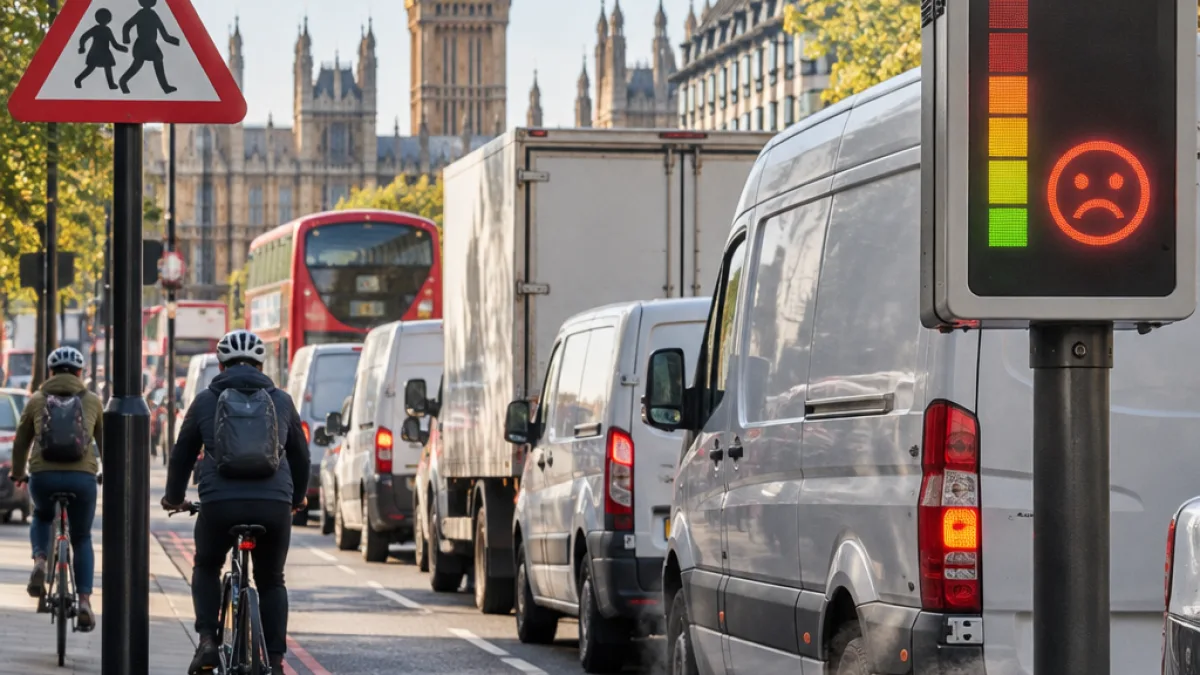
London is falling behind other European capitals on clean air, according to new analysis that places Greater London 16th among 40 cities and gives the capital a ‘C’ ranking. The findings have renewed pressure on City Hall and Transport for London to address pollution from road traffic, particularly diesel-powered commercial vans.
The comparison by Clean Cities comes as the European Union prepares to introduce stricter limits on air pollution from 2030. The rules will not apply directly to London because the UK is no longer part of the EU, but the report says the capital would fail all four of the key measures if judged against those standards.
A widening gap with European cities
Clean Cities said London was performing worse than cities including Copenhagen, Berlin and Brussels. Its assessment presents the capital’s position not simply as a question of international league tables, but as a warning that progress made in reducing pollution may not be enough to meet the standards being adopted elsewhere.
City Hall said London’s air was “dramatically cleaner than it was a decade ago”, while acknowledging that further action was needed. That response reflects a central tension in the debate: the capital has made improvements, but the new analysis argues that those gains do not place London among Europe’s leading cities on clean-air policy or performance.
“We cannot clean up London's air while thousands of polluting vans continue to drive around our streets.”
Zak Bond, campaign manager at Clean Cities, blamed what the organisation described as City Hall’s failure to take tougher action on diesel vans. The vehicles are now identified in the report as the largest road-transport source of nitrogen oxides, or NOₓ, in central and inner London.
Commercial vans at the centre of the dispute
Department for Transport figures analysed for the report show that 100,761 diesel vans were registered by businesses in London at the end of 2025. That was the highest number recorded since the relevant data began to be collected in 2009.
By comparison, the number of battery-electric vans registered to companies stood at 5,582. The figures underline the scale of the transition still required if commercial traffic is to become less polluting. They also show why campaigners have focused on deliveries and freight rather than only on private cars.
| Measure | Figure |
|---|---|
| Greater London’s position | 16th of 40 European cities |
| Clean-air ranking | C |
| Business-registered diesel vans, end of 2025 | 100,761 |
| Business-registered battery-electric vans | 5,582 |
Mr Bond called for the mayor to introduce a zero-emission zone for freight, arguing that London should regain the lead it once held in the clean-air debate. Such a proposal would target the movement of goods through the capital and put the vehicle choices of businesses at the centre of the city’s pollution strategy.
Concerns over children and active travel
The report also criticised the limited amount of protected cycling infrastructure on London’s main roads. It found that only 12% of those roads currently have protection for cyclists, compared with 73% in Copenhagen and 66% in Greater Amsterdam.
That comparison is particularly relevant in a city where the report says 1.5 million cycle journeys are made each day. The figures suggest that a large number of people are using streets where cycling protection remains comparatively limited, making the design of roads part of both the pollution and public-health debate.
“Children are still exposed to traffic fumes on their way to school and in their own neighbourhoods. This is simply not good enough for a city that has promised to protect children's health.”
Jemima Hartshorn, founder and director of Mums for Lungs, said cleaner deliveries, more School Streets and safer walking and cycling routes were needed. Her comments move the issue beyond roadside measurements, highlighting where exposure occurs: on journeys to school and in residential areas where families live.
Pressure on the capital to act
The report’s recommendations are aimed at several parts of London’s transport system. Its calls include cleaner diesel deliveries, stronger action on freight, expanded protection for people walking and cycling, and continued progress in moving public transport away from polluting vehicles. The analysis also warned that more progress was needed on electrifying the bus fleet.
For Londoners, the immediate significance of the findings lies in the contrast between the capital’s acknowledged improvement and its position against cities that have moved further towards cleaner transport. City Hall maintains that air quality is markedly better than it was ten years ago. Clean Cities argues that the remaining pollution is still too high and that the capital risks being overtaken.
- Greater London ranked 16th out of 40 European cities, with a C rating.
- Diesel vans were identified as the largest road-transport source of NOₓ in central and inner London.
- Campaigners are calling for a zero-emission freight zone, cleaner deliveries and safer active-travel routes.
The political question now is how quickly London chooses to respond. The stricter EU limits will not automatically govern the capital, but the report gives campaigners a new benchmark against which to judge policy. With more than 100,000 diesel vans registered to London businesses and only a fraction as many battery-electric alternatives, the debate is likely to remain focused on freight, enforcement and the health of children travelling through the city.