The Universe is around 13.8 billion years old, and scientists rely on both deep-sky observations and high-energy laboratory experiments to reconstruct what happened in the first fleeting instants after the Big Bang.
Peering back in time with light and experiments
Astronomers exploit the finite speed of light: looking further into space lets them see earlier epochs. Large telescopes collect ancient photons that reveal how structure formed over billions of years — from the first atoms and the cosmic microwave background through to galaxies and the stars within them. But the picture becomes uncertain as researchers attempt to reach the Universe’s very first seconds.
Professor Dan Hooper, head of the Theoretical Astrophysics Group at Fermilab and professor of astronomy and astrophysics at the University of Chicago, argues that for epochs earlier than a few seconds after the Big Bang the evidence is no longer direct and astronomers must turn to laboratory physics. By reproducing the extreme temperatures and densities that prevailed then, particle accelerators allow scientists to test how matter and energy behaved under those conditions.
“From a few seconds after the Big Bang to the present, we have a lot of relevant observations and measurements to work with,” Professor Hooper has written, emphasising the role of experiments in probing earlier times.
What laboratory recreations can and cannot show
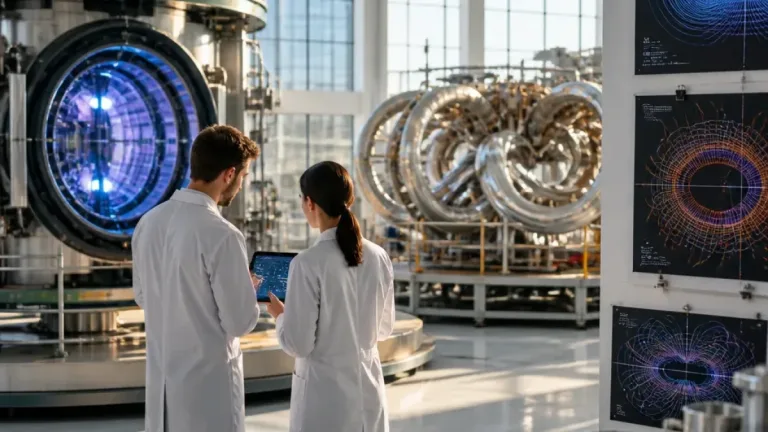
Particle accelerators do not rerun history; rather, they simulate key states of matter at very high temperatures. Colliding particles at enormous energies produces short-lived conditions analogous to those in the early Universe — for example, the formation of quark–gluon plasma and other exotic states known from theoretical models.
Those experiments test the behaviour of known particles and forces under extreme circumstances, constraining theories about the evolution of the cosmos in the first fractions of a second. They complement astronomical data rather than replace it, because telescopes provide the empirical backbone for later cosmic history while accelerators probe the microphysics that would have governed the earliest times.
How observations and experiments fit together
Scientific understanding of the Universe’s history is built from multiple, independent lines of evidence. Key elements include:
- Cosmic observations: measurements of the cosmic microwave background, the distribution of galaxies, and light from distant objects reveal the large-scale evolution of the Universe from seconds after the Big Bang onward.
- Laboratory physics: high-energy collisions recreate extreme temperatures and test particle interactions that would have been relevant very early on.
- Theoretical models: particle physics and cosmological theory knit observations and experiments into a coherent chronology of events.
The interplay of these elements underpins current confidence in our picture of cosmic history from about a second after the Big Bang to today. Earlier than that, uncertainties increase and researchers rely more heavily on laboratory tests of the underlying physics.
Simple reference: epochs and where evidence comes from
| Epoch | Primary evidence |
|---|---|
| Seconds to present | Astronomical observations (light from early Universe, cosmic microwave background, galaxy surveys) |
| Fractions of a second | Particle accelerator experiments recreating high-temperature states; theoretical physics |
That simple division highlights why cosmologists say the later history of the Universe is relatively well constrained, while the primordial instant remains an active frontier of research.
Implications and open questions
Combining telescopes and accelerators has sharpened answers to major questions about the early Universe, including how the first nuclei formed and how initial fluctuations grew into galaxies. Yet important puzzles remain — such as the nature of dark matter, the cause of cosmic inflation, and whether there is any meaningful ‘before’ the Big Bang — and they demand both new observations and new laboratory probes.
Books and public writing by working scientists, including Professor Hooper’s own account of early-cosmic physics, help explain how these complementary approaches allow researchers to reconstruct the Universe’s origin story without direct observation of its earliest instant.
As experimental techniques and telescopes improve, the boundary between what can be inferred from light and what must be recreated in the lab will continue to shift, narrowing uncertainties about our cosmic beginnings.