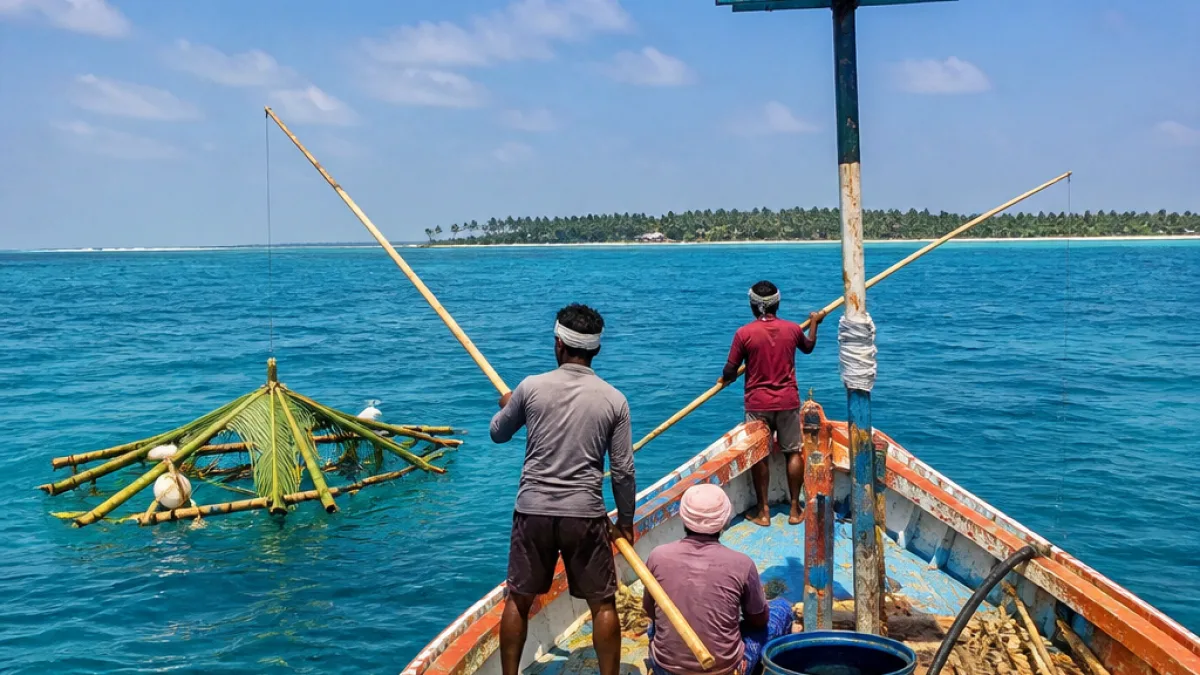
MINICOY: A fish aggregating device (FAD) installed off Minicoy is giving the island’s traditional tuna fishery an additional offshore reference point, an intervention intended to reduce the time and fuel spent searching for scattered fish schools without replacing the pole-and-line practices used by local fishers.
The device was placed on 18 January 2026 by the ICAR–Central Island Agricultural Research Institute’s Regional Station, Minicoy, in partnership with the Maliku Masveringe Jamaat, the island’s fishermen society. It was anchored around 8.5 nautical miles from the island, at latitude 08°24′18.66″ N and longitude 72°57′15.38″ E.
A technology linked to a long-established fishery
Minicoy, the southernmost island in the Lakshadweep archipelago, has a long association with tuna fishing. The fishery supports not only boat crews but also a wider chain of work involving fish marketing, processing and the preparation of Masmin, the island’s traditional smoke-dried tuna product. In this setting, any change in the way fishing grounds are located can have consequences beyond the individual trip.
Fishers using the pole-and-line method depend on finding tuna schools in the open sea. The location and concentration of these schools can vary, while weather conditions influence how long vessels can remain at sea and how safely they can operate. When tuna are dispersed, crews may have to travel for longer periods before fishing begins, increasing fuel consumption and the cost of each outing.
Reducing the search burden
An FAD provides an identifiable offshore location around which pelagic fish may gather. For fishers, this can offer a more defined point to check when planning a trip, rather than relying entirely on extended searches across open waters. The device is therefore intended as a support to existing knowledge and techniques, not as a replacement for the island’s traditional fishing system.
The expected operational benefits include better planning of fishing trips, less unnecessary movement and a possible reduction in the fuel required to locate tuna schools. Shorter search periods could also help limit the physical strain associated with prolonged fishing operations. These are particularly important considerations for an island community where fishing conditions are shaped by distance, sea state and access to offshore grounds.
- Location: approximately 8.5 nautical miles offshore from Minicoy
- Deployment: 18 January 2026
- Target fishery: traditional pole-and-line tuna fishing
- Key species: skipjack tuna and yellowfin tuna
Monsoon risks and safety concerns
The need for such assistance becomes more pronounced during difficult sea conditions. Rough waters during the southwest monsoon can make the search for fish more hazardous and demanding. Extended time at sea also increases fatigue, while additional fuel use raises the financial pressure on fishing trips. The intervention addresses these practical challenges by offering a known location that can be incorporated into fishing plans.
Its relevance is not limited to catch efficiency. By potentially reducing the duration of searching, an offshore aggregation point may support safer and more predictable operations. The available account, however, does not establish that every trip has become shorter or safer; it describes the purpose of the deployment and the benefits the device is designed to support.
Assessment based on landing records
The impact of the deployment is being examined through a comparison of recorded tuna landings. The assessment uses 2025 as the period before installation and compares it with landings recorded in 2026 after the FAD was deployed. The source account identifies this year-on-year comparison but does not provide the landing figures or the final numerical findings.
| Assessment element | Details |
|---|---|
| Pre-deployment reference | Recorded tuna landings in 2025 |
| Post-deployment period | Recorded tuna landings in 2026 |
| Intervention | FAD installed offshore on 18 January 2026 |
| Primary fishery | Pole-and-line tuna fishing |
The comparison is significant for a community where the value of the fishery extends from capture to processing and sale. A carefully documented result could help show whether the device is improving access to tuna schools, lowering the effort needed to find them or supporting more consistent fishing activity. It could also provide a basis for considering similar measures elsewhere, while taking account of local fishing practices and marine conditions.
Balancing support with marine stewardship
Any effort to improve fishing access in Lakshadweep also has to remain attentive to the condition of the surrounding marine environment. The FAD initiative, as described, is framed around supporting an established fishery and making fishing operations more efficient. Its longer-term value will depend on how fishing effort, landings and operating conditions are monitored over time.
For Minicoy, the immediate importance lies in the combination of local participation and practical technology. The fishermen’s society was involved with the research institution in the deployment, while fishers continue to use the familiar pole-and-line method. That approach keeps the intervention connected to the island’s livelihood system, its processing traditions and the realities of working at sea.
The 2026 landing assessment will be central to determining what the device has achieved. Until the comparative figures are available, the FAD can be described as a targeted aid intended to make tuna fishing less dependent on prolonged searches. Its progress will be watched closely by a community for whom safe and economical access to fish grounds is tied to household incomes as well as Minicoy’s distinctive maritime identity.