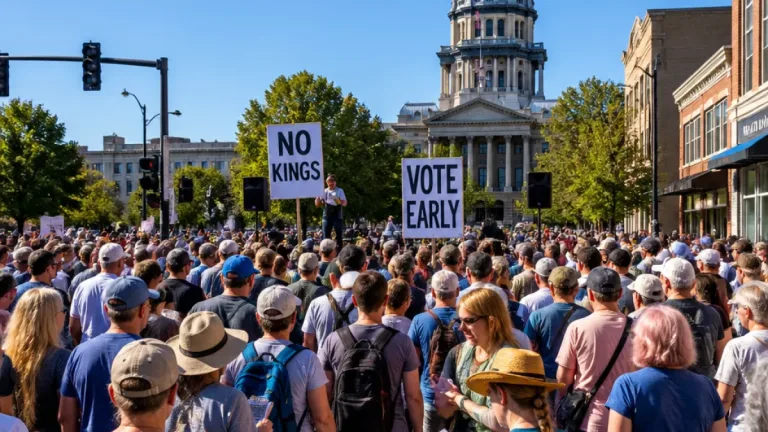
Music and the scent of hotdogs and ice cream drew families and neighbours to a civic engagement fair at the Lawrence Heights Community Centre as organisers sought to translate festival energy into votes for the Oct. 26 municipal election.
Community outreach aims to close participation gap
The non-partisan event, hosted by North York Harvest Food Bank, brought together voter-engagement groups including Voice the Vote — a joint initiative of Toronto Metropolitan University’s Democratic Engagement Exchange and United Way Greater Toronto — to hand out information and encourage residents to take part in the municipal ballot.
At a table with a mock ballot box, volunteer Jonathan Dong distributed Voice the Vote handbooks and spoke with residents about the importance of participating in local democracy. Dong, who identifies as Chinese Canadian and lives in Richmond Hill north of Toronto, said language and community disconnection contribute to low representation for some groups.
“I think it’s very important to have the conversations within these communities to increase that representation and increase our voter turnout,”
Organisers described the fair as part of a broader effort to reach people outside traditional political channels — using neighbourhood hubs, cultural centres and community partners to make voting information more accessible.
Context: historic low turnout and a surprising early surge
Public concern over municipal voter turnout in Toronto has been mounting. Official figures show a downward trajectory in recent contests:
- 2018 municipal election: about 41% participation;
- 2022 municipal election: less than 30% participation;
- 2023 mayoral byelection: 37% participation.
Those city figures sit alongside provincial data compiled by the Association of Municipalities of Ontario, which reports turnout of nearly 33% in the 2022 municipal elections and roughly 38% in 2018.
Despite those declines, advance voting in this election has been robust: more than 222,000 Toronto residents cast ballots early — the highest advance turnout in more than a decade, organisers noted. That early response has given community groups a focus: convert advance momentum and festival interest into higher overall participation on Oct. 26.
Targeted engagement and barriers
Organisers at the Lawrence Heights event highlighted several barriers that can suppress participation, including language gaps, limited outreach in newcomer communities and a sense among some residents that municipal politics is distant from daily concerns. Volunteers aimed to address those obstacles by providing plain-language materials and direct conversation on local issues such as transit, housing and neighbourhood services.
Voice the Vote and partners also sought to reach younger voters and renters, groups that historically register lower turnout. By situating information in familiar community settings — and offering a non-judgemental, festival-like environment — volunteers hoped to reduce the friction of getting informed and casting a ballot.
What this means for Toronto
Low turnout can reshape the municipal mandate elected officials claim, shrinking the proportion of the population that actively chooses city leadership and policy direction. Community-led efforts that increase awareness and lower barriers aim to broaden the base of voices represented in city hall decisions.
With more than 222,000 advance ballots already cast, the immediate test for organisers is sustained engagement through the final days of the campaign. Whether neighbourhood fairs, information handbooks and targeted outreach translate into a higher overall turnout on Oct. 26 will be a critical measure of their impact.