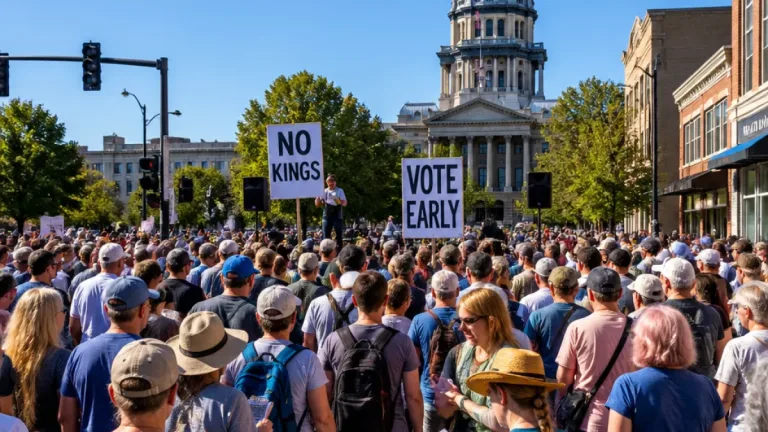
With the municipal election less than a week away, three of Sarnia’s four mayoral candidates faced voters Monday night at the Imperial Theatre to debate local priorities including mental health and addiction supports, relationships with the County of Lambton and what the mayor’s role should be.
Hundreds attend community-organized forum
The forum was organised by the Imperial Theatre in partnership with the Sarnia-Lambton Chamber of Commerce, the Book Keeper, Jean Collective and Healthy Democracy. According to organisers, hundreds of residents attended to hear from the candidates and ask questions on issues that affect daily life in the city.
Mental health and addiction dominated much of the discussion. Each candidate presented different approaches to dealing with people struggling with substance use and homelessness.
Contrasting approaches to addiction and supports
Scott Molson outlined what he described as his "three R's" to help people dealing with addictions: rehabilitation, recovery and aftercare. He said rehabilitation would involve short-term stays at Bluewater Health, recovery would include longer stays at Ryan's House, and aftercare would be provided at the Hub located in the former SCITS building.
"Rehabilitation, you go to Bluewater Health and you stay there for a week, Recovery, you go to Ryan's House and you stay there for a month, then after that you go to the Hub which is at the old SCITS,"
Bill Dennis emphasized a different perspective, arguing that jurisdictions and service providers cannot force help on people who are not willing to accept it. He referenced the Rainbow Park incident and said offers of social housing had been refused by some individuals who would not abide by house rules or stop using drugs.
"When we had the Rainbow Park incident, many of these people were offered spaces in social housing but they didn't want to obey by the rules, they didn't want to stop using drugs,"
County relations and the mayor's role
Carrie McEachran called for stronger co-ordination between the mayor and councillors who represent Sarnia at County of Lambton meetings, saying the city’s delegates must present a united front.
"It's also important to remember it's not just the mayor of Sarnia that sits at that table; we have councillors that sit at that table too,"
Dennis responded by criticising what he called McEachran's inexperience and argued the city suffers from a strained relationship with the county. He said Sarnia contributes roughly half of county dues, yet the county resists Sarnia's expansion and offloads challenges onto the city.
How candidates define the mayor
Questions about the mayoral role prompted candidates to describe what kind of representative they would be. Molson stressed the mayor must speak for all residents and represent the city’s diversity. Candidates debated both the practical powers of the office and the importance of collaboration with council and senior levels of government.
- Mental health and addictions: contrasting proposals for rehabilitation, recovery and long-term supports.
- County relationship: debate over how Sarnia should work with County of Lambton and whether the city receives fair treatment.
- Mayoral role: discussion of representation, collaboration with councillors and leadership style.
The debate offered voters a chance to hear where candidates stand on immediate social-service responses and intergovernmental relations just days before they go to the polls. Organisers said the forum’s goal was to provide a neutral space for citizens to compare platforms and ask questions directly.
| Candidate | Key stance highlighted |
|---|---|
| Scott Molson | Three-stage addiction approach: rehabilitation at Bluewater Health, recovery at Ryan's House, aftercare at the Hub |
| Bill Dennis | Emphasis on personal responsibility; sceptical of forced interventions; critical of county relations |
| Carrie McEachran | Focus on coordinated representation at county table; stronger teamwork between mayor and councillors |
With election day imminent, residents will weigh the candidates’ proposals on these and other local matters when they cast ballots. The forum organisers said they hope the conversation continues at the door-to-door and advance-voting stages ahead of the municipal vote.