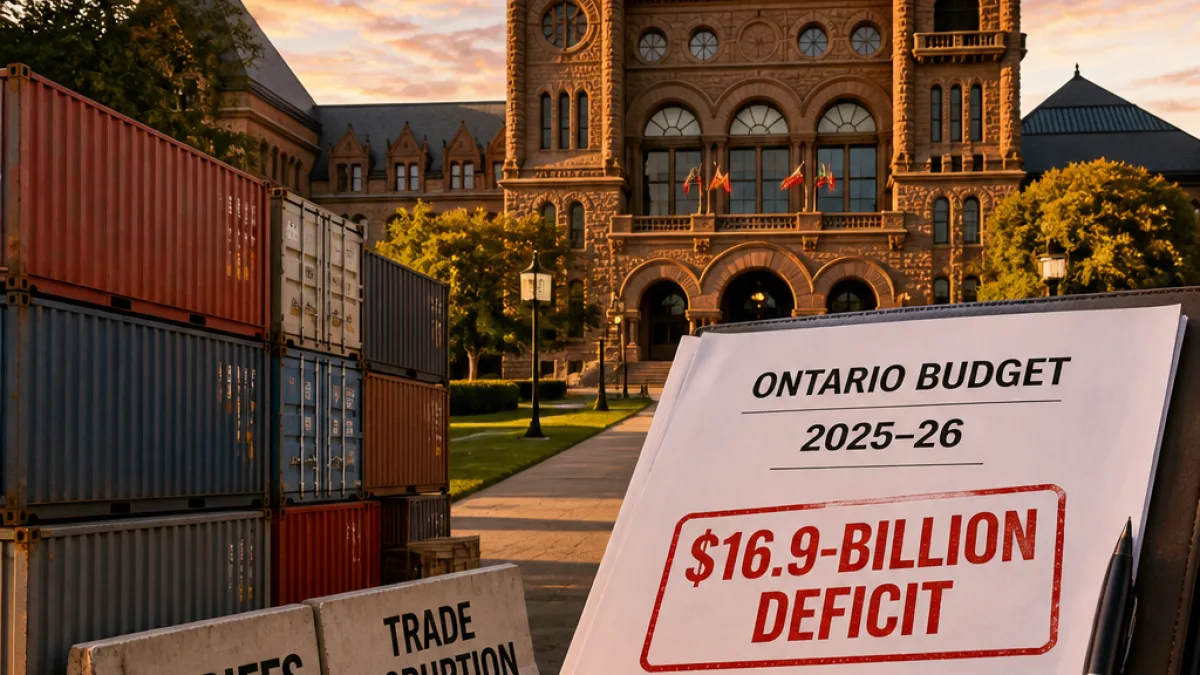
TORONTO — Ontario’s financial outlook has taken another turn for the worse, with the Progressive Conservative government projecting a $16.9-billion deficit this fiscal year and postponing its expected return to balance by another year.
Finance Minister Peter Bethlenfalvy presented the province’s fall economic statement on Thursday, revising upward the shortfall previously forecast in the spring. The earlier projection called for a $13.8-billion deficit in 2026-27. The new figure represents a deterioration of $3.1 billion in the government’s latest fiscal plan.
The update also moves the expected balanced-budget date from 2028-29 to 2029-30. It is the fourth time since 2024 that Premier Doug Ford’s government has pushed its balance target back by one year, according to the information released with the statement.
Tariffs and uncertainty weigh on outlook
Bethlenfalvy has attributed much of the change to a weaker and less predictable economic environment. The government says U.S. tariffs and continuing trade disruptions have affected key parts of Ontario’s economy, including steel, automobiles and manufacturing.
The minister also pointed to wider global instability and the effect of international events on energy costs. In remarks in the legislature, he said the effects were being felt through higher gasoline prices, increased costs for goods and uncertainty affecting investment and employment.
“The impact of U.S. tariffs, which have hit, among others, our steel, auto and manufacturing sectors, and global conflicts such as the Strait of Hormuz impacting energy prices, has led to the world awash in a sea of instability.”
He said those pressures are reaching both businesses and families across the province. Bethlenfalvy has also argued that Ontario has absorbed the tariff impact better than some economists had expected, even as a slower economy has contributed to the larger deficit.
Key changes in the fiscal plan
| Item | Earlier projection | New projection |
|---|---|---|
| 2026-27 deficit | $13.8 billion | $16.9 billion |
| Expected year of balance | 2028-29 | 2029-30 |
The revised numbers make clear that the government is choosing to maintain spending measures aimed at supporting the economy while accepting a deeper short-term deficit. Bethlenfalvy said deficits are not desirable over the long term, but described them as necessary under the current conditions.
Measures aimed at affected industries
The fall statement includes several responses that had already been announced before the document was tabled. Ontario plans to match the federal government’s recent move to provide businesses with a tax break on capital investments. The province also says it will direct billions of dollars toward sectors hit by tariffs, particularly steel and automotive companies.
- A provincial tax measure matching the federal capital-investment break;
- Billions of dollars in support for tariff-affected sectors;
- Specific attention to steel and automotive businesses facing trade pressure.
The government has framed the assistance as an effort to help companies withstand the effects of disrupted trade and maintain investment during a period of uncertainty. The source material does not specify how the sector funding will be distributed or identify individual companies receiving support.
A repeated delay to the balance target
The latest change extends a pattern that has become a recurring feature of Ontario’s fiscal planning. Since 2024, the Ford government has moved its projected return to balance back four times, each time by a year. The latest schedule means the province now expects to eliminate its deficit in 2029-30 rather than in the previously stated 2028-29 fiscal year.
For households and employers, the statement comes as the government says the pressures behind the forecast are visible in everyday costs and business decisions. The finance minister cited fuel prices, the cost of goods and uncertainty around employment and investment as signs of how international trade tensions are affecting Ontario locally.
The economic update does not change the government’s stated concern about the size of the deficit. Instead, it acknowledges that the province’s fiscal recovery will take longer while officials respond to tariffs, trade disruption and global economic instability.
Ontario’s revised projection now sets a higher financial hurdle for the government in the years ahead: it must manage a $16.9-billion shortfall in the current fiscal year while pursuing support for industries exposed to the trade dispute. The province’s new timetable places the return to balance in 2029-30, one year later than the plan presented earlier this year.