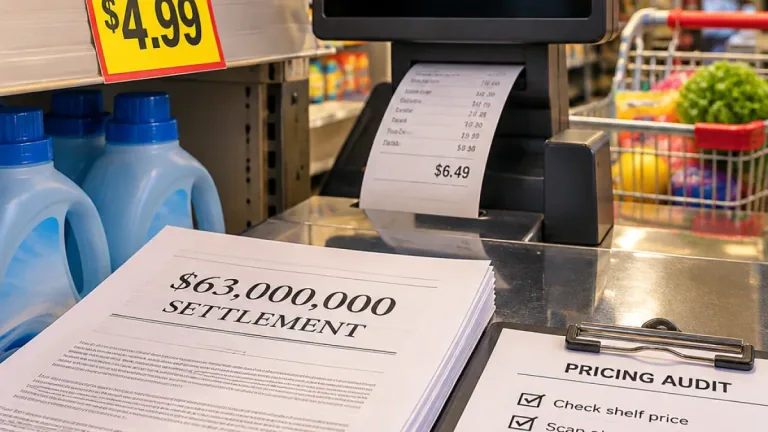
MADISON — The Wisconsin Department of Justice has joined a bipartisan, multistate legal effort contending that Dollar General Corporation has engaged in deceptive pricing practices that overcharge customers at checkout. The complaint, filed alongside the Federal Trade Commission and 19 other states, alleges that thousands of stores have charged customers more at the register than the prices shown on shelf tags, in-store advertisements and other posted prices.
Allegations and state response
The lawsuit asserts Dollar General received tens of thousands of consumer complaints about mismatched prices and that company practices have not fixed the problem, even after the retailer was made aware. Wisconsin Attorney General Josh Kaul framed the case as a basic consumer-rights issue.
“The prices that folks see displayed when they’re shopping should be the same as the prices they’re charged when they check out,” said Kaul. “If the prices charged in the checkout aisle are higher than the prices on the shelves, there should be accountability.”
Randy Romanski, secretary of the Wisconsin Department of Agriculture, Trade and Consumer Protection, emphasized the state’s routine inspection work as part of its consumer-protection duties.
“Wisconsin takes price accuracy seriously,” said Romanski. “The DATCP Bureau of Weights and Measures conducts hundreds of thousands of inspections each year to protect Wisconsin consumers because consumers should be able to trust that the prices advertised to them are accurate, as it is among the most basic and essential protections consumers have.”
Scope and legal claims
The complaint filed with the FTC and joined by Wisconsin contends that the retailer’s practices violate the Federal Trade Commission Act and the Gramm-Leach-Bliley Act. Wisconsin’s participation asserts violations of state consumer-protection statutes and weights and measures laws. According to the complaint, the alleged scheme has extracted millions of dollars in overcharges from customers, disproportionately affecting vulnerable shoppers who rely on advertised prices to budget for essentials.
The complaint also claims that Dollar General was repeatedly made aware of price discrepancies but did not implement sufficient policies and safeguards to prevent further overcharges.
What this means for Wisconsin shoppers
For consumers, the suit raises immediate questions about how to respond if they believe they were charged incorrectly. While the case proceeds through the courts, state officials are reiterating that price accuracy is enforceable and that customers who encounter mismatched prices should report incidents to state consumer-protection agencies.
- Document discrepancies: Keep receipts and take photos of shelf tags or in-store ads.
- Report problems: File complaints with the Wisconsin Department of Justice and the Department of Agriculture, Trade and Consumer Protection.
- Know your rights: State weights and measures rules are intended to ensure advertised prices match checkout totals.
Allegations summarized
| Allegation | Legal basis cited |
|---|---|
| Register prices exceed shelf, tag or advertised prices | FTC Act; Wisconsin consumer protection laws; weights and measures statutes |
| Failure to implement adequate safeguards after complaints | FTC Act; alleged unfair or deceptive acts or practices |
Context and local enforcement
Wisconsin’s DATCP and its Bureau of Weights and Measures perform hundreds of thousands of inspections each year, according to state officials, enforcing price accuracy among other consumer protections. Those inspections cover retail scales, label accuracy and price posting, all of which intersect with the allegations in the complaint.
For rural and lower-income shoppers who depend on predictable pricing for budgeting, the stakes are concrete: a few dollars in unexpected overcharges can matter when purchasing staples. That concern is central to the states’ case, which frames alleged systematic overcharging as a significant harm to everyday consumers.
Next steps
The complaint is now part of a coordinated action with the FTC and other states. As the litigation unfolds, Wisconsin officials have underscored their commitment to enforce price-accuracy rules. The state has not released additional remedies it seeks beyond participation in the broader legal action; the multistate and federal processes will determine potential penalties, injunctions or corrective measures if the court finds liability.
Consumers who believe they have been affected are encouraged to retain evidence of the transaction and contact state consumer-protection authorities to report incidents.
As the case moves forward, it will test how federal and state law are used together to address alleged deceptive pricing practices by a major retailer with a large footprint in Wisconsin.