
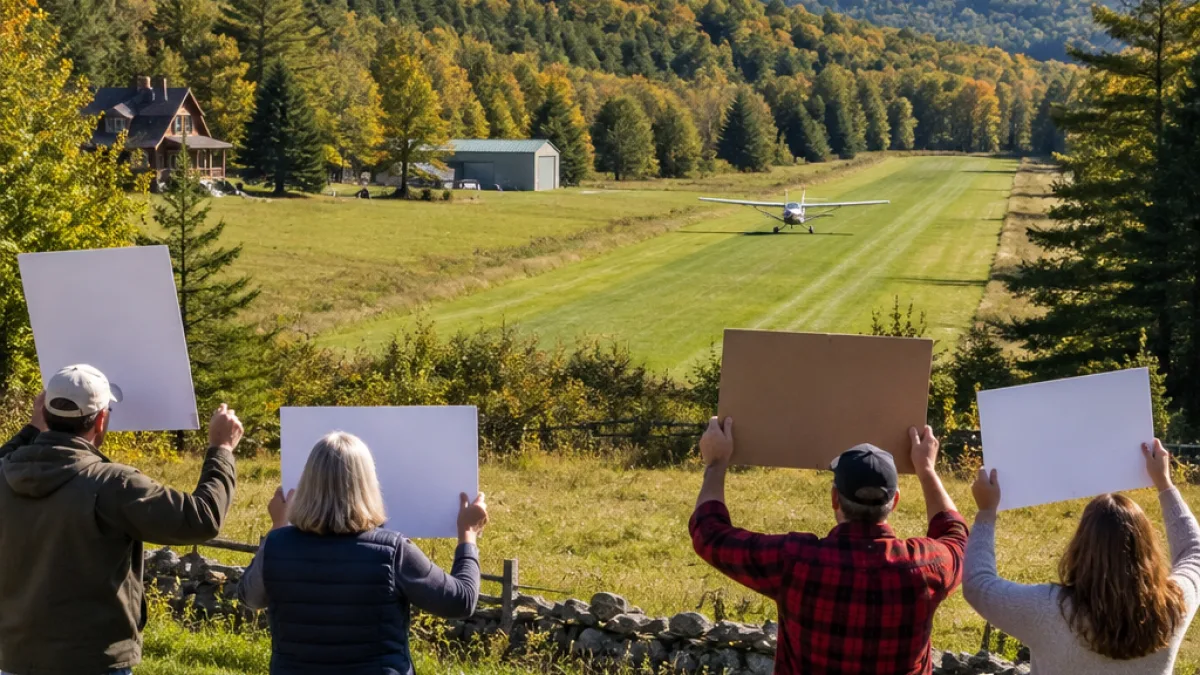
LINCOLN, Vt. — In this quiet mountain community, a proposed private airstrip has turned a neighboring dispute into a nearly five-year legal battle over land, aircraft and the meaning of rural life in Vermont.
Kyle Clark, the chief executive of electric aircraft manufacturer Beta Technologies, and his wife, Katie, want to use a 900-foot grass landing strip on their 130-acre residential property. The plan would allow private aircraft to land near the couple’s home, including flights Clark could use to travel to work.
For nearby residents, however, the proposal is about more than the sound or sight of aircraft crossing above their homes. Opponents have raised concerns about safety, wildlife and the effect of aviation activity on a landscape defined by open fields, forested hillsides and mountain views. The controversy has tested how far a private landowner’s plans can extend into the lives and surroundings of neighboring properties.
A rural welcome gives way to resistance
The Clarks bought the Lincoln property in late 2021. At first, their arrival was met with the kind of hospitality common in a small rural community. According to an investigation by The Boston Globe, one neighbor brought the family a casserole, while another offered horses for the couple’s children to ride.
That relationship changed after neighbors learned that the property was intended to include a private aircraft landing area. What had begun as a new family settling into the community became an argument over the future use of the land and the boundaries of a close-knit neighborhood.
Marilyn Ganahl has emerged as one of the most vocal opponents. She owns a neighboring 105-acre horse farm and nature preserve and has spent years challenging the airstrip proposal. Ganahl estimates that her legal expenses have grown to approximately $300,000.
The dispute remains before Vermont’s highest court
The project has cleared important regulatory and court hurdles, but the opposition has not ended. Two neighbors filed an appeal with the Vermont Supreme Court on Oct. 19, 2026, challenging the state’s decision to approve the landing area, according to VTDigger.
The appeal leaves the conflict unresolved. While the approval represents a significant step for the Clarks, the filing shows that opponents remain willing to continue the fight through Vermont’s legal system. The case now carries consequences beyond the two properties, as the court challenge places the state’s decision-making over the proposed landing area under further scrutiny.
| Detail | Reported information |
|---|---|
| Location | Lincoln, Vermont |
| Property size | 130 acres |
| Proposed strip | 900 feet |
| Neighboring property | 105-acre horse farm and nature preserve |
| Supreme Court appeal filed | Oct. 19, 2026 |
Concerns reach beyond aircraft
The neighbors’ objections are rooted in the landscape as well as in aviation. Their concerns include the safety of aircraft operations near homes, possible effects on wildlife and changes to the character of a rural area where quiet fields and wooded slopes are central to daily life.
For residents who have spent years caring for farms and natural areas, the proposed strip represents a new kind of activity on the surrounding land. A grass runway may occupy only part of a large property, but its use could be visible and audible well beyond the owner’s boundaries. The dispute reflects the tension that can arise when a low-density community encounters a project linked to private aviation and advanced technology.
A personal conflict with public consequences
The disagreement has also become deeply personal. The Globe reported that the Clarks issued no-trespass orders to 23 neighbors. During a visit to the area, opponents walking along a public road encountered property caretakers who told them that surveillance cameras had recorded their presence.
Both sides have accused the other of intimidation. Those allegations have added another layer to a conflict that began with a land-use proposal. The issue is no longer confined to permits, flight operations or the physical design of a landing strip; it has reshaped relationships among people who live alongside one another.
- Supporters of the project: The Clarks have pursued approval for a private 900-foot grass landing strip on their property.
- Opponents of the project: Nearby residents cite safety, wildlife and rural character concerns.
- Current legal status: Two neighbors are challenging the state’s approval before the Vermont Supreme Court.
A test for Vermont’s rural landscape
Lincoln’s dispute captures a broader question facing rural communities: how should private property rights be balanced against the landscape, safety and expectations shared by neighbors? In Vermont, where working farms, conserved land and mountain views often sit close together, a change on one parcel can affect how an entire area is experienced.
The proposed airstrip also carries an unusual association with the state’s growing electric-aircraft sector. Clark’s leadership of Beta Technologies links the local controversy to an industry built around changing the way people travel. Yet in Lincoln, the immediate debate remains grounded in familiar rural concerns: who controls the use of land, how neighbors coexist and whether a new activity fits the place around it.
For now, the landing area remains at the center of an unresolved legal and community fight. The Supreme Court appeal ensures that the question will continue beyond the property line, while the years of litigation have already altered relationships between the Clarks and their neighbors. A project that began as a private plan to reach work by air has become a public test of Vermont’s rural boundaries.