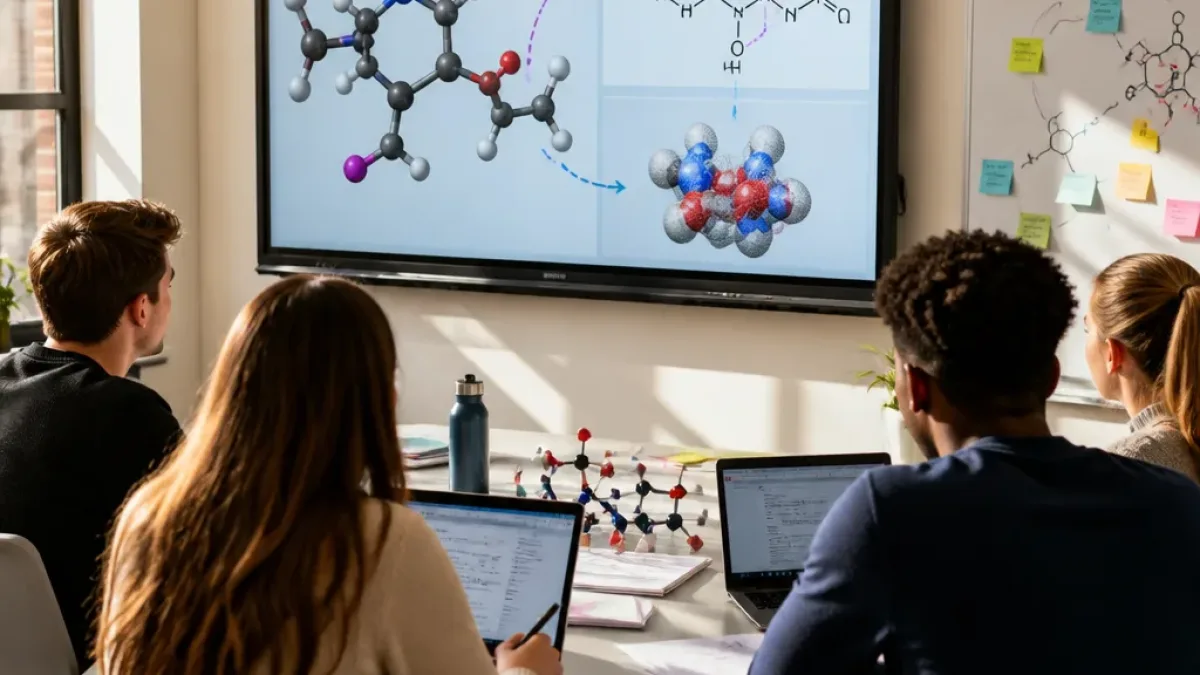
Undergraduate students are increasingly expected to interpret sophisticated molecular imagery, but many struggle to read and understand three-dimensional structures presented in two-dimensional formats. In response, a group of educators and specialists has developed BioMolViz, a collaborative programme that produces assessments, learning objectives and teaching materials to strengthen biomolecular visual literacy.
From classroom quizzes to a national community
The initiative originated when lecturers noticed recurrent misconceptions: students had difficulty recognising structural features, orienting 3D molecules from flat images and recognising conventional representation styles. What began as a small effort to create better quiz and test items has matured into a wider community of practice involving faculty and biomolecular visualisation experts.
BioMolViz now focuses on building, reviewing and trialling assessment items aimed at revealing how students think about molecular visualisations. The project’s director, KP Procko, an associate professor of instruction at the University of Texas at Austin, described how the work has evolved from test-question production to more direct engagement with learners.
“Our project started by creating quiz and test questions. Today, we are doing more direct work with students.”
Research-informed teaching and student interviews
The team has moved beyond producing items to conducting observational research while students tackle visualization-based problems. Those interviews, carried out as learners worked through tasks, generated insights into student thought processes; the researchers say some of those insights were unexpected and helped refine instructional approaches.
In 2025 BioMolViz published findings that documented how faculty used assessment tools across multiple institutions to probe student interpretation of molecular visualisations. The results underline how systematic assessment can inform teaching decisions and expose consistent areas of difficulty that might otherwise be attributed to individual student misunderstanding.
Practical outputs and professional development
BioMolViz produces tangible resources for instructors, including:
- assessment items and rubrics to measure visual literacy;
- learning objectives that articulate specific competencies students should achieve;
- teaching resources and workshops that demonstrate how to use visualisation tools in the classroom.
The project has also hosted hands-on training. For example, faculty at Suffolk University took part in a 2022 workshop on molecular visualisation and drug discovery that used virtual-reality tools — an event run in partnership with the technology provider Nanome. Such workshops aim to give lecturers both experience with cutting-edge visualisation software and practical strategies to transfer that experience to student learning.
| Year | Activity |
|---|---|
| 2022 | Workshop on visualisation and drug discovery (virtual reality) |
| 2025 | Publication on multi-institution use of assessment tools |
Implications for teaching and curriculum design
For practising lecturers, the BioMolViz model has two immediate implications. First, deliberate assessment design can reveal consistent misinterpretations, enabling targeted instruction rather than ad-hoc clarification. Second, community-based development and peer review of materials helps ensure that resources are portable across institutions and sensitive to different teaching contexts.
Faculty members involved in the project, such as Pamela Mertz at St Mary’s College of Maryland, emphasise that collaborative communities can improve both teaching and learning. The approach reframes difficulties with molecular visualisation as systemic gaps that can be addressed through shared resources, evidence-informed assessments and coordinated professional development.
As molecular graphics and research visualisation tools grow more sophisticated, the BioMolViz experience suggests universities and departments would benefit from prioritising visual literacy alongside traditional content. By doing so, educators can better prepare students to interpret the images they will encounter in advanced study and scientific careers.