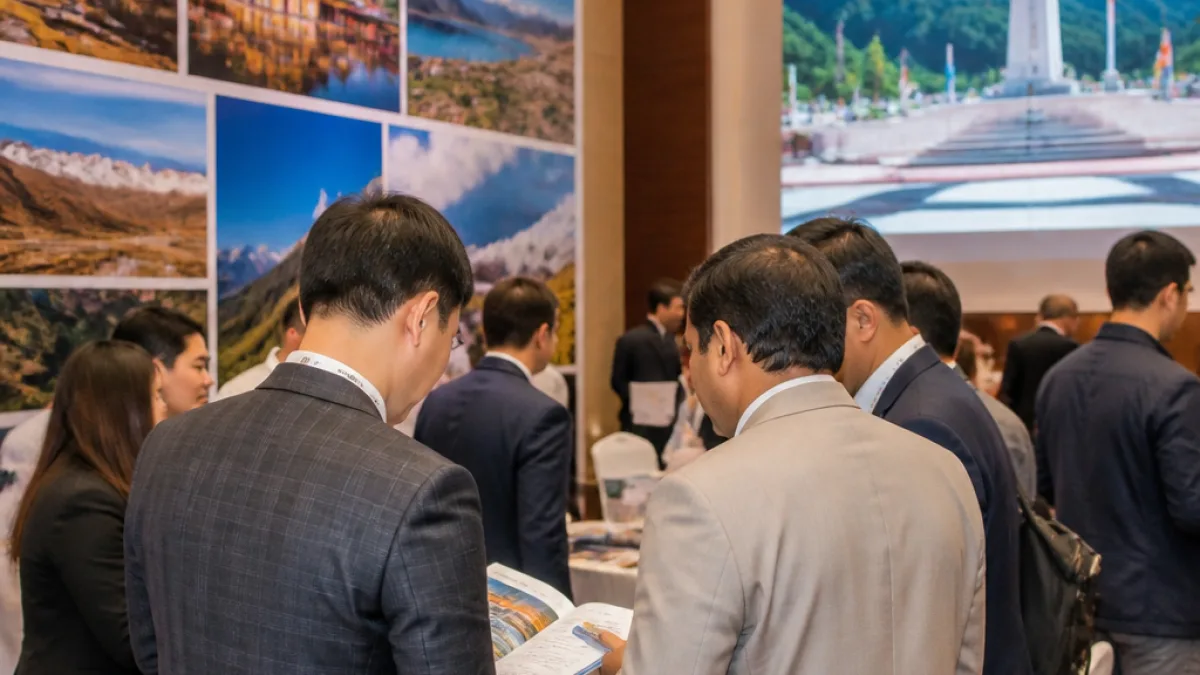
International tourism stakeholders gather in Tawang
Tawang in Arunachal Pradesh has become the centre of a major tourism outreach programme, with the Union Ministry of Tourism and the state government opening the 14th International Tourism Mart on Thursday. The three-day event has brought together domestic and international buyers, sellers, tour operators, government agencies, media representatives and other tourism stakeholders from across the country and abroad.
More than 200 participants are taking part in the mart, which is being organised by the Ministry of Tourism in association with the Arunachal Pradesh government and other northeastern states. The event is intended to present the region's varied tourism possibilities while creating opportunities for commercial partnerships between businesses involved in travel and hospitality.
The gathering has a distinctly international character. As many as 43 international buyers from 22 countries are attending, with participating markets including Australia, Bhutan, France, Germany, Indonesia, Italy, Japan, Malaysia, the Philippines, Poland, Russia, Singapore, South Korea, Sri Lanka, Thailand, the United Arab Emirates, the United Kingdom and the United States.
History and landscape form part of the visitor experience
For the visiting delegates, Tawang's historical memory is among the principal points of engagement. A group from countries including the US, Italy, South Korea, Russia and France visited the Indo-China war memorial, where they listened to the account of Rifleman Jaswant Singh Rawat and his role during the 1962 Indo-China war.
The memorial is a prominent stop in the itinerary and connects the tourism programme with a chapter of national history that remains strongly associated with Tawang. The account of Rawat, who is remembered for holding back advancing Chinese forces for 72 hours, gives international visitors an introduction to the region's military past alongside its cultural and natural attractions.
That combination is important for Arunachal Pradesh, where tourism promotion is closely linked to questions of access, local identity and the careful presentation of places with historical and cultural significance. A larger visitor economy can create opportunities for local enterprises, but it also requires public agencies and tourism operators to coordinate access to sensitive locations and ensure that the character of such sites is respected.
Government signals focus on global partnerships
Union Tourism and Culture Minister Gajendra Singh Shekhawat, who attended the inaugural programme, highlighted the Centre's attention to the northeastern region and the need to build international partnerships to expand its tourism potential. Arunachal Pradesh Chief Minister Pema Khandu and Nagaland Chief Minister Prem Singh Tamang were also present.
The mart is an annual flagship programme of the Ministry of Tourism. Its purpose extends beyond promotion: it provides a common platform where tourism businesses, entrepreneurs, tour operators and public agencies can examine areas for cooperation. For Arunachal Pradesh, the presence of international buyers offers an opportunity to present destinations that are not yet as familiar to overseas travellers as established tourism circuits elsewhere in India.
| Feature | Details |
|---|---|
| Location | Tawang, Arunachal Pradesh |
| Duration | Three days |
| Edition | 14th International Tourism Mart |
| Participants | More than 200 domestic and international stakeholders |
| International buyers | 43 representatives from 22 countries |
Access and infrastructure remain central to expansion
One of the technical sessions is focused on facilitating tourist access to protected and restricted areas in the Northeast, under the Ministry of Home Affairs. The subject is particularly relevant to Arunachal Pradesh, where tourism development has to operate within administrative, security and environmental considerations.
The discussion places access at the heart of the state's tourism prospects. Better coordination over permissions and entry procedures can influence how easily visitors move through the region, while the growth of tourism also places greater importance on dependable arrangements at destinations. The source material does not specify any new infrastructure project or access rule announced at the mart, but the inclusion of the session indicates that expanding tourism is being considered alongside the practical conditions governing travel.
Another technical discussion, led by the Ministry of Information and Broadcasting, will examine the development of a live-events and concert economy in the Northeast. The subject broadens the conversation beyond conventional sightseeing and points to the possibility of using cultural programming and organised events to draw visitors. Any such expansion, however, would depend on suitable planning and coordination with local communities and authorities.
North East Bazaar showcases regional opportunities
The event also features the North East Bazaar, adding a marketplace dimension to the formal sessions and business meetings. The bazaar is part of the wider effort to place the region's tourism offerings before buyers and other industry participants gathered in Tawang.
For the host state, the mart offers more than a short-term display. It brings together policy discussions, commercial networking and a direct presentation of Arunachal Pradesh's history and tourism potential. The challenge after the event will be to convert these contacts into sustained visitor flows and business links without weakening the cultural character and administrative safeguards that shape travel in the state.
- 43 international buyers are attending from 22 countries.
- The three-day mart includes business networking, technical sessions and the North East Bazaar.
- Delegates have visited the Indo-China war memorial in Tawang.
- Sessions are addressing protected-area access and the live-events economy in the Northeast.
With the mart being held in Tawang, the event has also placed the town itself at the centre of the region's tourism conversation. Its historical significance, along with its position as a gateway to several forms of travel experience in Arunachal Pradesh, gives the meeting a setting that is both commercially useful and closely tied to the state's traditions and public memory.