PUDUCHERRY: The Asian Development Bank has approved a USD 139.55 million loan for a broad urban infrastructure programme in Puducherry, placing water supply, sanitation, public spaces and municipal administration at the centre of efforts to improve living conditions and protect the Union Territory’s tourism economy.
The Puducherry Integrated Urban Livability Improvement Project is expected to reach more than 3.2 lakh people. Its proposed work will combine physical improvements to civic networks with measures aimed at improving revenue collection, financial management and the institutional capacity of municipal bodies.
The approval comes as Puducherry’s urban areas face increasing pressure from population concentration, tourism and climate-related risks. Around 68 per cent of the Union Territory’s 1.8 million population lives in urban areas, while more than 2.3 million tourists visit every year. The figures underline the competing demands placed on water, sewerage, public areas and local administration.
Water network forms a major component
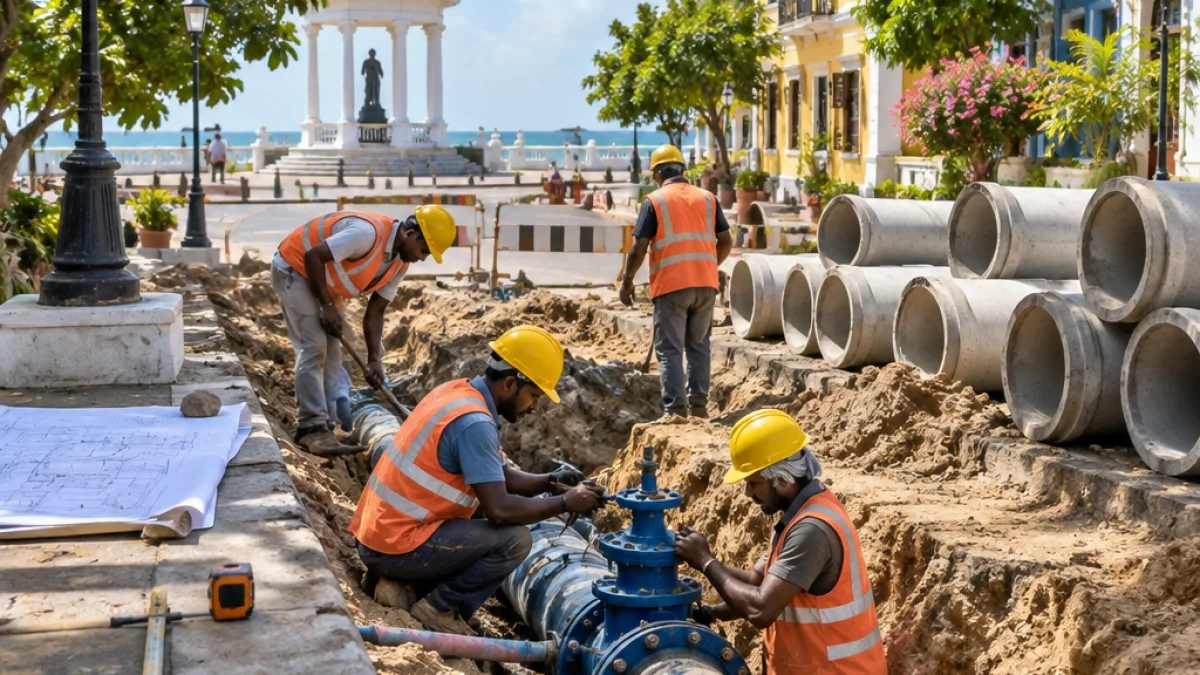
Under the water supply component, the programme proposes the rehabilitation of 100 km of existing pipelines and the laying of another 80 km of new water network. The plan also includes overhead service reservoirs, district metered areas and brackish-water reverse osmosis desalination plants.
These elements are intended to address both the condition and management of the supply system. Upgrading older stretches can support the renewal of municipal infrastructure, while new pipelines can extend network coverage. District metered areas and additional storage facilities are included as part of the proposed system improvements, according to the project details.
| Proposed intervention | Scale or provision |
|---|---|
| Existing water network rehabilitation | 100 km |
| New water pipelines | 80 km |
| New underground sewer network | 270 km |
| Sewerage infrastructure rehabilitation | 80 km |
| Expected beneficiaries | More than 3.2 lakh people |
Sewerage expansion planned
The sewerage component is expected to involve the construction of 270 km of underground sewer network and the restoration of another 80 km of existing sewerage infrastructure. For a densely settled urban region, the expansion of underground networks is a significant civic intervention, particularly where public services must serve both permanent communities and a large seasonal or visitor population.
The project’s focus on sanitation also connects urban infrastructure with public health and environmental management. However, the available project details do not specify an implementation schedule or identify the individual localities in which the network works will be carried out. The precise sequencing of construction and rehabilitation will therefore be important for residents, businesses and road users when the programme moves into execution.
Tourism and climate pressures
ADB has pointed to rapid urbanisation, climate-related threats and continuing gaps in essential municipal services as factors affecting Puducherry’s competitiveness as an investment and tourism destination. The Union Territory’s historic streets, public spaces and coastal character are closely linked to its appeal, making the upkeep of basic services an important part of the visitor economy as well as everyday urban life.
A reliable water and sanitation system is also central to the functioning of hotels, restaurants, commercial establishments and public institutions. The project’s public-space component, though not detailed further in the available information, is part of the same integrated approach. It places civic amenities and the quality of urban surroundings alongside network infrastructure rather than treating them as separate concerns.
- Water: Existing lines will be upgraded and new pipelines added.
- Sanitation: Underground sewerage coverage will be expanded and older infrastructure rehabilitated.
- Municipal governance: Revenue administration, financial systems and institutional capacity will be strengthened.
- Urban environment: Public spaces will form part of the improvement programme.
First ADB engagement in the Union Territory
The programme is notable because it marks the ADB’s first engagement in Puducherry. ADB Country Director for India Mio Oka said the initiative was part of the institution’s wider support for urban development in India.
“The project marks ADB’s first engagement in the Union Territory of Puducherry and is aligned with our support to help India's cities become the engines of economic growth,” Oka said.
The financing also gives administrative reform a place alongside construction. Improvements in revenue administration and financial management can influence how effectively civic bodies maintain networks after the initial investment. Institutional capacity, similarly, will determine how planning, monitoring and service delivery are handled across the project’s different components.
For Puducherry, the immediate significance of the approval lies in the scale and breadth of the proposed intervention. More than 350 km of water pipelines are covered through rehabilitation and new construction, while sewerage works together account for 350 km of new or rehabilitated infrastructure. The project’s success will ultimately depend on how these investments are converted into dependable services for households, businesses and visitors across the Union Territory.