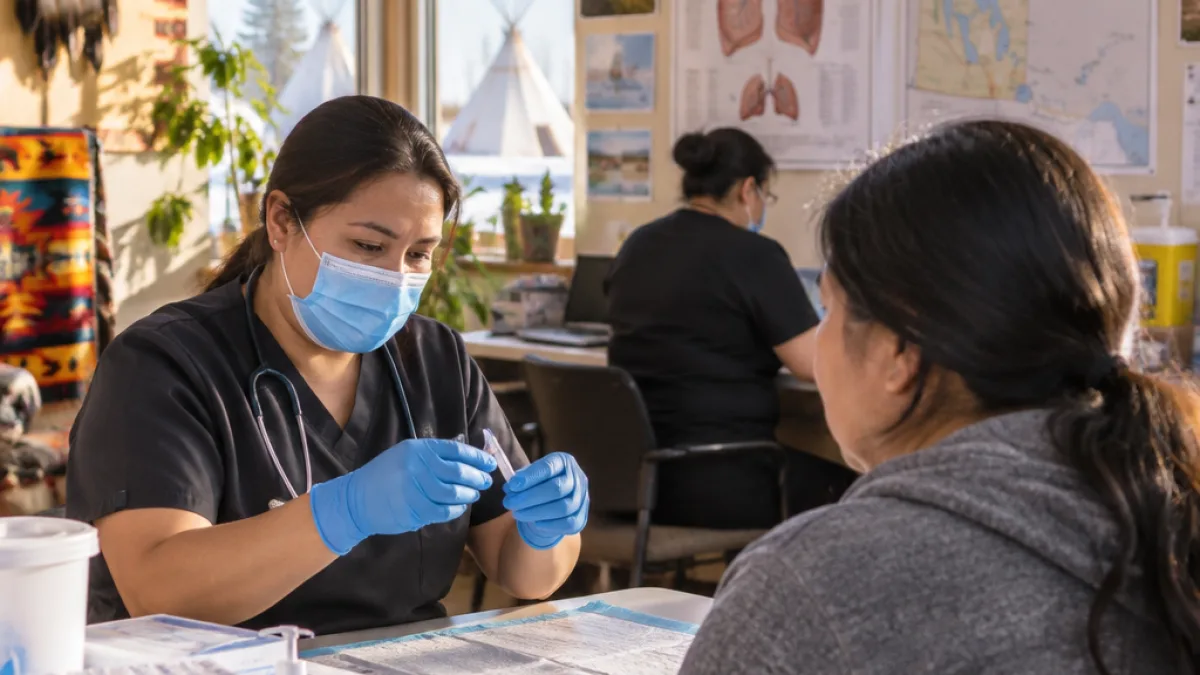
A First Nations-led public health organization is assuming responsibility for some tuberculosis diagnosis and treatment services in Manitoba First Nations communities, a transition its leaders say could make care more accessible to people facing a disproportionate burden of the disease.
Keewatinohk Inniniw Minoayawin Inc., a federally funded organization, is taking over services that had been delivered by the Winnipeg Regional Health Authority. The move is intended to give First Nations greater control over health care for their members while bringing more direct support into communities.
The change comes as Manitoba continues to record tuberculosis rates well above the national average. Federal data show the province reported 225 cases in 2025, translating to an incidence rate of 14.9 cases per 100,000 people. That was more than twice the Canadian average and the highest rate among the provinces that year.
A shift toward community-based support
Michelle Monkman, the chief executive officer of Keewatinohk Inniniw Minoayawin, said the previous model relied heavily on remote communication. Winnipeg-based nurses managed cases, but did not provide the same level of physical presence and direct assistance in communities.
“What they’re actually needing is … a little bit more of a hands-on approach.”
Monkman said First Nations health teams are often working with limited staffing while responding to urgent medical needs. In that environment, tuberculosis work can be difficult to prioritize, even though diagnosis and treatment require sustained attention and followup.
The organization’s approach is based on keeping supports closer to the people receiving care. The available information does not specify which communities are included in the transition or how many patients and health-care workers will be affected. It does establish, however, that the handover involves some tuberculosis services previously provided through the regional health authority.
Manitoba’s continuing tuberculosis burden
Tuberculosis is an infectious disease that can be fatal, and Manitoba’s rates have remained among the highest in Canada during the decade leading up to 2026. The figures underline why access to testing, treatment and continuing public-health support remains a significant concern in the province.
| Measure | Manitoba in 2025 |
|---|---|
| Reported tuberculosis cases | 225 |
| Incidence rate | 14.9 per 100,000 people |
| Cases involving people born outside Canada | 80.6 per cent |
| Cases involving Indigenous people | 11.4 per cent |
The provincial figures also point to the different populations affected by tuberculosis. Most people diagnosed in Manitoba in 2025 were born outside Canada, accounting for 80.6 per cent of cases. Indigenous people represented 11.4 per cent of cases, reflecting the disease’s continuing impact on First Nations communities despite the broader demographic picture.
Local control and the work beyond diagnosis
The transition reflects a wider principle in Indigenous health care: services can be more responsive when First Nations organizations have greater authority over how care is organized and delivered. In this case, the stated goal is not limited to identifying tuberculosis. It also includes maintaining support for people and communities during treatment, when regular contact and practical assistance can affect whether care remains accessible.
That distinction is important in communities where health workers may already be managing emergencies and other urgent needs. A remote service can help connect patients with specialists and nurses, but the organization says communities also require staff who can provide more direct, hands-on support.
Keewatinohk’s assumption of the work is therefore both an administrative change and a change in the way services are intended to reach patients. The organization hopes the model will contribute to Canada’s efforts to end tuberculosis while ensuring that people in communities with a high burden of disease are not left without continuing support.
The transition also leaves practical questions for the communities involved, including how the new services will be staffed and how patients will experience the change. Those details were not provided in the available information. For now, the central message from the First Nations-led team is that reducing tuberculosis requires more than testing and diagnosis: it requires care that is present, sustained and connected to the communities it serves.