Thiruvananthapuram’s ₹54-crore smart traffic system remains in a holding pattern after city police declined to take charge of the infrastructure, citing faulty signals, non-functional cameras and the absence of a settled arrangement for its long-term upkeep. The network, installed under the Smart City project, was intended to make traffic management more responsive by adjusting signal timings according to the movement of vehicles.
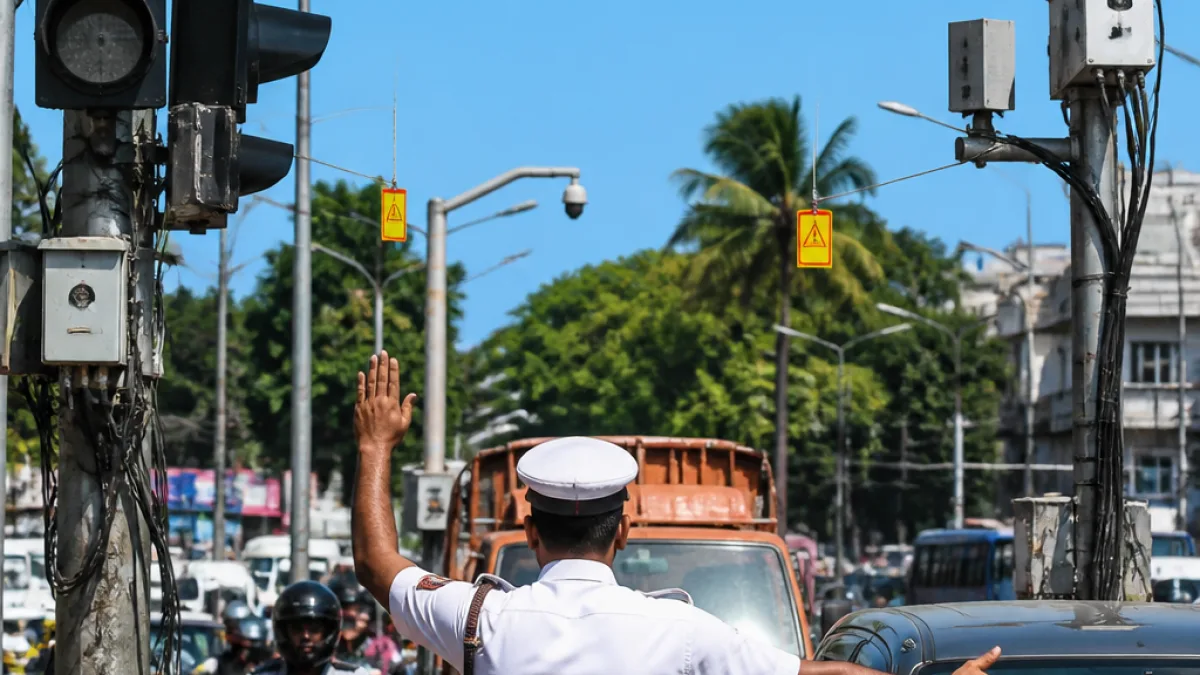
The system covers 57 junctions in the capital city. However, police have said that its present condition does not permit a formal handover. While personnel continue to regulate traffic manually, the police commissioner has made a distinction between managing vehicles on the road and accepting responsibility for the technology, equipment and maintenance obligations attached to it.
“The system is not functioning properly, and its malfunctions are confusing motorists and contributing to congestion,” city police commissioner Arul R B Krishna said.
Failures affecting monitoring and enforcement
A police assessment has identified deficiencies in 234 automatic number plate recognition cameras and 46 red-light violation detection cameras. The first category is designed to read vehicle registration numbers, while the second records vehicles crossing the stop line after a signal has turned red. Together, these systems were expected to support traffic monitoring, enforcement and the digital penalty mechanism.
The reported failures therefore extend beyond inconvenience at signal points. When cameras do not operate, the enforcement chain linked to them is weakened, including the ability to identify traffic violations and support e-challans. The police have shared a study detailing the defects with Smart City Thiruvananthapuram Ltd (SCTL), the agency associated with the project.
| System element | Position reported |
|---|---|
| Project cost | ₹54 crore |
| Junctions covered | 57 |
| ANPR cameras with deficiencies | 234 |
| Red-light cameras with deficiencies | 46 |
| Maintenance contract reportedly valid until | 2029 |
Connectivity and funding concerns
About 40 cameras connected to the city police commissionerate have also stopped working because internet charges were not paid, according to the commissioner. This has added a connectivity-related problem to the existing concerns over signal performance and camera operation. For motorists, the result is a technology-enabled traffic network that is not delivering consistently at the points where it is expected to guide movement or record violations.
The annual maintenance contract for the signals and cameras is understood to continue until 2029. Police, however, have raised questions about who would bear the cost after that period if the system is transferred to them. The proposed handover consequently depends on more than repairs. It also requires an explicit financial and administrative framework setting out responsibility for operation, maintenance and future expenditure.
Handover awaits a workable framework
The issue is particularly significant for a city where police personnel are currently required to keep traffic moving manually even as a system designed to automate and improve junction management remains unavailable for formal use. Adaptive signals are meant to respond to traffic density rather than follow a fixed sequence, but unreliable equipment can make road conditions harder for motorists to anticipate.
A further complication is the self-sustaining model proposed under the Smart City Mission. The proposal envisages revenue from e-challans being part of the system’s financial design. The available details do not establish how that model would operate in practice, but the police’s objections make clear that funding cannot be left unresolved while control of the network is being considered.
For the system to move forward, the immediate priorities are the correction of defective signals, restoration of camera functionality, settlement of unpaid connectivity charges and a clear decision on who will operate and finance the network. Until those matters are addressed, city police are expected to continue with manual traffic regulation, while the intended benefits of the smart system remain out of reach for commuters across Thiruvananthapuram.
- Police have not accepted the smart traffic infrastructure because of technical and financial concerns.
- Deficiencies have been reported in 234 ANPR cameras and 46 red-light cameras.
- The handover requires a defined maintenance and funding plan beyond the reported contract period ending in 2029.