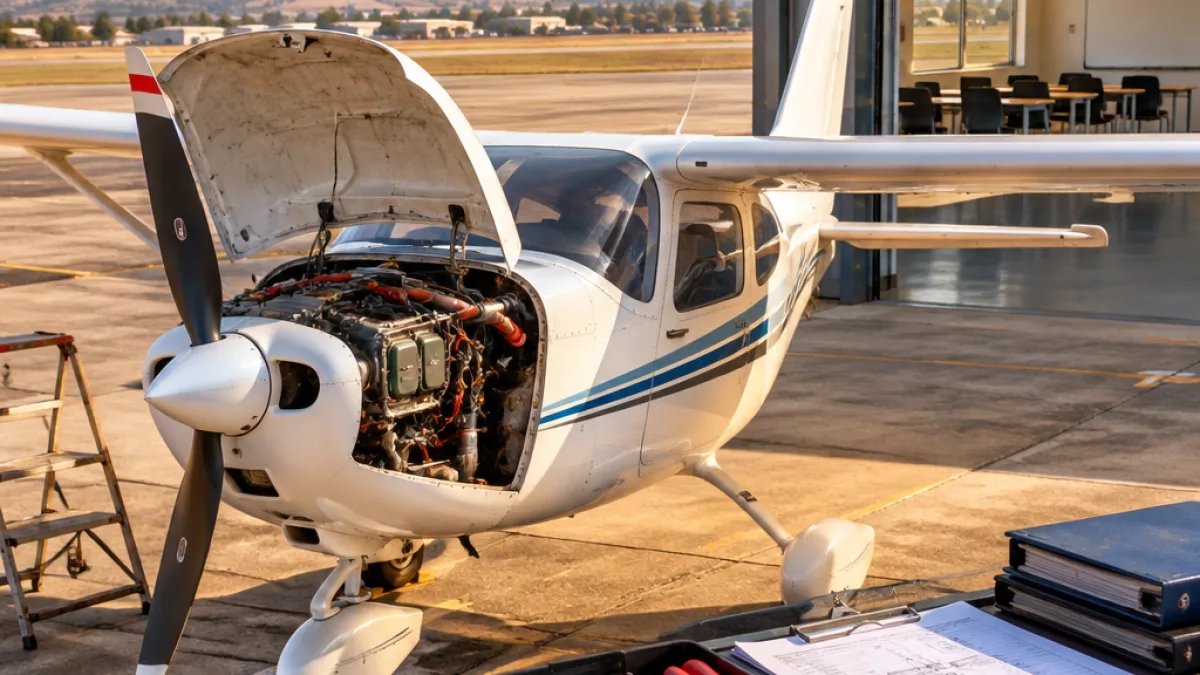
A probe by the Directorate General of Civil Aviation (DGCA) into a serious trainer-aircraft incident in Belagavi in 2023 has found shortcomings at the local base of Redbird Flight Training Academy (RFTA). The findings cover maintenance practices, the system used to monitor operations and the availability of personnel, placing renewed focus on the safety controls supporting flight training in the city.
The incident occurred on May 30, 2023, when a 24-year-old student pilot was carrying out a solo circuit and landing exercise near Belagavi Airport. The trainee was flying a TECNAM P2008JC aircraft owned by RFTA. The schedule for the day included four solo circuits, with a go-around, two stop-and-go exercises and a final full-stop landing.
During the fourth circuit, shortly after take-off and while the aircraft was climbing, the pilot noticed sustained engine vibrations and a burning odour. The engine speed began fluctuating and the aircraft did not have sufficient thrust to continue gaining height. As the aircraft started losing altitude, the trainee followed the engine-failure procedure and then chose an emergency landing in a nearby suitable field.
“The engine’s propeller had completely stopped rotating by the time of the landing.”
The aircraft touched down in the open field, bounced on impact and came to rest tilted on its left side. The report recorded significant damage to the aircraft, but the student pilot was not injured. The sequence highlights the narrow margin available to a trainee pilot when an engine problem occurs soon after departure, when altitude and time for decision-making are limited.
Maintenance issue identified
According to the DGCA report, the likely cause was linked to the way the oil system had been purged during engine installation. The investigation said this led to the failure of an intake-valve retainer. The intake valve then fell into the combustion chamber, causing extensive damage inside the chamber and severe engine damage.
The technical finding is significant because it connects the in-flight loss of power with work carried out during engine installation rather than treating the forced landing as an isolated operational event. For a flight-training organisation, such a link places attention on the chain between maintenance instructions, installation procedures, inspection, documentation and the academy’s internal oversight. The report, however, specifically identifies the deficiencies at the RFTA base without providing additional corrective measures in the available findings.
DGCA observations at Belagavi base
After the incident, a DGCA team inspected the academy’s Belagavi facility to examine whether its maintenance practices were compliant and whether the base had adequate supervision. The investigation’s broad observations were:
- Maintenance practices: the probe found deficiencies in the way maintenance work was carried out.
- Surveillance: the academy’s monitoring system was described as poor.
- Manpower: the Belagavi base was found to have inadequate staffing.
| Aspect | Finding in DGCA report |
|---|---|
| Aircraft | TECNAM P2008JC trainer |
| Incident | Forced landing during a solo circuit |
| Primary technical cause | Improper oil-system purging during engine installation |
| Base-level concerns | Maintenance, surveillance and manpower deficiencies |
For Belagavi, the report is relevant beyond the individual aircraft because flight academies depend on reliable engineering systems and close operational supervision to train pilots safely. The findings also underline the importance of ensuring that an academy’s local base has enough qualified personnel and an effective process to detect deviations before an aircraft is released for flight. In this case, the pilot escaped injury after making an emergency landing, while the aircraft sustained major damage.
The DGCA investigation therefore places the 2023 event within a wider framework of organisational controls rather than limiting it to the engine failure itself. The report’s observations on maintenance, surveillance and staffing will remain central to assessing how training operations are managed at the Belagavi base. The available findings do not state further action against the academy or provide a timeline for any remedial measures.